By LCN Business Desk
More than nine in ten Guyanese aged 65 and over draw a pension, among the best coverage in the hemisphere, and a United Nations report named Guyana for it this month.
What most of them draw is G$46,000 a month.
What did ECLAC find?
That coverage has risen a long way in 24 years, and that the contributory system is not what lifted it.
ECLAC published Social Panorama of Latin America and the Caribbean 2026 in Santiago on 18 November. Its subject is whether pension systems can last. The figures here come from the Commission's own release and from Kaieteur News, which reported the same document.
| Measure | 2000 | 2024 |
|---|---|---|
| Share of people 65 and over drawing any pension | 53.6% | 79.2% |
| Share covered by a non-contributory pension | 4.7% | 33.6% |
Coverage rose by 25.6 points. The state-pension share rose by 28.9. The second rise is bigger than the first, which means the whole gain came from pensions nobody paid in for.
How did Guyana get above 90 per cent?
With the Old Age Pension, which is paid to everyone who qualifies by age and asks nothing about contributions.
ECLAC names six countries that got there this way: Guyana, Suriname, Chile, Mexico, Paraguay and Bolivia. All six passed 90 per cent by 2024. Two are CARICOM members, and they sit at opposite ends of the same border.
Across the region that route carried almost all the gain. Non-contributory coverage of the over-65s went from 4.7 per cent in 2000 to 33.6 per cent in 2024, a rise of 28.9 points, while coverage of any kind rose 25.6 points. The increase in pensions paid without contributions is larger than the increase in pensions altogether.
That line is from the Commission's own release of 18 November. ECLAC's figures here come from that summary rather than from the report's own text.
What does that pension actually pay?
G$46,000 a month, which is less than half what a public servant's basic salary may not fall below.
Budget 2026 raised it from G$41,000 with effect from 1 January. It reaches about 95,000 people and costs more than G$52 billion a year. In 2020 it was G$20,500.
| Monthly, Guyana | Amount | The pension as a share |
|---|---|---|
| Old Age Pension, 2026 | G$46,000 | |
| Public service minimum basic salary | G$102,346 | 44.9% |
| The Public Service Union's own living wage estimate | G$215,000 | 21.4% |
The public service floor is 2.2 times the pension.
ECLAC measured the region in the same unit, and the comparison is not close.
The region's average contributory pension is worth 1.3 minimum wages. The pension that carried Guyana past 90 per cent coverage is worth 0.45 of one, barely a third as much.
The G$102,346 figure is the one the Public Service Union and the parliamentary opposition both use, and the G$215,000 is the Union's own estimate of a living wage rather than an official poverty line.
ECLAC's executive secretary José Manuel Salazar-Xirinachs made the regional case for pensions in one line.
Monetary poverty among older people would increase from 10.4 to 41.8 percent if said population did not receive income through pensions.
Coverage counts how many people receive a pension. It says nothing about the size of one. A pensioner drawing G$46,000 a month and a pensioner drawing ten times as much each count once.
ECLAC asks a pension system to do two things at once: reach people, and pay them enough to live on. It says plainly that progress on one must not come at the expense of the other.
Guyana does the first as well as almost any country in the hemisphere. On the second, its pension is a fifth of what the Public Service Union calls a living wage.
Is the pension above the poverty line?
Guyana has not set one in twenty years. Three outside bodies have, and their answers differ by a factor of more than thirty.
The last national line came from the 2006 Household Income and Expenditure Survey. It put moderate poverty at US$1.75 a day in 2006 prices and found 36.1 per cent of people below it. The Bureau of Statistics said in 2018 that a new survey would revise it. Nothing the Bureau has published since carries a replacement, and household survey data stops in 2021.
Into that gap the international institutions have put their own measures.
| Measure | Line | Share of Guyanese below it |
|---|---|---|
| Inter-American Development Bank, 2024 | US$6.85 a day | 58% |
| same, extreme poverty | US$3.65 a day | 32% |
| World Bank, 2019 | upper-middle-income line | 48.4% |
| UNDP Multidimensional Poverty Index, 2023 | not an income line | 1.8% |
The IDB built its figure on Guyana's 2021 Labour Force Survey and carried it forward. The World Bank used older data still, and says so. The United Nations index measures something else again, counting deprivation across health, education and living standards rather than income. Fifty-eight per cent and 1.8 per cent are answers to different questions about the same country.
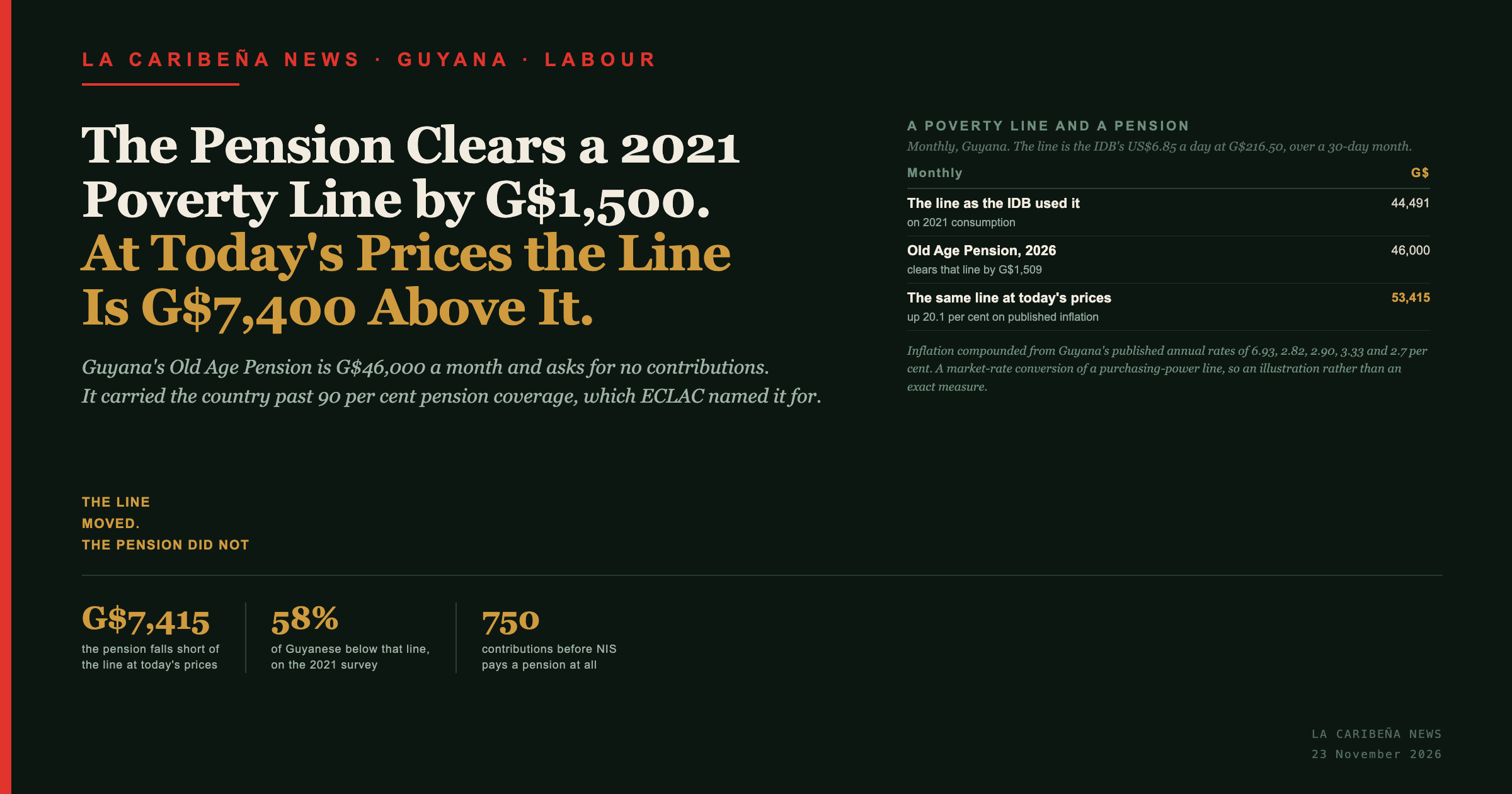
Put into Guyanese money, the line and the pension look close. At G$216.50 to the United States dollar, US$6.85 a day is G$44,491 over a 30-day month. The pension is G$46,000, which clears it by G$1,509.
That margin does not survive contact with the calendar. The line sits on consumption measured in 2021, and Guyana's prices have not stood still since. Annual inflation ran 6.93 per cent in 2022, 2.82 in 2023, 2.90 in 2024, 3.33 in 2025 and 2.7 per cent to March 2026. Compounded that is 20.1 per cent, and the line at today's prices is G$53,415.
The pension clears a 2021 poverty line by G$1,509 a month. Carried to today's prices, the same line stands G$7,415 above the pension.
The sum is set out above so it can be checked. Against the extreme line of US$3.65 a day, about G$23,700 before the same adjustment, the pension is a little under twice.
Three things bound it. The conversion is at the market rate while the international lines are stated in purchasing-power terms, so it illustrates rather than measures exactly. The inflation series comes from the published annual rates rather than from a rebased Bank of Guyana index. And US$6.85 is the line applied to high-income countries, a classification Guyana reached recently and which Guyanese commentary is still arguing over. None of the three moves the direction.
And the scheme workers actually pay into?
The National Insurance Scheme, and it is contributory. Nothing in, nothing out.
A worker needs 750 contributions to draw an NIS old age pension. Somebody who never reached that number draws nothing from NIS, whatever their age, and falls back on the G$46,000. The two schemes share most of a name and almost nothing else.
Employers carry the cost of the contributory side. Guyana's employers pay 8.4 per cent of every wage into the National Insurance Fund, and its own accounts say the Actuary's recommendations were not implemented. The fund's position is tighter than the coverage number suggests: it took in G$2.68 billion more than it paid out in 2023 and still recorded a comprehensive loss. Collection is a live problem: the Finance Minister told the National Insurance Scheme to find missing employer contributions before workers reach pension age. A contribution an employer never remitted is a contribution the worker cannot count.
The same split shows up elsewhere. Antigua and Barbuda's Social Security Fund recorded no liquid assets in its last published actuarial review. Paraguay pays the pension fund first when a bank fails, while Guyana's scheme leaves pension funds out of that queue. Paraguay is one of the six countries that passed 90 per cent coverage.
Who is left out?
Workers who are not on anybody's payroll.
In 2024, 182 million people, 55 per cent of the region's labour force, held no pension coverage. ECLAC ties that to informal work. The ageing behind it is running at twice the European pace. Somebody selling, driving, farming or contracting outside a registered payroll pays in nothing and builds up nothing.
What the ones who do pay in receive is modest. Across 14 countries in 2024, the average payroll pension came to 1.3 times the average minimum wage.
The gap is wider for women, and the reason is upstream of the pension system.
| Measure | Women against men |
|---|---|
| Employment rate | 50% against 72% |
| Employment income | 22.8% lower |
| Pension coverage | 7.2 percentage points lower |
| Pension amount received | 11.5% lower |
A pension is a record of paid work. Where the paid work was less, shorter or unregistered, the pension repeats it. Eight countries in the region have added mechanisms to narrow that, including recognition of care work.
What are Caribbean governments spending?
A record share of what they produce. ECLAC puts it at 11.2 per cent of GDP.
ECLAC measured seven English-speaking Caribbean countries together: Guyana, The Bahamas, Barbados, Belize, Jamaica, Saint Lucia and Trinidad and Tobago. Their social spending reached 11.2 per cent of GDP in 2025. Kaieteur reports that as the highest on record for the group. Spending shrank after the pandemic and has risen since 2023.
Regionally, public spending on pensions alone moved from 4.3 to 4.9 per cent of GDP between 2014 and 2024. The same Commission has been arguing about where the earnings to pay for it come from: CEPAL puts the region's export growth at 20 per cent and names modern services as the opportunity, in a world market where the region sells 2 per cent. The direction is set by demography rather than by policy, and it does not reverse on its own.
What should a Caribbean business take from it?
The coverage figure and the contribution figure answer different questions.
An employer reading that regional coverage has reached 79.2 per cent is reading a result the state paid for. The payroll contribution buys something else: a pension worth, on average across 14 countries, 1.3 times a minimum wage. Only one of the two comes out of the wage bill.
For a firm with contractors, seasonal staff or family labour, the 55 per cent figure is the operating reality rather than a statistic. Those workers reach 65 covered by whatever the state pays, which is the part ECLAC says is already under pressure from ageing.
The date that matters is not ECLAC's. It is the next actuarial review of whichever national scheme a firm pays into, because that is the document that says whether the payroll half can keep its promises.
The entities
- Economic Commission for Latin America and the Caribbean (ECLAC): the United Nations regional commission that publishes the Social Panorama, presented on 18 November 2026. - José Manuel Salazar-Xirinachs: ECLAC's executive secretary, quoted here from the Commission's release. - Social Panorama of Latin America and the Caribbean 2026: ECLAC's annual flagship report, this year on the sustainability of pension systems. - Old Age Pension: Guyana's universal pension, G$46,000 a month in 2026, paid from general revenue to people who qualify by age, with no contribution record required. - National Insurance Scheme: Guyana's contributory scheme, funded by payroll contributions, which pays an old age pension only after 750 contributions. - Guyana Public Service Union: the union whose published figures for the public service minimum basic salary and for a living wage are used here.
What the title card shows
G$46,000: Guyana's monthly Old Age Pension in 2026, raised from G$41,000 on 1 January, paid to about 95,000 people, and requiring no contribution record. G$44,491: the Inter-American Development Bank's US$6.85 a day poverty line converted at G$216.50 to the United States dollar over a 30-day month, which the pension clears by G$1,509. G$53,415: the same line carried forward by Guyana's published annual inflation of 6.93, 2.82, 2.90, 3.33 and 2.7 per cent, being 20.1 per cent compounded, which leaves it G$7,415 above the pension. 58 per cent: the share of Guyanese the Bank put below that line, on the 2021 Labour Force Survey. G$102,346: the public service minimum basic monthly salary.
Frequently asked questions
Can a Guyanese draw a pension without ever contributing?
Yes, but only the Old Age Pension, which pays G$46,000 a month in 2026 and asks for no contribution record. The National Insurance Scheme is contributory and pays nothing to somebody who never contributed.
How much is the Old Age Pension against a wage?
G$46,000 a month is 44.9 per cent of the G$102,346 public service minimum basic salary, and 21.4 per cent of the G$215,000 monthly living wage the Guyana Public Service Union estimates.
What does the NIS pension require?
750 contributions. A worker who falls short of that number draws no NIS old age pension, whatever their age, and is left with the Old Age Pension.
Is the Old Age Pension above Guyana's poverty line?
Guyana has published no poverty line since the 2006 Household Income and Expenditure Survey, which used US$1.75 a day in 2006 prices. The lines now cited for Guyana are international ones: the Inter-American Development Bank put 58 per cent of Guyanese below US$6.85 a day in its 2024 working paper, using the 2021 Labour Force Survey, and 32 per cent below US$3.65. Those are purchasing-power figures and do not convert to Guyanese dollars at the exchange rate.
What did ECLAC say about Guyana?
That Guyana is among six Latin American and Caribbean countries whose total pension coverage passed 90 per cent of people aged 65 and over by 2024, through pensions paid without contributions. The others are Suriname, Chile, Mexico, Paraguay and Bolivia.
How many people in the region have no pension coverage?
About 182 million in 2024, being 55 per cent of the labour force, which ECLAC links to informal employment. <!-- archive: dominica-cbi-discounting-nassief-inquiry-demand-2026 | citizenship-by-investment pricing and an inquiry. Shares Caribbean and per-cent terms and no subject: nothing in it bears on pensions, coverage or what a pension pays. --> <!-- archive: two-summits-4-november-2026-chogm-ibero-american-haiti-suriname-2026 | summit attendance by heads of government. Shares CARICOM and country names and no subject: no pension, wage or social-spending content. --> <!-- archive: nicil-state-equity-three-extractive-companies-no-income-unaudited-since-2013-2026 | state equity holdings in extractive companies and unaudited accounts. A different balance sheet and a different question. --> <!-- archive: antigua-cip-120-million-2026-budget-against-69-5-million-surplus-2026 | a passport programme's budget line against a projected surplus. Fiscal, and not social protection. The Antigua piece this article DOES link is the Social Security Fund one. -->