By LCN Business Desk
Every Guyanese employer pays into the National Insurance Scheme on every wage, up to a cap that has not moved since January 2020.
The Scheme's own actuary recommended changing both the cap and the rate. Its 2023 accounts record what became of that advice.
What does the Scheme cost an employer?
Eight point four per cent of every wage, up to a cap.
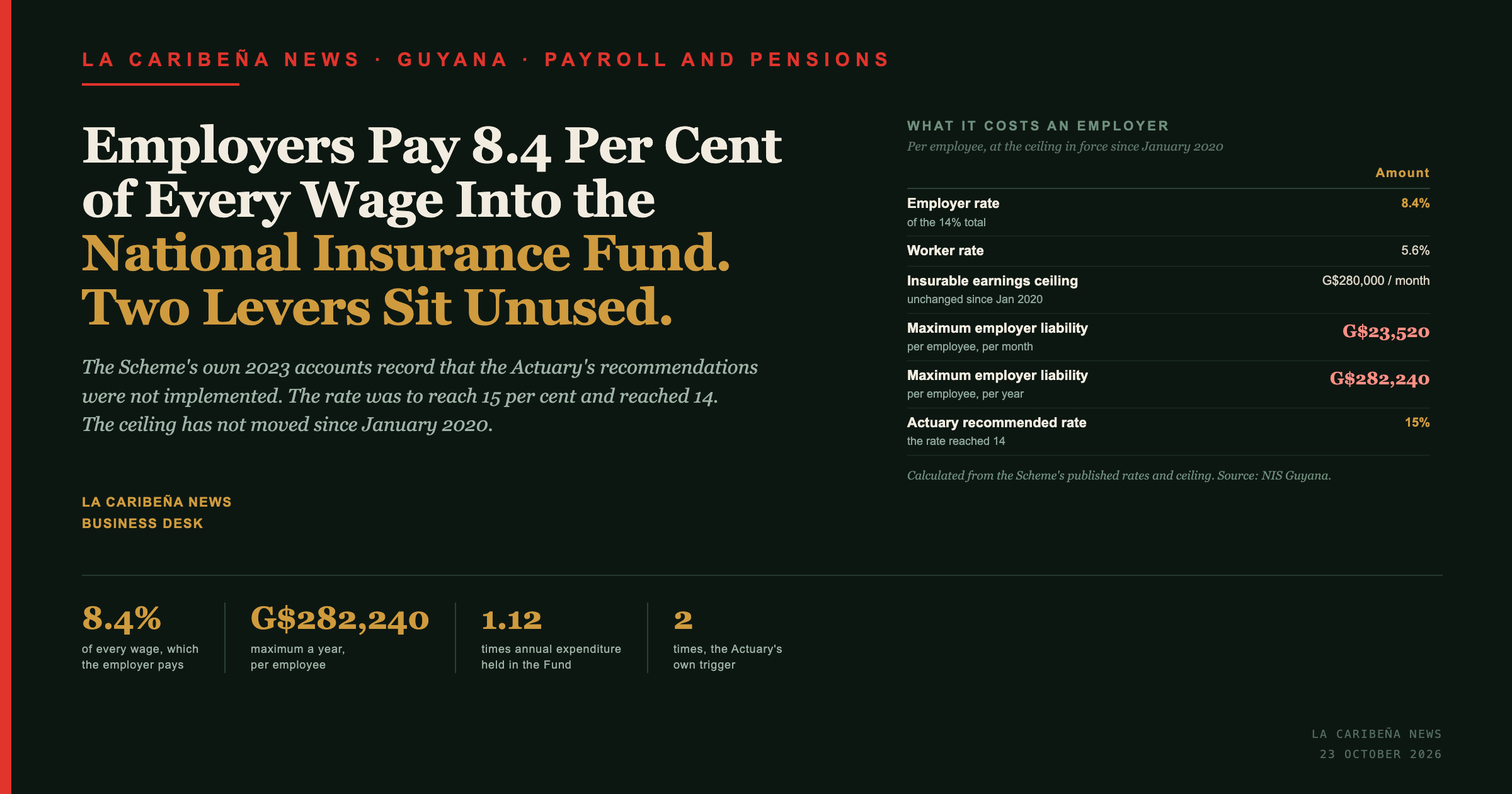
The Scheme takes 14 per cent of a wage up to the insurable earnings ceiling. The worker pays 5.6 and the employer pays 8.4, so the employer pays 60 per cent of every point.
At the current ceiling of G$280,000 a month, the most an employer can be liable for on any one employee is G$23,520 a month, or G$282,240 a year. Every dollar a worker earns above the cap costs the employer nothing in contributions, and earns the worker nothing in pension.
Two things can change that figure: the rate, or the ceiling. Both have been recommended to the Scheme by its own Actuary, and neither has been carried out in full.
What do the accounts say?
That the review was done and the advice was not taken.
"Section 37 of the National Insurance Act requires that an actuarial review of the National Insurance Scheme be conducted at least every five years. The eighth review was conducted as at 31 December 2011, five years after the previous review.
>
The next actuarial valuation as required by the Scheme was due as at 31 December 2016. This has been completed, however, the recommendations of the Actuary were not implemented by the Board and the Administration as at 31st December 2023."
Seven years separate the valuation's due date from the accounts that record its recommendations unactioned. The statement appears in the notes to accounts certified by external auditors and submitted to the subject Minister.
What had the Actuary recommended?
Six changes, from the review as at 31 December 2011.
| Recommendation | |
|---|---|
| i | Increase the contribution rate from 13 to 15 per cent no later than the first quarter of 2013 |
| ii | Adopt a funding policy requiring contribution-rate adjustment if reserves were expected to fall below two times annual expenditure in the following year |
| iii | Increase the wage ceiling to G$200,000 per month |
| iv | Freeze pension increases for two years, or until the contribution rate is increased and finances improve |
| v | Increase the pension age from 60 to 65 on a phased basis |
| vi | Revise accrual rates so the maximum 60 per cent benefit is reached after 40 years rather than 35; average insurable wages over five years rather than three; index pension increases to price inflation rather than the minimum public sector wage |
Source: Note 22, National Insurance Scheme financial statements for 2023.
Two of those bear directly on payroll.
The first asked for the contribution rate to go from 13 to 15 per cent by early 2013. The rate today is 14. One of the two recommended points was levied. One was not. Taking it to 15 on the present split would put the employer at 9.0 per cent, a further 0.6 points of payroll on every wage up to the cap.
The third asked for the ceiling to reach G$200,000 a month. It passed that in October 2015 and reached G$280,000 in January 2020, where it remains. Raising it is the other lever, and it falls on employers in the same 60:40 proportion: a ceiling of G$400,000 would lift the maximum employer liability per employee from G$282,240 to G$403,200 a year.
Is the Scheme short of money?
No. It is taking in more than it spends, and by a widening margin.
| G$ million | Receipts | Expenditure | Surplus |
|---|---|---|---|
| First half 2025 | 22,022.8 | 19,534.9 | 2,487.9 |
| First half 2026 | 24,541.0 | 21,856.6 | 2,684.4 |
| Full year 2025, actual | 46,754.6 | 41,542.4 | 5,212.2 |
| Full year 2026, revised estimate | 49,019.9 | 44,283.5 | 4,736.4 |
Source: Ministry of Finance, Mid-Year Report 2026. Surpluses calculated from the receipts and expenditure given.
Contributions alone rose from G$21.44 billion in the first half of 2025 to G$23.92 billion in the first half of 2026. The Mid-Year Report describes that as a G$2.5 billion increase in contributions, which is the growth rather than the surplus.
An actuarial review asks a different question from a cash statement. It asks whether a fund can meet obligations that run for decades, not whether it covered this year's benefits. A scheme can take in more than it spends every year and still be unable to meet what it has promised, which is why the Act requires the review in the first place.
What did the Actuary warn, and what happened?
The fund was projected to run out in 2021. It did not, and the Actuary's own test is failed anyway.
The note sets out the 2011 review's thirty-year projections, assuming no change to contribution rates or benefit rules: cash flow deficits in all years, a pay-as-you-go rate of 18.7 per cent in 2012 rising to around 28 per cent by 2041, and a single sentence, "The fund will be exhausted in 2021." Better performance would defer depletion to 2023; worse would bring it forward to 2019.
The fund was not exhausted. At the end of 2023 it stood at G$38.532 billion, after a year in which income of G$37.160 billion exceeded expenditure of G$34.476 billion by G$2.684 billion.
But recommendation (ii) asked for a funding policy that would trigger a contribution-rate adjustment whenever reserves were expected to fall below two times annual expenditure.
A fund of G$38.532 billion against expenditure of G$34.476 billion is 1.12 times. Against benefits alone it is 1.22 times, where the IMF recorded about two and a half years of benefits a decade earlier.
The trigger was never adopted, and the level it was meant to protect was passed before the accounts were signed.
Where does the ceiling fit?
The Scheme reports on it explicitly, and it has not moved.
The General Manager's submission for 2023 states: "During the year under review, the Insurable Earnings Ceiling remained unchanged." It stands at G$280,000 a month and G$64,615 a week, the level set in January 2020 and applied by the Scheme's own 2026 electronic contribution schedule.
Earnings above the ceiling are neither contributed on nor counted towards a pension. IMF Working Paper WP/16/206, a 2016 study of Caribbean schemes, put the mechanism plainly: wage ceilings are "increased by legislation from time to time", and so "a portion of wages of high income earners is excluded from the computation of contributions and does not also count towards benefits".
Two Caribbean schemes removed the need to keep deciding. The Bahamas raised its ceiling 50 per cent and introduced automatic biannual adjustment of both the ceiling and pensions in payment. Trinidad and Tobago indexed its earnings limits to earnings inflation from 5 January 2004. Jamaica doubled its ceiling from October 2003, Dominica raised its from EC$1,000 to EC$6,000 from 2008, and Belize from B$320 to B$640 a week in 2003.
How does that rate compare in the region?
Guyana sits above the Caribbean average.
That paper's 2014 comparison put the regional average at 10.2 per cent of covered wage, and ranked Guyana's 14 second only to Barbados at 18.
Self-employed contributors pay 12.5 per cent of declared income and are not covered for Industrial Benefits. Voluntary contributors, meaning those who cease insurable employment before 60, pay 9.3 per cent of insurable earnings determined from their last two years of employment.
Who else has said this?
A chartered accountant, in print, a month ago.
Writing in Kaieteur News on 27 September 2026, Christopher Ram set out the same record from the same documents. He noted that the Eighth Actuarial Review warned the Scheme was approaching "crisis stage" while earlier recommendations remained unimplemented, that by 2016 the Scheme itself acknowledged more than 70 recommendations had accumulated from actuarial and reform exercises, and that the 2023 audited statements still carried serious actuarial concerns.
His summary: "NIS has accumulated recommendations far faster than it has implemented them."
Ram also recorded that as Finance Minister in 2009, Dr Ashni Singh told Parliament the Scheme had about G$5.6 billion invested in CLICO, roughly 20 per cent of its assets. The Mid-Year Report still carries the resulting instrument, a government debenture described in its own notes as a "Payment to NIS to assist in recovering from losses due to their investment in CLICO (Guyana) as per Debenture Agreement dated September 16, 2016".
What is not settled?
What the completed 2016 valuation actually says, whether a review fell due in 2021, and what has happened since 2023.
Note 22 describes the valuation due as at 31 December 2016 as "the next" after the eighth, and records it as completed. A further review would have fallen due as at 31 December 2021. The 2023 accounts do not mention one.
The recommendations the accounts record as unimplemented are the 2016 Actuary's. What they were is not stated. The six they do publish belong to the 2011 review, so the advice that went unactioned for seven years has never been described in public.
The 2016 valuation exists. The Scheme says so in its own audited accounts. It has never been published. The Scheme's actuarial reviews are carried out by the International Labour Organization and issued as reports to the Government, and on the public record this newspaper can find, the eighth remains the most recent one anyone outside the Scheme can read.
And 2023 remains the Scheme's most recent published position. Its annual reports run without a gap from 1970 to 2023. As at 23 October 2026, no report has appeared for 2024 or 2025, so the accounts recording the Actuary's recommendations as unimplemented are the newest the Scheme has issued.
This sits alongside a Finance Minister who told the Scheme in September to find contributions that had gone missing before the workers they belong to turn 60, reported in Finance Minister Tells NIS to Find Missing Contributions Before Workers Turn 60, and a workforce moving towards self-employment, set out in More Guyanese Are Working for Themselves. The economy around it grew 19 per cent, examined in Guyana's Economy Grew 19 Percent.
The entities
- National Insurance Scheme (NIS) is Guyana's social security scheme, established 1969.
- National Insurance Act governs it. Section 37 requires an actuarial review at least every five years, and section 36(1)(a) requires the annual report.
- Note 22 of the 2023 financial statements is the note recording the actuarial position.
- The eighth review, as at 31 December 2011, is the most recent review published, and the one whose recommendations and projections the note sets out.
- The valuation due as at 31 December 2016 is the one the note records as completed, with recommendations unimplemented as at 31 December 2023.
- Christopher Ram is the chartered accountant whose Kaieteur News column of 27 September 2026 set out the same actuarial record.
- Mid-Year Report 2026 is the Ministry of Finance publication carrying the Scheme's half-year receipts and expenditure.
- International Labour Organization (ILO) has historically conducted the Scheme's actuarial reviews as reports to the Government.
- Insurable earnings ceiling is the cap above which wages are neither contributed on nor counted towards a pension.
- IMF Working Paper WP/16/206, October 2016, is the regional study quoted for comparison. The IMF records that its working papers do not represent its views.
What the title card shows
Every data point on the article's title card, in text.
- G$38.532 billion. The National Insurance Fund at the end of 2023. Source: the 2023 Annual Report.
- G$34.476 billion. Total expenditure in 2023, same source.
- 1.12 times. The fund as a multiple of annual expenditure, calculated from those two figures.
- Two times. The level the 2011 Actuary recommended as a trigger for adjusting the contribution rate.
- 2016. The due date of the valuation the accounts record as completed and unimplemented.
- Quotation: "the recommendations of the Actuary were not implemented by the Board and the Administration as at 31st December 2023".
Frequently Asked Questions
What do the 2023 accounts say about the actuarial review?
That the valuation due as at 31 December 2016 was completed, and that the Actuary's recommendations had not been implemented by the Board and the Administration as at 31 December 2023.
How often is a review required?
At least every five years, under section 37 of the National Insurance Act. The eighth was conducted as at 31 December 2011.
Did the fund run out as projected?
No. The 2011 review projected the fund would be exhausted in 2021. At the end of 2023 it stood at G$38.532 billion, after a year in which income exceeded expenditure by G$2.684 billion.
How much cover does the fund have?
G$38.532 billion against total expenditure of G$34.476 billion is 1.12 times annual expenditure, or 1.22 times benefits paid. The 2011 Actuary recommended a funding policy triggered if reserves were expected to fall below two times annual expenditure.
What did the Actuary recommend in 2011?
Raising the contribution rate from 13 to 15 per cent, adopting the two-times funding policy, raising the wage ceiling to G$200,000 a month, freezing pension increases for two years, raising the pension age from 60 to 65 in phases, and changes to accrual rates, the averaging period and the indexation basis.
Has the insurable earnings ceiling changed?
No. The Scheme reported to the Minister that it remained unchanged during 2023. It stands at G$280,000 a month, the level set in January 2020.
How much do Guyanese contribute?
14 per cent of the wage up to the ceiling, 5.6 per cent from the worker and 8.4 per cent from the employer. Self-employed contributors pay 12.5 per cent of declared income, and voluntary contributors 9.3 per cent of insurable earnings from their last two years of employment.
Has the 2016 valuation been published?
No. The 2023 accounts record it as completed, but it has not been published. The most recent review anyone outside the Scheme can read is the eighth, as at 31 December 2011. A further review would have fallen due as at 31 December 2021, and the accounts do not mention one.