By LCN Business Desk
Anyone who has signed a lease in Georgetown in the past five years, or priced a plot of land, will have formed their own view of where housing costs have gone. Guyana's official housing index has not moved since 2009. The gap between those two things is not this newspaper's observation. It belongs to the International Monetary Fund, which wrote both halves into a single sentence and left it there.
While anecdotical evidence suggest an increase in real estate values, the housing component of inflation have not contributed significantly to recent inflation.
That sentence appears in the Fund's 2025 Article IV staff report on Guyana, in its own wording. Three separate times, the same report calls on the government to improve its statistics on real estate prices.
What does the index actually show?
A housing line that has not risen above its 2009 base in any reading the Bureau publishes.
| Georgetown housing index | Reading |
|---|---|
| December 2018 | 100.35 |
| December 2019 | 99.55 |
| December 2020 | 97.32 |
| December 2021 | 97.10 |
| December 2022 | 98.56 |
| December 2023 | 98.63 |
| December 2024 | 98.80 |
| December 2025 | 97.92 |
| September 2026 | 99.18 |
*Every housing reading printed in the Guyana Bureau of Statistics release for September 2026, which sets every category to 100 at December 2009.*
Across those eight years the line moved by 1.2 per cent, downward. The index as a whole rose 30.8 per cent over the same stretch and the food line rose 69.9 per cent, by LCN's calculation from the Bureau's levels, so housing did not lag the rest of the basket so much as sit out of it.
Housing is not the only category below its starting point. Clothing stood at 89.69 in September 2026 and footwear at 81.29, and neither has been above 100 in any reading. For those two that is not strange: both are imported traded goods, and the price of a traded good can fall in nominal terms when it is sourced more cheaply from abroad.
Housing is neither imported nor traded. It is a service, made up of rent and of utility tariffs, and it is the one category in the basket that cannot be bought in from somewhere cheaper. It is also the only one of the three that anyone would expect to follow a property market.
The Bureau's second series behaves the same way. The All Urban Consumer Price Index covers six towns on a newer classification, and its equivalent division stood at 102.62 in June 2026 against food at 248.59.
Does a consumer price index measure the price of property?
No. Buying a house or a plot of land is not consumption, and a consumer price index measures consumption.
The newer of the Bureau's two series is built on the international Classification of Individual Consumption by Purpose, whose housing division runs to five groups: actual rentals, imputed rentals, minor maintenance and repair, water and dwelling services, and electricity, gas and other fuels. The purchase of a dwelling is nowhere in that scope, so a property market can double without the index registering it.
The first two of those five groups are rent. The Bureau says its approach "is in conformity with recommended International Standard used by agencies such as the United Nations Statistics Division (UNSD), International Monetary Fund (IMF), World Bank, Eurostat and International Labour Organisation (ILO)", and on that standard a housing category tracks what tenants pay and what owner-occupiers would pay.
What is the Fund actually claiming?
That the housing component has not moved the measured rate. The Fund does not say housing costs are flat, and it does not say the index is wrong.
The sentence is about the instrument rather than the market. A line that does not move cannot push a total, so the housing component's failure to contribute is arithmetic rather than a finding about what shelter costs. The Fund sets the two observations beside each other and leaves them there.
Nor does it connect its request for better real estate statistics to the price index. It makes that request three times, and each time the reason given is banking supervision and the monitoring of systemic risk, in a financial system lending against property. The cost of living is not mentioned in any of the three.
Why will the Bureau not settle it?
Because it publishes neither the contents of the category nor the weight attached to it.
The Georgetown series gives the category a single word, "Housing", with no breakdown. The Bureau publishes no methodology document for the index, no weight for any category, and no statement of what share of that line is rent as against water, electricity or maintenance. It publishes no rent index and no house price index of any kind.
Part of the answer is a policy choice rather than a measurement failure. The Ministry of Finance's Mid-Year Report 2026 credits "policy actions to maintain stable electricity and water tariffs, combined with proactive steps to limit the passthrough effect of global fuel price increases" with containing price pressure. Where a government holds a tariff still, an index containing that tariff records stillness. How much of the category those tariffs represent is the thing nobody outside the Bureau can say.
The arithmetic still narrows the field. A category that has not moved cannot contain a heavily weighted component that has risen sharply. If electricity and water have been held stable, as the Ministry says, and the category as a whole has not moved, then either the rent measure inside it has not moved either, or rent carries so little weight in the Guyanese basket that a large rise in it would not show. Both of those are statements about the index rather than about the housing market, and the Bureau could settle which one is true by publishing two things: the weight of rent within the category, and the rent series itself.
Two possibilities remain and the published record cannot choose between them. Either rents in Georgetown have genuinely been flat since 2009, or the index is not capturing them. The economist Ramesh Gampat, writing in the Guyana Business Journal on 24 October, names "rising land and rental prices" among the pressures he believes official inflation understates, and describes his own evidence as anecdotal. The Fund used the same word.
Does this stay in Georgetown?
No. The same index is what the country's headline inflation figures are built on.
Appendix D of the Mid-Year Report is titled "Mid-Year Consumer Price Index" and sourced to the Bureau of Statistics. Its December 2025 column reads 147.05 for all items, 222.32 for food and 97.92 for housing, across the same nine categories, matching the Bureau's own release line for line. The Ministry is not publishing a separate national index. It is publishing this one.
So the housing line runs into everything downstream: the twelve-month rate, the 4.3 per cent the Ministry projects for 2026, and the figures Guyana reports to the Fund. LCN has set out six official inflation rates running from 2.5 per cent to 4.4, all of them built on this index, and has reported the Fund's own assessment of those statistics, signed off without a Board meeting to discuss it. The basket itself comes from a survey completed in 2006, and the one meant to replace it was finished in 2019.
What does it mean for a business?
That no published Guyanese statistic tracks what a tenant or a developer pays, and the Fund wants that fixed for reasons of its own.
The Fund's three requests are not about the cost of living at all. They are about financial stability. It asks for better statistics on "corporate and household balance sheets and real estate prices" to support banking supervision and the monitoring of systemic risks, because a banking system lending against property needs to know what the property is worth. Guyana's commercial banks have been expanding mortgage lending, and the supervisor is being asked to watch a market nobody is measuring.
For a firm the consequence is narrower and immediate. A business whose largest controllable cost is commercial rent, land or building materials has no index to point to in a negotiation, no series to index a lease escalation against, and no published number to put in front of a lender. The nearest official category is the one that has not moved since 2009, held in part by utility tariffs the business may not even pay.
The comparison ran the other way across two capitals in August, when Georgetown's food prices fell 0.5 per cent in the same month that Venezuela's family food basket rose. LCN has also reported importers who for two years said they could not get US dollars, and a region where energy inflation hit 8.33 per cent against a headline rate of 4.43. In each case the experience a business reports and the figure a statistics office publishes are both true and describe different baskets.
Until the Bureau publishes what is in the housing category and what it weighs, or until somebody publishes a rent series, a firm should take its own lease file over the shelter line, and should not write the headline rate into a contract that is mostly rent.
The entities
- Guyana Bureau of Statistics is the national statistical office, which compiles and publishes the Georgetown Consumer Price Index monthly and the All Urban Consumer Price Index periodically.
- Georgetown Consumer Price Index is Guyana's headline price measure, covering the capital, with every category set to 100 at December 2009 and reported across nine categories.
- All Urban Consumer Price Index is the Bureau's six-town series, classified on the Classification of Individual Consumption by Purpose (COICOP).
- Classification of Individual Consumption by Purpose (COICOP) is the United Nations classification whose housing division covers actual rentals, imputed rentals, minor maintenance, water and fuels.
- Ministry of Finance publishes Guyana's Mid-Year Report, whose Appendix D carries the Consumer Price Index table and whose text carries the full-year inflation projection.
- International Monetary Fund (IMF) published the 2025 Article IV staff report for Guyana, which reports that anecdotal evidence suggests rising real estate values alongside an inert housing component, and asks three times for better real estate price statistics.
- Ramesh Gampat is a former economist at the United Nations Development Programme and the author of an October 2026 Guyana Business Journal paper on Guyana's oil economy.
What the title card says
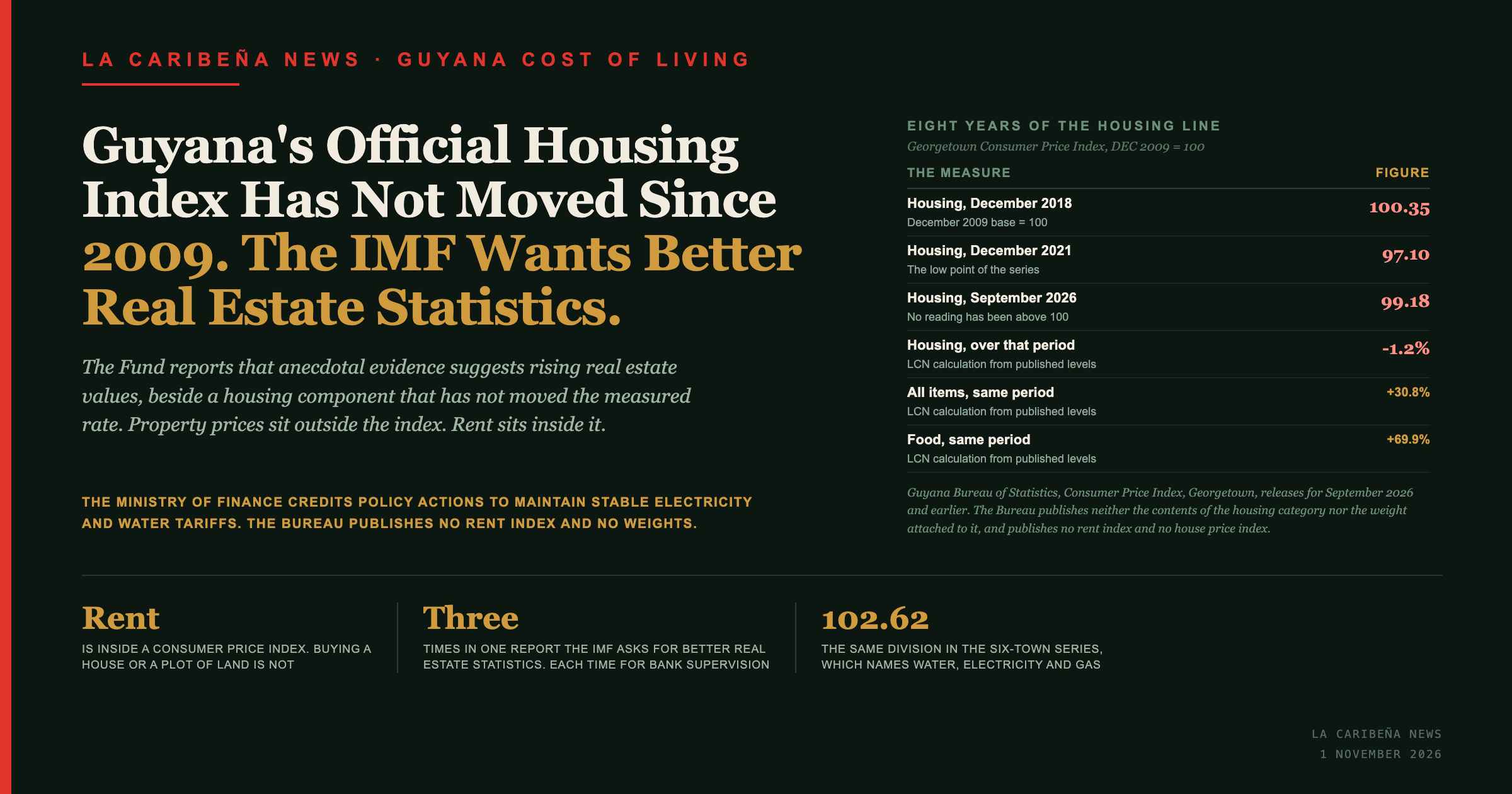
- Headline: Guyana's official housing index has not moved since 2009, and the IMF has asked three times for better real estate statistics.
- IMF, 2025 Article IV staff report: "While anecdotical evidence suggest an increase in real estate values, the housing component of inflation have not contributed significantly to recent inflation."
- Georgetown Consumer Price Index housing: 100.35 in December 2018, 97.10 in December 2021, 99.18 in September 2026, against a December 2009 base of 100. Source: Bureau of Statistics.
- Change over that period: housing down 1.2 per cent, the index as a whole up 30.8 per cent, food up 69.9 per cent. LCN calculations from the published levels.
- Rent is within the scope of a consumer price index, as actual and imputed rentals. The purchase of a dwelling is not. Source: COICOP 2018, Division 04.
- The Bureau publishes no weight for any category, no composition for the housing category, no rent index and no house price index.
- The IMF asks three times in one report for improved statistics on balance sheets and real estate prices, for banking supervision.
Frequently Asked Questions
Does Guyana's inflation index measure house or land prices?
No. A consumer price index measures household consumption, and the purchase of a dwelling or a plot is not consumption. The housing division of the international classification the Bureau's newer series follows covers actual rentals, imputed rentals, minor maintenance, water and fuels. Rising property values would not be expected to appear in it.
If property prices are excluded, why is the flat housing line still a question?
Because rent is not excluded. Actual and imputed rentals are the first two groups of that housing division, so the category is supposed to move with rents. The Georgetown housing line has stayed between 97.92 and 100.35 since 2009, and the Bureau publishes nothing that would show how much of the category is rent.
What did the IMF say about Guyanese real estate?
Its 2025 Article IV staff report states: "While anecdotical evidence suggest an increase in real estate values, the housing component of inflation have not contributed significantly to recent inflation." The same report asks three times for improved statistics on corporate and household balance sheets and real estate prices, to support banking supervision.
Does Guyana publish a rent index or a house price index?
Not on the Bureau of Statistics price-indices page, in its monthly releases, in its historical series or in its publications library, which carries no methodology document for the Consumer Price Index.
Does the Ministry of Finance use a different inflation index from the Bureau?
No. Appendix D of the Mid-Year Report 2026 carries the same nine categories and the same index levels as the Bureau's own Georgetown release, including 147.05 for all items and 97.92 for housing at December 2025.