By LCN Business Desk
The Ministry of Foreign Affairs of Colombia closed the file on Wednesday. The money it closed is smaller than the headline figure, and the schedule is longer.
Four fifths of the subscription was a guarantee the bank could call and might never call. The cash was US$102.5 million, spread across seven payments running to 2032.
What would Colombia actually have paid?
US$102.5 million in cash. The first-debate report on the bill sets out the terms the bank's Board of Governors fixed in Resolution 2025-BG10-R110 of 5 July 2025.
| Component | Shares | US$ |
|---|---|---|
| Paid-in capital, in seven instalments | 1,025 | 102,500,000 |
| Callable capital | 4,100 | 410,000,000 |
| Total subscription | 5,125 | 512,500,000 |
Figures as reproduced in the official translation annexed to the ponencia.
The paid-in portion is exactly one fifth. The bank's founding treaty applies the same one-to-four ratio to its own initial capital, so Colombia was being asked in on the terms the founders set for themselves.
Those payments were to run from 2026 to 2032. The report is blunt about where they had to sit: in the national budget, as a current transfer, under the heading of what Colombia pays to belong to world bodies.
What are the other 4,100 shares?
A guarantee, not a payment. Under article 9 of the Agreement on the New Development Bank, callable capital is "subject to call only as and when required by the Bank to meet its obligations incurred on borrowing of funds".
Calls must be uniform across every callable share, so no member can be singled out. Article 8 limits a member's liability to the unpaid portion of the issue price.
Four fifths of the price of joining this bank is a promise. One fifth is money.
A subscription reported as a cost of US$512.5 million therefore overstates what leaves the treasury by five times. It also hides the US$410 million of contingent liability sitting behind it.
What happened to the bill?
Nothing was voted. Two ministries filed it: the Ministry of Foreign Affairs, and the Ministry of Finance and Public Credit of Colombia. It ran as Bill 324 of 2025 in the Senate and 511 of 2025 in the Chamber of Representatives. It won a favourable committee report and stopped there.
| Date | Step |
|---|---|
| 25 November 2025 | Filed in the Senate Secretariat by the two ministries, published in Gaceta 2304 of 2025 |
| 5 December 2025 | The Presidency sends a message of urgency and insistence |
| April 2026 | Both chambers authorise their Second Committees to sit jointly |
| 17 June 2026 | A favourable first-debate report is published, three days before the legislature ends |
| 7 August 2026 | Abelardo de la Espriella is sworn in as President |
| 25 November 2026 | The Foreign Ministry abandons the accession |
The urgency message does specific work. Under article 163 of the Constitution it compels the Congress of Colombia to give a government bill priority. It is also what let the two Second Committees hold the first debate together, rather than one after the other.
So the bill had the fastest procedure available, five rapporteurs who recommended approval, and a year. El Espectador reports that it was never put to a vote, and reads the withdrawal a year later as part of a turn in Colombian foreign policy.
Two dates in that sequence sit next to each other. Gustavo Petro, the president who asked to join the bank, was placed on the OFAC Specially Designated Nationals List on 24 October 2025 while in office. His government filed the bill a month later.
The report itself names no outside party. It runs to 22,000 words and refers to the United States only as a currency.
Why does joining a bank need a law?
Because the bank is a treaty, and Colombia approves treaties by statute under Law 7 of 1944.
The resolution admitting Colombia sets the mechanics. It calls for an instrument of accession under articles 48(c) and (d) of the treaty. Membership then starts on the day that paper is lodged, under article 49(b). The bill's second article says the treaty binds Colombia only once that link is perfected.
Three further steps sat beyond the first debate. A treaty bill needs four debates, and then the Constitutional Court reviews it whether anyone asks or not. The report also had to carry a fiscal-impact statement under Law 819 of 2003. That law makes a government name a new source of revenue where a treaty bill cuts into income.
Is Colombia a member now?
No, and it never was. The resolution describes Colombia as an observer country in the process of becoming a full member. The bank's members page carries it under "Prospective Members", with a note that such countries "have been admitted by NDB's Board of Governors and will officially become a member country once they deposit their instrument of accession".
A borrowing member is the class that may take loans from the bank, under article 5(c) of the treaty. The other class subscribes capital and does not borrow.
No time limit appears in the four obligations the report reproduces. The paper could have been lodged whenever the law passed.
Several reports in 2025 described Colombia as having joined. It did not.
Which countries in the Americas belong to the bank?
Brazil, as a founder. The bank has ten members and Colombia appears in none of its capital tables.
| Member | Member since | Subscribed capital, US$m |
|---|---|---|
| Brazil, Russia, India, China, South Africa | 3 July 2015 | 10,000 each |
| Bangladesh | 16 September 2021 | 942 |
| United Arab Emirates | 4 October 2021 | 556 |
| Egypt | 20 February 2023 | 1,196 |
| Algeria | 19 May 2025 | 614 |
| Uzbekistan | 5 June 2026 | 121.5 |
Dates and capital from the bank's own members and shareholding pages, read 26 November 2026.
Five countries have been admitted since 2021 and none of them is in this hemisphere. Uruguay is the only other prospective member in the Americas, and no CARICOM country appears anywhere on either list.
What did the Foreign Ministry say?
One sentence, and no figure. The statement carried by Agencia EFE reads: "El Gobierno nacional informa que no adelantará acciones encaminadas para el ingreso y adhesión de Colombia al Grupo de los Brics y al Nuevo Banco de Desarrollo (conocido como Banco de Desarrollo de los BRICS)".
In English: the national government advises that it will not take steps toward Colombia's entry into the BRICS Group, or its accession to the New Development Bank, known as the BRICS Development Bank.
That parenthesis is the government's own. The bank does not use it: its name is the New Development Bank, and the nearest it comes on its own site is a BRICS-NDB knowledge portal. Colombia's foreign ministry called it the Bank of the BRICS countries when it filed the bill, and the bill's own report calls it the BRICS Development Bank.
It names no sum, says nothing about the 5,125 shares, and does not say whether the bill is withdrawn or merely unattended. The Ministry added that Colombia will keep working with other world lenders. It named the money for the 2026 to 2030 National Development Plan.
What should a Caribbean reader take from this?
That the entry price to this bank is US$100,000, and the hard part is not the money.
The treaty divides its authorised capital into one million shares with a par value of US$100,000 each, and says the value of one share "will also be the minimum amount to be subscribed for participation by a single country". The Board of Governors then decides how many shares an applicant takes. Colombia, as a borrowing member, was set 5,125.
What stopped Colombia was a legislative calendar, which is the one step in the sequence a finance ministry neither controls nor schedules.
The region keeps meeting the same gap from the other side. St Vincent and the Grenadines has drawn 1.9 per cent of EC$177.7 million in Saudi loans. The CARICOM Development Fund has disbursed US$169 million since 2009 while sponsoring a bond of US$250 million. Subscribed, approved, available and drawn are four different numbers.
Colombia is also finishing a trade deal manufacturers cannot see with CARICOM.
The seven instalments were due to begin in 2026. Nobody will pay the first one.
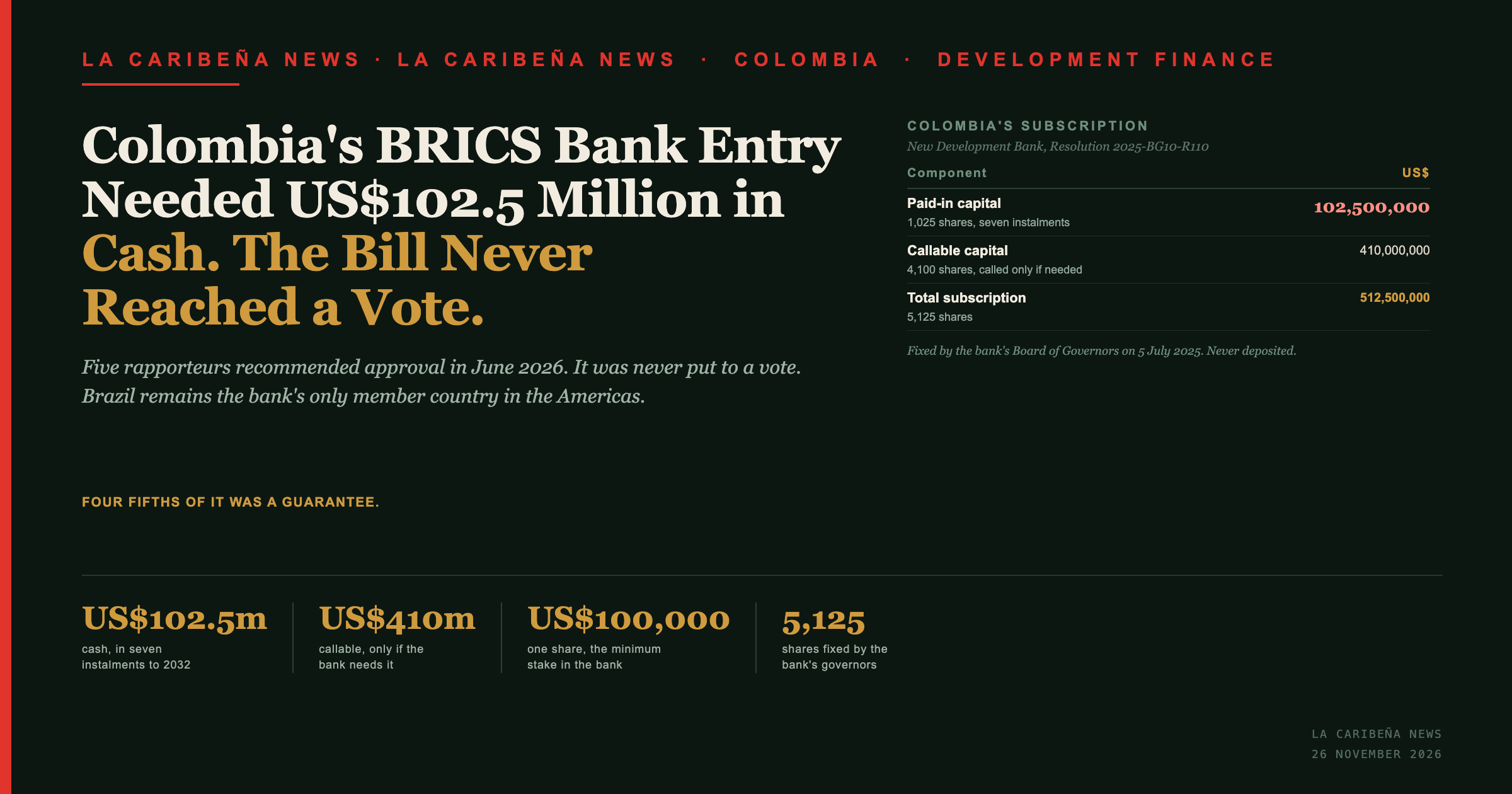
Title card, text equivalent
All figures on the title card, with their sources.
- US$512.5 million and 5,125 shares: Colombia's initial subscription to the New Development Bank as fixed by the bank's Board of Governors. Source: Resolution 2025-BG10-R110 of 5 July 2025, reproduced in Gaceta del Congreso No. 735 of 2026.
- US$102.5 million and 1,025 shares: the paid-in portion, payable in seven instalments. Source: the same.
- US$410 million and 4,100 shares: the callable portion. Source: the same.
- US$100,000: the par value of one share, and the minimum participation for a single country. Source: article 7 of the Agreement on the New Development Bank, Fortaleza, 15 July 2014.
- Ten: member countries of the bank, of which one is in the Americas. Source: New Development Bank, members page, read 26 November 2026.
- 25 November 2025 and 25 November 2026: the date the bill was filed and the date the accession was abandoned. Sources: Gaceta del Congreso No. 735 of 2026, and Agencia EFE via El Tiempo.
Entities named in this report
- The New Development Bank (NDB) is the multilateral development bank established by the BRICS countries, and the institution Colombia has stopped joining.
- The Agreement on the New Development Bank is its founding treaty, signed at Fortaleza, Brazil, on 15 July 2014.
- The Board of Governors of the bank fixed Colombia's subscription in Resolution 2025-BG10-R110.
- The Ministry of Foreign Affairs of Colombia filed the bill in 2025 and abandoned the accession in 2026.
- The Ministry of Finance and Public Credit of Colombia filed the bill with it.
- The Congress of Colombia never voted on the bill, numbered 324 of 2025 in the Senate and 511 of 2025 in the Chamber of Representatives.
- Abelardo de la Espriella is President of Colombia, sworn in on 7 August 2026.
- Gustavo Petro is the former President, who requested admission and was placed on the OFAC Specially Designated Nationals List while in office.
- The Caribbean Community (CARICOM) has no country on the bank's member or prospective-member lists.
- The CARICOM Development Fund (CDF) is the regional development lender cited for comparison.
Frequently asked questions
How much would joining the BRICS bank have cost Colombia in cash?
US$102.5 million, for 1,025 paid-in shares. The instalments ran from 2026 to 2032. The full subscription was 5,125 shares worth US$512.5 million, and the other US$410 million was callable rather than payable.
What is callable capital?
Capital a member has subscribed but not paid. The bank may call it only to meet obligations from its own borrowing. Calls apply uniformly to every callable share, and a member's liability stops at the unpaid portion of the issue price.
Did Colombia's Congress reject the bill?
No. The government declared it urgent on 5 December 2025. Both chambers then let their Second Committees hold the first debate jointly. Five rapporteurs recommended approval in a report published on 17 June 2026. It was never put to a vote, and such a law needs four debates and Constitutional Court review.
Is there evidence that the United States lobbied against the bill?
None on the public record this newspaper can find. The first-debate report contains no reference to the United States beyond the currency, none to sanctions and none to outside pressure. El Espectador reads the withdrawal as part of a turn in Colombian foreign policy, which is that paper's own assessment rather than a documented approach.
Is Colombia a member of the bank?
No. It was admitted by the Board of Governors and never deposited an instrument of accession. The bank's own page lists it among prospective members, and the Colombian record calls it an observer.
What is the smallest stake a country can take in this bank?
One share, US$100,000. The founding treaty names that as the minimum amount a single country may subscribe for participation. The Board of Governors decides how many shares a new member actually takes.