By LCN Business Desk
The Eastern Caribbean Central Bank stopped work on its digital currency on 13 February 2026 to prioritise a fast payment system.
Nine months later, the Caribbean Development Bank named fast payments first among three things it says will speed up growth in the currency union.
What did the Caribbean Development Bank say would accelerate growth?
The Caribbean Development Bank named three opportunities it says would accelerate growth, and said the ECCB is already advancing all three.
They are "fast payment systems that work for commerce, accountable use of artificial intelligence, and deepening regional capital markets to channel savings into more productive investment", the Bank said.
The remarks were the keynote at the ECCB's 8th Annual Conference in Basseterre, Saint Kitts, this month. Gillian Charles-Gollop, the Bank's Vice President for Corporate Services, gave it.
"The opportunity before us is to move from architecture to execution; from regional institutions to regional scale; and from integration to interoperability that delivers measurable value for every jurisdiction and community we serve," she said.
What growth is the currency union actually projected?
Well under half the rate the target needs.
The ECCB's Big Push aims to double the size of the union's economy and the wealth of its citizens within a decade. Its Monetary Council put the arithmetic in its own communique.
| The Big Push | |
|---|---|
| Growth projected for 2026 | 3.3 per cent |
| Growth the Council says is needed | approximately 7.0 per cent |
| The rate that actually doubles a figure in ten years | 7.18 per cent |
| What ten years at the projected rate delivers | 38 per cent more output |
First two rows: ECCB Monetary Council, 112th meeting, 13 February 2026. Last two: this newspaper's arithmetic from the first row.
The Council said the projection "remains significantly below the approximately 7.0 per cent annual growth required to double regional output over the next decade".
The gap is not a few points of effort. Compounding turns it into the difference between a third more output and twice as much.
What did the central bank already choose?
It stopped developing a digital currency and put payments ahead of it.
"The Council approved the suspension of DCash 2.0 development to prioritise: Development of the Fast Payment System; and Participation in the CARICOM Payments and Settlement System (CAPSS) pilot," the same communique records, at section 7.0, under the heading Financial Inclusion.
The Council's 112th meeting was held at the ECCB campus in Saint Kitts and Nevis on 13 February 2026. Gaston Browne, Prime Minister and Minister for Finance of Antigua and Barbuda, took the chair.
So the first of the three accelerators named in November had been made a priority in February, ahead of a central bank digital currency.
Who is in the system it joined, and what does it settle in?
Four central banks, and United States dollars between them.
Kareem Michael, Governor of the Central Bank of Belize, chairs the CARICOM central bank governors' meeting. He named the pilot's members in writing on 24 November: the "Eastern Caribbean Central Bank (ECCB), Central Bank of The Bahamas, Central Bank of Barbados, and Central Bank of Trinidad and Tobago."
One of the four is a currency union rather than a country. The ECCB issues for eight members, so the territories behind the four banks number eleven.
CAPSS lets participants settle day-to-day transactions in local currencies. The net position between the central banks does not work that way. The Bank of Guyana says that net settlement will most likely be in United States dollars.
A fast payment system inside the currency union and a regional system between central banks are different builds. One decision put the ECCB behind both.
Who else in the region is building one?
Jamaica is preparing to pilot one. Guyana launched one with India in June.
Jamaica's banks are preparing to pilot instant account-to-account transfers of J$30,000 and under, available 24 hours a day, seven days a week. Barbara Hume, chief executive of the Jamaica Bankers Association, told the Jamaica Gleaner on 25 November. She gave no roll-out date. Brian Langrin, Governor of the Bank of Jamaica, said the central bank will publish a faster-payments vision by the end of the year.
Guyana went to India for its rail. It signed with NPCI International Payments Ltd and launched Fast Pay. That made it the first Caribbean country with a UPI-linked real-time payments system.
A domestic rail does not settle foreign currency. Guyanese importers say they cannot get enough of it. The Georgetown Chamber of Commerce and Industry is preparing to approach the government about it. Its President, Kathy Smith, told News Source Guyana on 26 November that members have complained and its Council has discussed what to do.
The central bank sold more dollars this year than last. It put US$767.5 million into the commercial banks in the first half of this year, 31.6 per cent more than a year earlier, and bought none back. The question is not new. At a Georgetown banking forum in November 2024, a furniture exporter asked the Governor why small businesses cannot open US dollar accounts.
What is the Caribbean Development Bank putting behind it?
A strategy that runs to 2035, and a programme for the region's smaller institutions.
The Bank says its Ten-Year Strategy 2026 to 2035, Transforming the Caribbean for Resilience, aligns with the Big Push.
It also supports a programme on integrity and financial transparency. The ECCB implements it. It helps smaller lenders build digital finance skills.
| Behind that programme | Role |
|---|---|
| The Government of Canada | co-funder |
| The International Monetary Fund | supporting |
| DigiLab Finance | supporting |
| The International Finance Corporation | supporting |
| The Caribbean Association of Banks | supporting |
Source: Caribbean Development Bank, November 2026.
What does this mean for a business in the currency union?
That the regional payments bet is a fast payment system and CAPSS, not a retail digital currency.
A firm planning around how it will be paid in three years should plan around those two, because the central bank put them first in February. DCash 2.0 development is suspended, and no restart date appears in the communique.
The communique records no equivalent reallocation behind the other two.
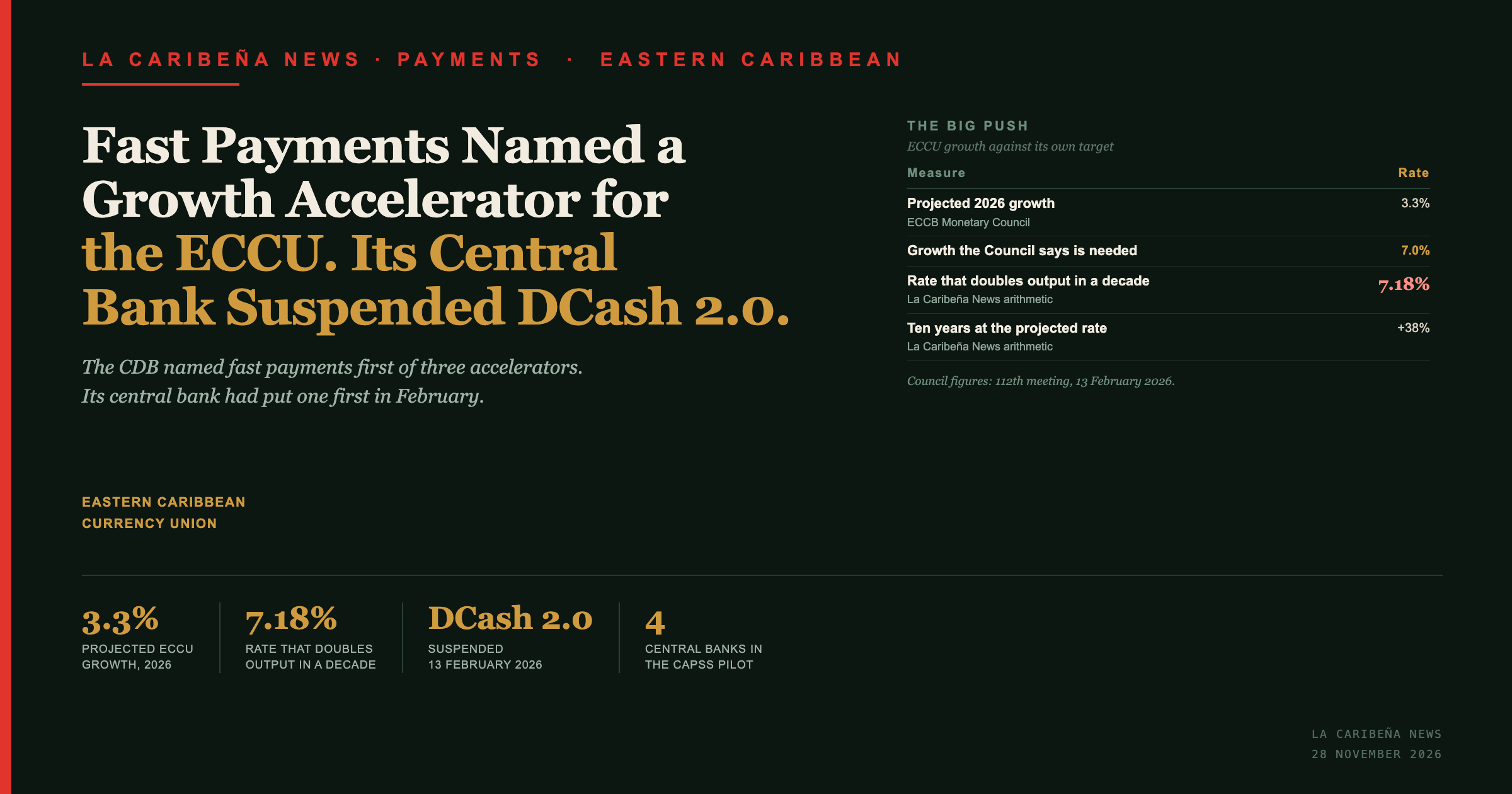
Title card, text equivalent
All figures on the title card, with their sources.
- Three: the opportunities the Caribbean Development Bank named as accelerators, being fast payment systems, accountable use of artificial intelligence and deeper regional capital markets. Source: Caribbean Development Bank, November 2026.
- 3.3 per cent: ECCU growth projected for 2026. Source: ECCB Monetary Council, 112th meeting, 13 February 2026.
- Approximately 7.0 per cent: the annual growth the Council says is required to double regional output over a decade. Source: the same.
- 7.18 per cent: the compound annual rate that doubles a figure in ten years, and 38 per cent: what the projected rate delivers over ten years. Source: La Caribeña News arithmetic.
- DCash 2.0: the development the Council suspended, to prioritise the Fast Payment System and CAPSS participation. Source: ECCB Monetary Council, 13 February 2026.
- Four: the central banks in the CAPSS pilot, and eleven: the territories behind them. Source: Kareem Michael, 24 November 2026.
- 8th: the ECCB Annual Conference at which the keynote was given, in Basseterre. Source: Caribbean Development Bank.
Entities named in this report
- The Caribbean Development Bank (CDB) gave the keynote and supports the ECCB programme.
- Gillian Charles-Gollop is the CDB's Vice President for Corporate Services and delivered it.
- The Eastern Caribbean Central Bank (ECCB) is the currency union's central bank and hosted the conference.
- The Big Push is the ECCB strategy to double the union's economy within a decade.
- DCash 2.0 was the ECCB digital currency development the Monetary Council suspended.
- CAPSS is the CARICOM Payment and Settlement System, in which the ECCB is a pilot participant.
- Gaston Browne, Prime Minister and Minister for Finance of Antigua and Barbuda, chaired the 112th Monetary Council meeting.
- Kareem Michael, Governor of the Central Bank of Belize, chairs the CARICOM central bank governors' meeting.
- Barbara Hume is chief executive of the Jamaica Bankers Association, whose banks are preparing the J$30,000 pilot.
- Brian Langrin, Governor of the Bank of Jamaica, will publish a faster-payments vision by the end of the year.
- Fast Pay is Guyana's real-time rail, built with NPCI International Payments Ltd of India.
- The Georgetown Chamber of Commerce and Industry (GCCI) is preparing to approach Guyana's government over foreign currency availability.
- Kathy Smith is the GCCI's President and said members have complained.
Frequently asked questions
What three things did the CDB say would accelerate ECCU growth?
Fast payment systems that work for commerce, accountable use of artificial intelligence, and deepening regional capital markets to channel savings into more productive investment.
How fast is the ECCU growing, and how fast does it need to grow?
The ECCB Monetary Council projected 3.3 per cent for 2026 and said approximately 7.0 per cent a year is required to double regional output over a decade. The precise doubling rate is 7.18 per cent.
Is DCash still being developed?
No. The Monetary Council suspended DCash 2.0 development on 13 February 2026, to prioritise the Fast Payment System and CAPSS participation. The communique records no restart date.
Which central banks are in the CAPSS pilot?
The Eastern Caribbean Central Bank, the Central Bank of The Bahamas, the Central Bank of Barbados and the Central Bank of Trinidad and Tobago. Because the ECCB issues for eight members, those four banks cover eleven territories.
Will CAPSS remove the need for United States dollars?
Not between central banks. Day-to-day transactions settle in local currencies, but a spokesperson for the Bank of Guyana says net positions between central banks will most likely settle in United States dollars.