By Theon Alleyne, CRCP, CCEP
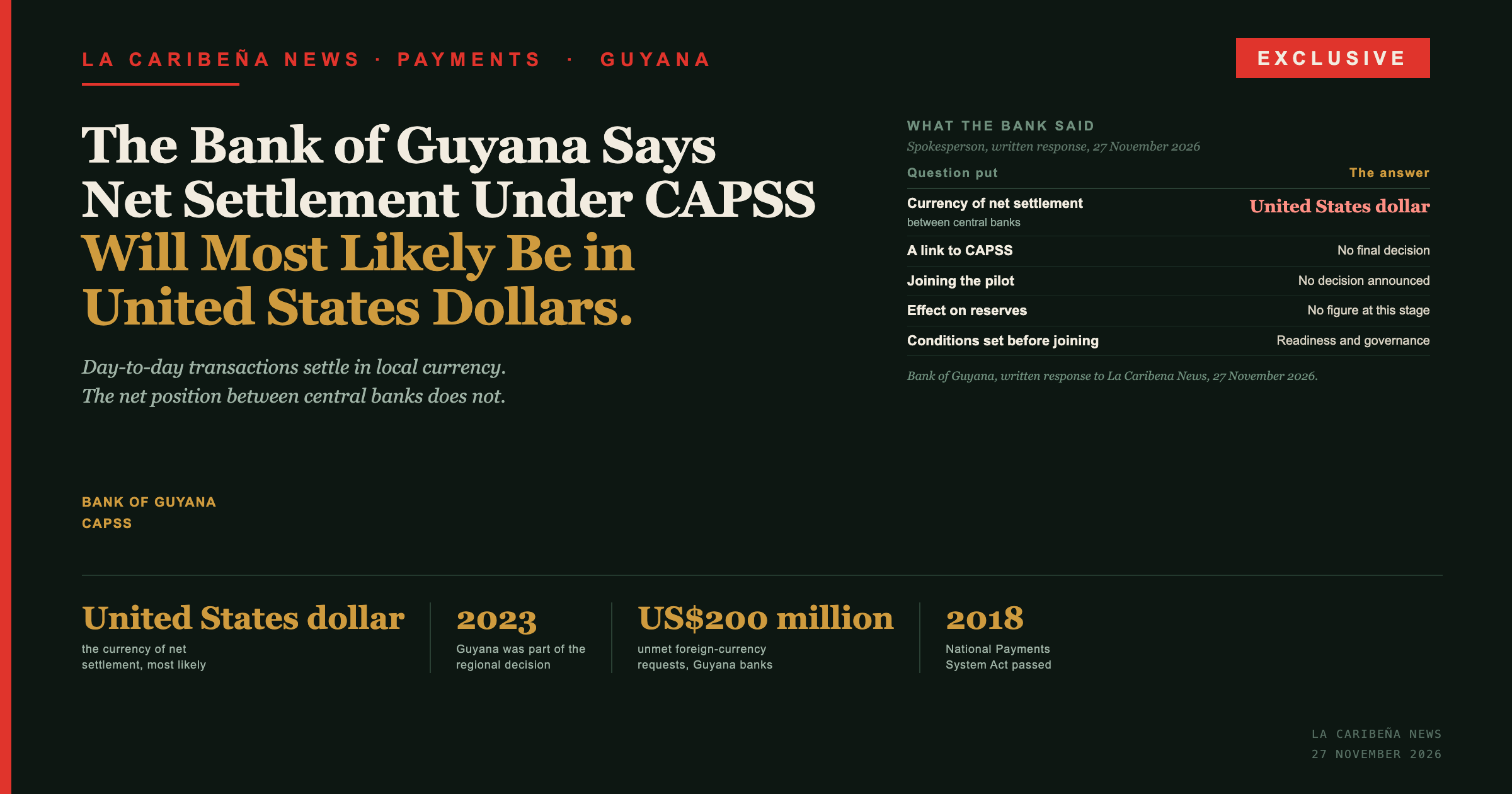
A spokesperson for the Bank of Guyana, responding to a request from La Caribeña News on 27 November 2026, says the net position between central banks under the CARICOM Payment and Settlement System will most likely settle in United States dollars.
President Irfaan Ali tasked the Governor with evaluating the proposal behind that system in June 2024. On the public record this newspaper can find, these are the Bank's first published answers on it.
Day-to-day transactions clear in local currencies. What passes between the central banks does not.
What did the Bank say about settlement?
That net positions still settle in a recognised international currency, most likely the United States dollar.
"CAPSS lets participants settle day-to-day transactions in local currencies, which reduces the need for foreign exchange at the point of each transaction," the spokesperson said. "Net positions between central banks still require final settlement, however. In practice, that settlement will take place in a recognised international currency, most likely the United States dollar."
The system is built to make regional payments "faster, cheaper and less reliant on correspondent banks", in the spokesperson's words. The dollar does not leave that arrangement. It moves from the firm to the central bank.
The Eastern Caribbean had said as much first. Its Governor, Timothy Antoine, had told Global Finance that background settlements would still involve United States dollars among central banks. The pilot itself has no launch date, and the meeting that will set one has not been held. A second central bank has now said it in its own name, and it is the one with the foreign-currency queue.
Is Guyana joining the pilot?
The Bank has announced no decision. It set two conditions.
The first is its own readiness, "covering domestic infrastructure, the legal and regulatory framework and operational risk management". The second is "decisions the CARICOM Committee of Central Bank Governors takes together".
The spokesperson said Guyana was part of the 2023 decision that set the regional direction, and that the Governors agreed to run the pilot in phases, "starting with a small group of central banks, so that the technology, legal arrangements and risk controls are properly tested before the system grows".
The Bank is "following the pilot closely" and "will announce any decision on Guyana's participation at the right time".
The pilot is proceeding with four central banks. The chairman of the governors' meeting named the Eastern Caribbean Central Bank, The Bahamas, Barbados and Trinidad and Tobago as the participants.
Will Guyana's own platform connect to CAPSS?
Not decided. The Bank has made no final decision on connecting its own platform to CAPSS.
"We have made no final decision on a link to CAPSS," the spokesperson said. Modernising the payments system "remains a priority", and work has continued since the National Payments System Act passed in 2018, with support from development partners. The Bank is "building to international standards so the infrastructure can connect with regional and international systems in future".
Any decision on a link "would follow from the readiness and governance points above".
Guyana signed with India's NPCI International in November 2024 and is building its national platform on a different model. The response does not reach that arrangement. On the Bank's account the decision on a link is still open.
What would joining require of Guyana's reserves?
Liquidity for settlement, and possibly prefunding or collateral. The Bank cannot put a figure on it at this stage.
Participation "would therefore affect how the Bank manages part of its reserves, particularly liquidity for settlement and any prefunding or collateral the system requires", the spokesperson said.
Prefunding and collateral are a cost before any transaction clears. A central bank that posts them is holding reserves against the system rather than against imports.
The size of the effect "depends on the final operating rules, how often settlement happens and how much business flows through the system, and participating central banks are still discussing those points". Any arrangement "would have to fit within our reserve management framework, where safety and liquidity come first".
"We cannot put a figure on it at this stage."
What is still to be decided?
Guyana's participation, the link to its own platform, and the operating rules themselves.
The Bank set out what has to happen before it can decide: its own readiness, and collective decisions by the CARICOM Committee of Central Bank Governors. On a link to CAPSS it said no final decision has been made, and that any such decision would follow from those same points.
The rules of the system are not settled either. The size of any reserve effect "depends on the final operating rules, how often settlement happens and how much business flows through the system, and participating central banks are still discussing those points", the spokesperson said.
| Still to be settled | Whose decision |
|---|---|
| Whether Guyana joins the pilot | The Bank's readiness, and the Committee of Central Bank Governors |
| Whether the national platform links to CAPSS | The same two conditions |
| How often settlement happens, and on what rules | Participating central banks, still in discussion |
| The size of any reserve commitment | Follows from the operating rules |
Dr. Gobind Ganga, the Governor, chairs the 68th meeting of the CARICOM central bank governors in May 2027.
The spokesperson closed by offering "an update as the work moves forward".
What does this mean for a business waiting on foreign currency?
That CAPSS is not the near-term answer to the queue, on the Bank's own account.
The problem the system was meant to answer was put by Ali himself. Payments in some sectors, tourism among them, can take up to 50 days to clear, he said in June 2024, when he asked the Governor and the Minister of Finance to assess the Afreximbank proposal and asked Barbados to convene the region's finance ministers and governors.
Guyana's commercial banks told Ali that unmet requests for foreign currency stand at just over US$200 million. What share of that queue is payments to other CARICOM states is not published, and it is the figure that would size the relief.
What the response does settle is the shape of the relief. A firm paying a regional supplier would transact in local currency, which strips out two conversions and a bank abroad. The dollars move behind the system, to the central bank, which then needs them for net settlement and possibly for prefunding.
On that account, a business planning around the foreign-currency queue is planning around the arrangement it has now.
When the Guyana Development Bank opened in October with a first tranche of US$100 million, an importer buying from Ghana found the payment still had to leave in United States dollars.
Title card, text equivalent
All figures and claims on the title card, with their sources.
- Net positions between central banks will settle in a recognised international currency, most likely the United States dollar. Source: a spokesperson for the Bank of Guyana, written response to La Caribeña News, 27 November 2026.
- The Bank has made no final decision on a link to CAPSS. Source: the same.
- Participation depends on the Bank's own readiness and on decisions the CARICOM Committee of Central Bank Governors takes together. Source: the same.
- Participation would affect reserve management, particularly liquidity for settlement and any prefunding or collateral. Source: the same.
- The Bank cannot put a figure on the reserve effect at this stage. Source: the same.
- 2018: the year the National Payments System Act passed. Source: a spokesperson for the Bank of Guyana.
- Just over US$200 million: unmet requests for foreign currency reported by Guyana's commercial banks. Source: La Caribeña News, reporting the banks to President Irfaan Ali.
- May 2027: the 68th meeting of the CARICOM central bank governors, chaired by Dr. Gobind Ganga. Source: Central Bank of Belize, 20 November 2026.
- June 2024: when President Irfaan Ali tasked the Governor and the Minister of Finance with evaluating the Afreximbank proposal. Source: Guyana Standard, 23 June 2024.
- 50 days: how long payments can take to clear in some sectors, on President Ali's account. Source: the same.
Entities named in this report
- The Bank of Guyana is Guyana's central bank, which gave this response through a spokesperson.
- Dr. Gobind Ganga is Governor of the Bank of Guyana and chairs the 68th meeting of the CARICOM central bank governors in May 2027.
- CAPSS is the CARICOM Payment and Settlement System, built on the PAPSS model and in a pilot phase.
- The CARICOM Committee of Central Bank Governors takes the collective decisions the Bank named as its second condition.
- The National Payments System Act passed in Guyana in 2018 and underpins the modernisation work.
- NPCI International is the Indian payments body Guyana signed with in November 2024.
- Timothy Antoine is Governor of the Eastern Caribbean Central Bank and had said background settlements would still involve United States dollars.
- President Irfaan Ali tasked the Governor and the Minister of Finance in June 2024 with evaluating the Afreximbank proposal behind the system.
- The African Export-Import Bank (Afreximbank) made that proposal, and built the Pan-African system CAPSS is modelled on.
Frequently asked questions
Will CAPSS remove the need for United States dollars in Caribbean trade?
No. A spokesperson for the Bank of Guyana says day-to-day transactions settle in local currencies. That reduces the need for foreign exchange at each transaction. Net positions between central banks still require final settlement, in a recognised international currency, most likely the United States dollar.
Is the Bank of Guyana in the CAPSS pilot?
The Bank has announced no decision. It says participation depends on two things. The first is its own readiness. That covers domestic infrastructure, the legal and regulatory framework and operational risk management. The second is decisions the CARICOM Committee of Central Bank Governors takes together.
Will Guyana's new payments platform connect to CAPSS?
The Bank says it has made no final decision on a link. It is building to international standards, so the infrastructure can connect with regional and international systems in future.
What would joining cost Guyana in reserves?
The Bank cannot put a figure on it at this stage. It says participation would affect how it manages part of its reserves. That means liquidity for settlement, and any prefunding or collateral the system requires. The size depends on operating rules still being discussed.
What is still to be decided?
Whether Guyana joins the pilot, and whether its national platform links to CAPSS. Both turn on the Bank's own readiness and on collective decisions by the CARICOM Committee of Central Bank Governors. The system's operating rules and settlement frequency are still under discussion among participating central banks. The spokesperson offered an update as the work moves forward.