By LCN Business Desk
Transport burns about 39 per cent of the fuel CARICOM countries use.
On 25 November the Caribbean Development Bank hired a consultant to design a fund about it.
What exactly was launched?
A consultancy, not a fund.
The Bank launched the work with CCREEE, the Caribbean Centre for Renewable Energy and Energy Efficiency. The job is to design a financing mechanism for the Bank's borrowing members. The Caribbean E-Mobility Fund is described throughout as proposed.
pManifold Business Solutions holds the contract. Its chairman and managing director, Rahul Bagdia, said the approach is "grounded in evidence, meaningful stakeholder engagement and the diverse realities of Caribbean economies".
The launch was timed to CARICOM Energy Month and World Sustainable Transport Day.
The fund would have two windows, and only one of them is money.
| The proposed fund | |
|---|---|
| First window | Policy, regulation and technical capacity, including guidance on battery recycling and disposal |
| Second window | Vehicles, charging stations, cleaner public and commercial fleets, and work on electricity networks |
Source: the same release.
The second row is the one a contractor reads. Charging points and grid work are civil and electrical jobs, and they are named before any vehicle is bought.
What has to happen before money moves?
Five pieces of work, and then an application nobody has made.
| The consultancy will deliver | |
|---|---|
| 1 | A regional market assessment and pre-feasibility study |
| 2 | Stakeholder consultations across participating countries |
| 3 | A Green Climate Fund concept note |
| 4 | Recommendations on operational and financing arrangements |
| 5 | A resource mobilisation and partner engagement strategy |
Source: Caribbean Development Bank, 25 November 2026.
A concept note is the first step toward the Green Climate Fund, not a decision by it. The release carries no fund size, no capitalisation, no timeline and no date on which anyone could apply.
Why transport?
Because it is where the fuel goes, and the fuel is imported.
Transport accounts for approximately 39 per cent of fuel consumption across CARICOM member states, on the Bank's figure. It calls that a driver of dependence on imported fuel, and of exposure to world prices.
Judith Ephraim-Schmidt, the Bank's Coordinator for Sustainable Energy, put the reasoning in one line. "Our energy transition cannot be confined to how we generate and use electricity. It must also address how we move people and goods."
The exposure is visible next door. French Guiana's petroleum products rose 23.3 per cent over twelve months, which is what imported fuel does to a small market.
Who is being asked to contribute?
Ten groups, named.
| Invited to the consultations | |
|---|---|
| Public | Governments, regulators, regional organisations |
| Utilities and operators | Utilities, transport operators |
| Money | Financial institutions, investors |
| Other | Technical institutions, civil society, communities |
Source: the same release.
Mohammad Rafik M.S. Nagdee, Executive Director of CCREEE, said the fund could become "a regional market-building instrument, a catalyst for innovation, and a practical demonstration of what Caribbean regionalism can achieve".
What should a Caribbean business do now?
Speak at the design stage, because the design decides what is financeable.
The consultations are the live part. A bus operator, a haulier, a utility or a lender has a window now. The terms are still being recommended rather than applied.
The Bank has been busy with structure this month. It also named three opportunities it says will accelerate growth at the Eastern Caribbean Central Bank's annual conference, and electric transport was not among them.
The region has seen what an unwritten rulebook costs. A CARICOM study published on 26 November put the region's shipping carbon bill at US$3.6 billion, with the rules on what comes back not written.
Nothing here is a funding announcement. The fund is proposed, the work to design it has started, and the first deliverable is a study.
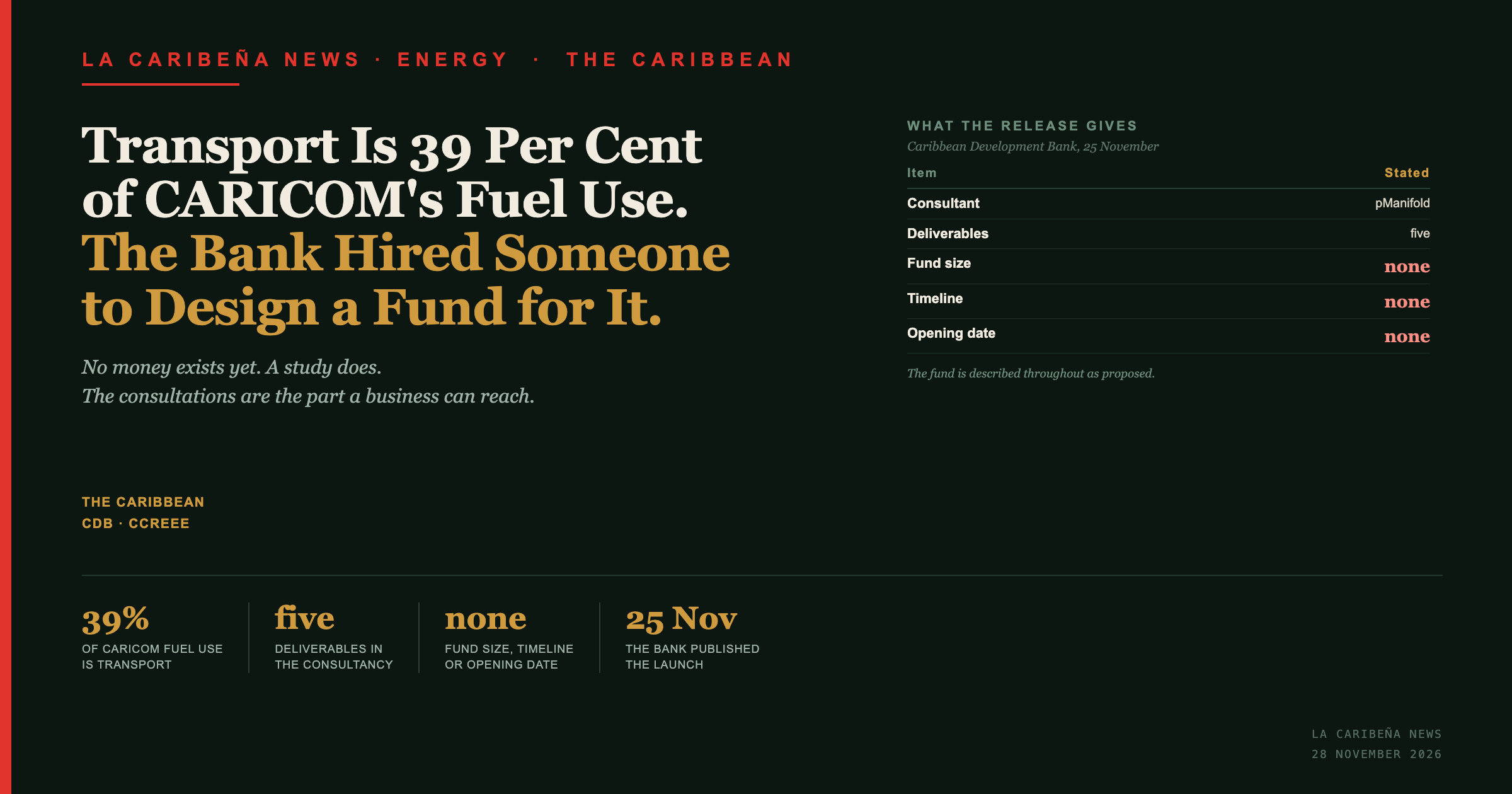
Title card, text equivalent
All figures on the title card, with their sources.
- 39 per cent: transport's approximate share of fuel consumption across CARICOM member states. Source: Caribbean Development Bank, 25 November 2026.
- Two: the windows the proposed fund would have, one for policy and capacity, one for finance. Source: the same.
- Five: the deliverables of the consultancy, from market assessment to resource mobilisation strategy. Source: the same.
- Zero: the fund size, timeline and opening date given in the release. Source: the same.
- 25 November 2026: the date the Bank published the launch. Source: the same.
Entities named in this report
- The Caribbean Development Bank (CDB) is advancing the proposed fund for its Borrowing Member Countries.
- The Caribbean Centre for Renewable Energy and Energy Efficiency (CCREEE) is supporting it.
- The Caribbean E-Mobility Fund is the proposed financing mechanism being designed.
- pManifold Business Solutions holds the consultancy, and Rahul Bagdia is its chairman and managing director.
- Judith Ephraim-Schmidt is the Bank's Coordinator for Sustainable Energy.
- Mohammad Rafik M.S. Nagdee is Executive Director of CCREEE.
- The Green Climate Fund (GCF) is where the concept note would go.
- CARICOM is the Caribbean Community, whose member states the fuel figure covers.
Frequently asked questions
Has a Caribbean electric vehicle fund been created?
No. A consultancy to design a proposed fund was launched on 25 November 2026. The Caribbean Development Bank describes the fund as proposed throughout.
How much money is in it?
No amount is given. The release carries no fund size, no capitalisation, no timeline and no date on which anyone could apply.
Who is doing the work?
pManifold Business Solutions, under contract to the Caribbean Development Bank with the support of CCREEE.
What would the fund pay for?
Electric vehicles, charging stations, cleaner public and commercial transport fleets, and improvements to electricity networks. A separate window would fund policy, regulation and technical capacity, including battery recycling and disposal guidance.
Why is transport the target?
It accounts for approximately 39 per cent of fuel consumption across CARICOM member states, which the Bank links to dependence on imported petroleum and exposure to price volatility.