By LCN Business Desk
Prices in French Guiana rose 2.5 per cent in the year to October.
Almost all of it was fuel.
What did the statistics office report?
A rise of 0.6 per cent in October, after a fall the month before.
INSEE published the figures on 26 November, and France-Guyane carried them the same day. Prices had fallen 0.2 per cent in September.
Energy did the work in the month. It rose 6.3 per cent, after 3.1 per cent in September.
| October 2026, month on month | Change |
|---|---|
| Unleaded petrol | 9.4% |
| Road diesel | 8.7% |
| Bottled gas | 6.2% |
| Energy, all | 6.3% |
| Food | 0.2% |
Source: INSEE, via France-Guyane, 26 November 2026.
Transport services rose 24.6 per cent in the month, with national air transport up 4 per cent.
What is left when energy comes out?
A rate a third the size.
| Year to October 2026 | Change |
|---|---|
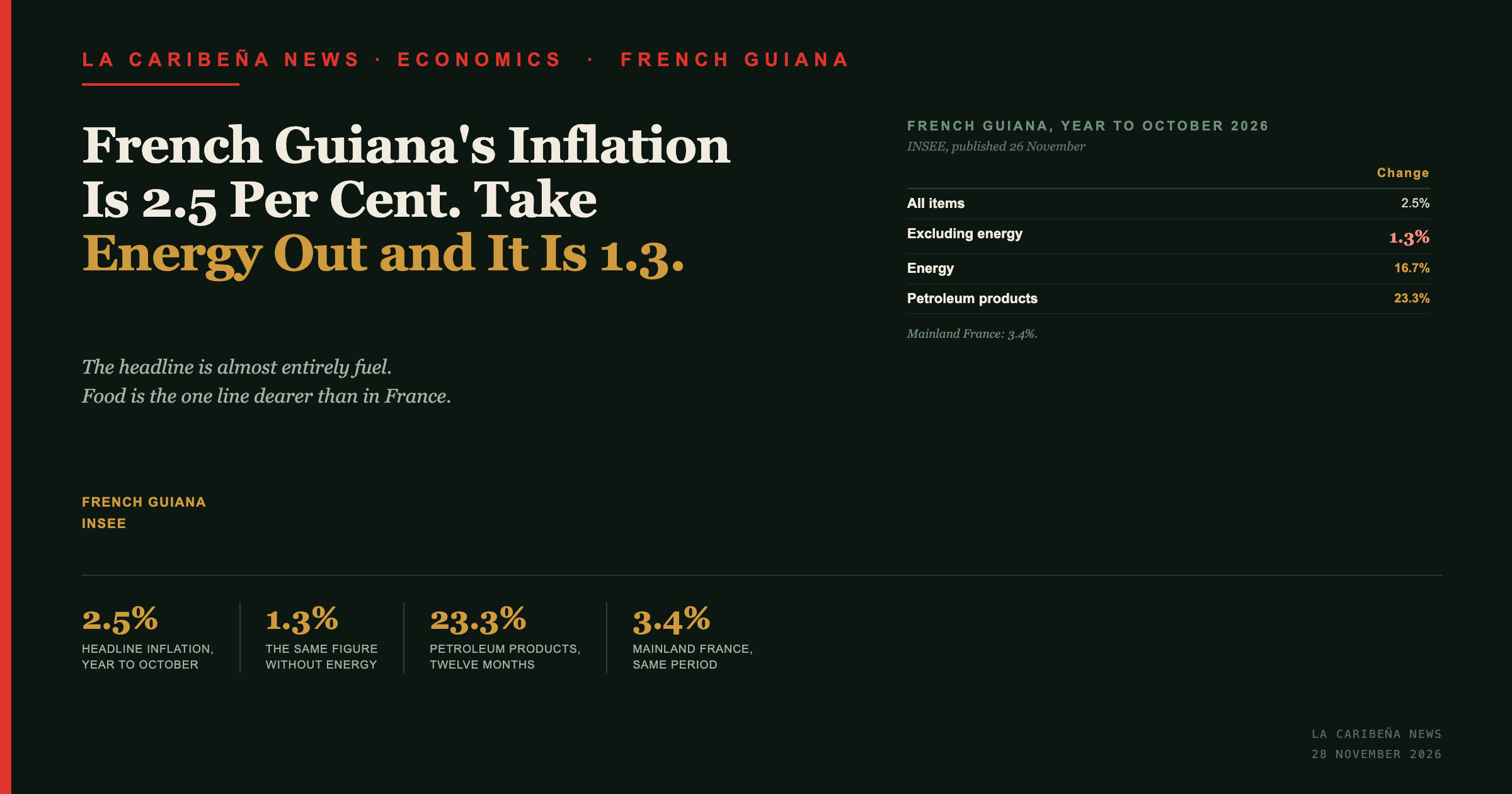
| All items, French Guiana | 2.5% |
| All items, France nationally | 3.4% |
| French Guiana excluding energy | 1.3% |
| Energy | 16.7% |
| Petroleum products | 23.3% |
Source: the same.
The headline and the underlying rate are telling different stories. One of them is about a department whose prices are broadly flat, and the other is about the price of landing fuel in it.
Manufactured goods actually fell, by 0.4 per cent, and clothing and footwear by 3.5.
Where is French Guiana dearer than France?
Food, and it is the exception.
Food rose 2 per cent over the year in French Guiana against 1.2 per cent in mainland France. Fresh produce rose 3.6 per cent.
So the department is below the national rate on almost everything, and above it on the shop. Services rose 2.1 per cent.
How does that compare with Guyana next door?
It does not compare cleanly, and that is worth knowing before anyone tries.
The two territories share a land border on the Maroni. They do not share a method. French Guiana uses INSEE's base 2025 index, in euros, published monthly. Guyana measures against a basket chosen after a 2006 household survey.
Guyana also publishes more than one answer. Its six official inflation rates run from 2.5 per cent to 4.4, and the Bureau of Statistics gave 3.4 per cent for the year to September 2026.
Set those side by side and the numbers look close. They are measuring different baskets over different periods in different currencies, and nothing follows from the resemblance.
What does this mean for a business?
That a cost line and a price index are moving apart, and only one of them is in the headline.
A firm importing into French Guiana is paying 23.3 per cent more for petroleum products than a year ago. That lands on freight, on generators and on every delivery run. The 2.5 per cent headline does not describe it.
A firm selling there faces the opposite. Outside energy and food, prices are barely moving, and manufactured goods are cheaper than they were.
Fuel is also the line most likely to turn. It fell in September and jumped in October, and the twelve-month figure is built on that volatility.
Across the region the spread is wide.
| Territory | Annual inflation | As at |
|---|---|---|
| French Guiana | 2.5% | October 2026 |
| Guyana, Bureau of Statistics | 3.4% | year to September 2026 |
| Cayman Islands | 5.7% | second quarter 2026 |
| Jamaica | 8.2% | October 2026 |
Sources: INSEE for French Guiana. For the rest, this newspaper's reporting: Cayman's index was up 5.7 per cent on a year earlier, and in Jamaica annual inflation eased to 8.2 per cent.
Four territories, four baskets, four reference periods. The column is a set of separate answers, not a ranking, and a contract indexed to one of them is not hedged against another.
Title card, text equivalent
All figures on the title card, with their sources.
- 2.5 per cent: French Guiana's consumer price inflation in the year to October 2026. Source: INSEE, published 26 November 2026, via France-Guyane.
- 1.3 per cent: the same figure excluding energy. Source: the same.
- 16.7 per cent and 23.3 per cent: the twelve-month rise in energy and in petroleum products. Source: the same.
- 3.4 per cent: inflation in mainland France over the same period. Source: the same.
- 0.6 per cent: the rise in October alone, after a fall of 0.2 per cent in September. Source: the same.
Entities named in this report
- INSEE is France's national statistics institute and publishes the French Guiana index.
- France-Guyane is the department's daily newspaper and carried the release.
- French Guiana is an overseas department of France and uses the euro.
- The Bureau of Statistics publishes Guyana's consumer price index.
- The Maroni is the river border between French Guiana and Suriname.
Frequently asked questions
What is French Guiana's inflation rate?
2.5 per cent in the year to October 2026, on INSEE figures published on 26 November. Prices rose 0.6 per cent in October alone.
Why is it lower than France's?
Mainland France recorded 3.4 per cent over the same period. Outside energy, French Guiana ran at 1.3 per cent, with manufactured goods falling 0.4 per cent and clothing and footwear 3.5 per cent.
What is driving the French Guiana figure?
Energy. It rose 16.7 per cent over twelve months and petroleum products 23.3 per cent. In October alone unleaded petrol rose 9.4 per cent and road diesel 8.7 per cent.
Is food more expensive than in France?
Yes. Food rose 2 per cent in French Guiana against 1.2 per cent nationally, and fresh produce rose 3.6 per cent.
Can this be compared with Guyana's inflation?
Not directly. French Guiana uses INSEE's base 2025 index in euros, while Guyana's basket comes from a 2006 survey and its official rates range from 2.5 per cent to 4.4.