By LCN Business Desk
The Cayman Islands Government has taken the whole 100 per cent import duty off fuel and capped the fuel charge on most household electricity bills.
Its own statisticians have now measured what happened to electricity prices anyway.
What did the index show, and which costs rose most?
An index of 143.0, with transport the fastest division at 12.8 per cent over the year.
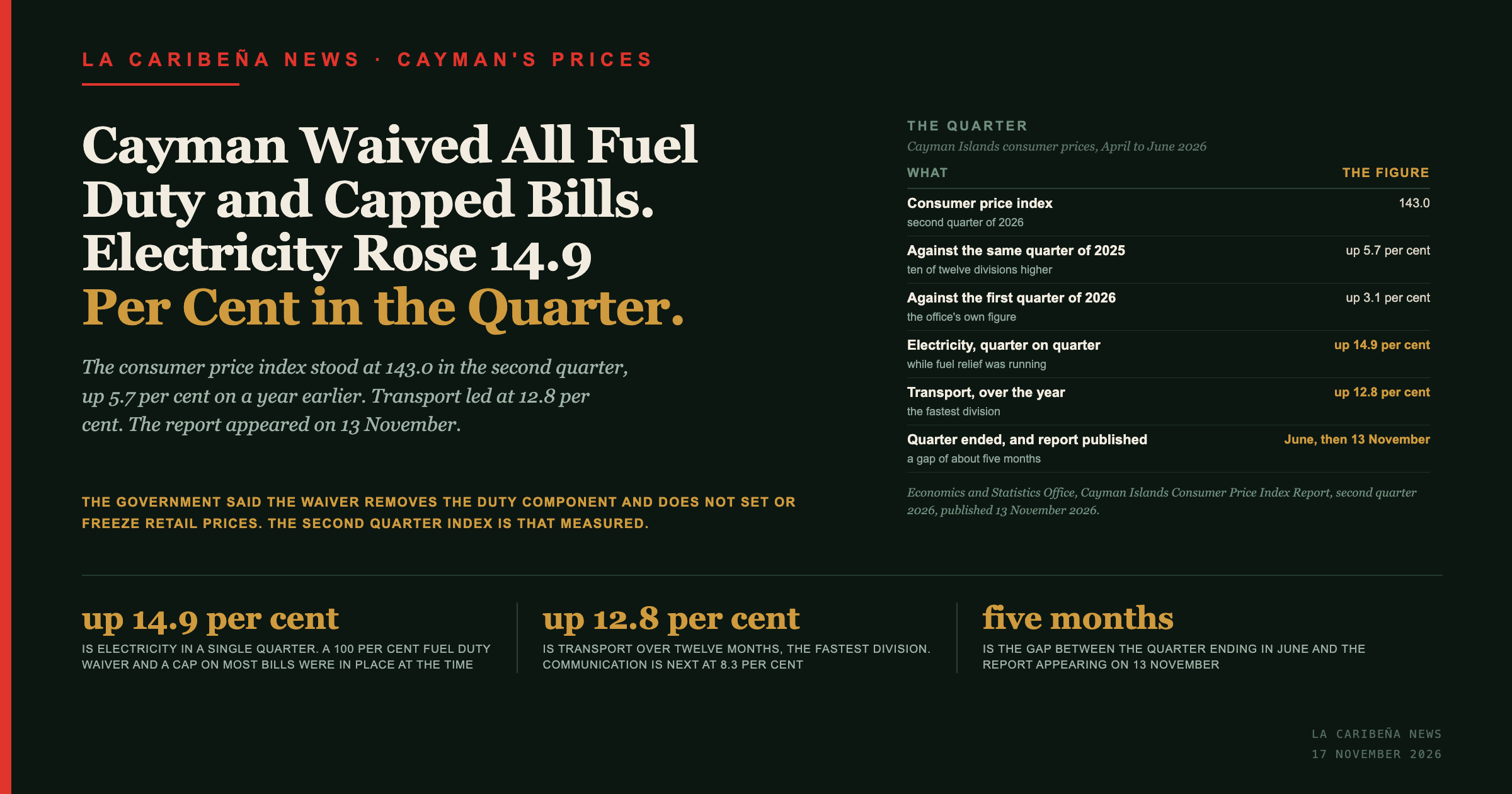
The index sat at 143.0 in the quarter, 5.7 per cent above the same quarter of 2025 and 3.1 per cent above the first quarter of this year. Ten of the twelve divisions recorded higher price indices. The figures come from the Economics and Statistics Office's own report, published on 13 November 2026.
| Division | Change on a year earlier |
|---|---|
| Transport | up 12.8% |
| Communication | up 8.3% |
| Housing and utilities | up 5.3% |
| Restaurants and hotels | up 4.5% |
| Food and non-alcoholic beverages | up 3.5% |
| Health | up 3.3% |
Cayman Islands consumer price index, year to the second quarter of 2026. Economics and Statistics Office.
Food sits fifth in that ranking and matters more than its position suggests, because it is the division households cannot defer. Within it the office records milk, cheese and eggs up 7.9 per cent, fish and seafood up 4.7 and meat up 3.4.
What happened to electricity?
It rose 14.9 per cent inside a single quarter.
The housing, water, electricity, gas and other fuels division rose 2.2 per cent between the first and second quarters, and the office attributes that increase to electricity at 14.9 per cent.
That quarter ran while the government's fuel relief programme was in place. The Cayman Islands Government extended the programme on 29 September 2026, holding a 100 per cent import duty waiver on gasoline, diesel and propane to 31 December. It also capped electricity fuel charges for nearly 95 per cent of households. By the end of August it had spent about CI$11.35 million.
The government said at the time what the waiver could and could not do. It removes the duty component, it does not set or freeze retail prices, and consumers "may see a reduction, little change or an increase at the pump". The second-quarter index is what that looks like measured.
How current is the report, and does it name its own quarter?
It measures a quarter that ended in June, and in one place it names the wrong quarter.
The gap between the period measured and the day a business could read it is about five months. A firm setting prices or wages in November is working from the cost of living as it stood in June.
The year-on-year panel is headed June 2026 over June 2025 and the quarter-on-quarter panel June 2026 over March 2026. The text beneath the second reads: "The fourth quarter Consumer Price Index (CPI) increased by 3.1 percent compared to the first quarter of 2026, which ended in March." The comparison and the heading are both second quarter against first.
Cayman News Service, reporting the release on 16 November, gave 2.6 per cent for the quarterly movement in its opening and 3.1 per cent in its body. The office's own figure is 3.1.
How does this compare with the region?
Lower than Jamaica's, on a transport line that is also lower.
Jamaica's annual inflation eased to 8.2 per cent in October, with transport running at 15.0 per cent over twelve months. Cayman's comparable figures are 5.7 and 12.8, measured to June rather than October.
Both economies import most of what they consume and both have transport as their fastest-rising division. The Cayman figure carries no central bank target to be measured against, because the territory uses a currency pegged to the United States dollar.
What should a Cayman employer take from this?
That the cost line moved faster than the measurement did.
The same office put unemployment at 2.1 per cent in Spring 2026, while employed Caymanians fell 7.8 per cent and the total labour force shrank 3.2 per cent. A tighter labour force meeting a 5.7 per cent cost of living is a wage negotiation, not a statistic.
For a business budgeting into 2027, the shape is more usable than the headline. Which headline to use is its own question elsewhere in the region: Guyana publishes six official inflation rates, running from 2.5 per cent to 4.4. Transport and communication sit at the top. Electricity moved 14.9 per cent in three months despite relief. Food rose on the lines households buy weekly.
<!-- archive: guyana-inflation-cpi-basket-2006-survey-imf-prices-rating-c-2026 | read it: it is about Guyana measuring inflation against a basket chosen after a 2006 household survey and the replacement finished in 2019. That is the age of a basket's weights; this piece concerns the lag between a quarter ending and its report appearing. Both are measurement quality and they are different faults, so linking it here would blur the two. -->
Entities
- Economics and Statistics Office: the Cayman Islands agency that compiles the consumer price index and the labour force survey. - Cayman Islands Government: the government that waived fuel import duty and capped electricity fuel charges. - Cayman News Service: the Cayman outlet that reported the release on 16 November 2026.
What the title card shows
- Cayman Islands consumer price index, second quarter of 2026: 143.0. - Change on the same quarter of 2025: up 5.7 per cent. Change on the first quarter of 2026: up 3.1 per cent. - Divisions recording higher price indices: ten of twelve. - Transport over twelve months: up 12.8 per cent. Communication: up 8.3 per cent. Housing and utilities: up 5.3 per cent. - Electricity, quarter on quarter: up 14.9 per cent. - Date the quarter ended: June 2026. Date the report was published: 13 November 2026. - Source: Economics and Statistics Office, Cayman Islands Consumer Price Index Report, second quarter 2026.
Frequently asked questions
What is the Cayman Islands inflation rate?
Consumer prices in the second quarter of 2026 were 5.7 per cent higher than in the second quarter of 2025, with the index at 143.0. Against the first quarter of 2026 the rise was 3.1 per cent.
Which costs rose fastest?
Transport, up 12.8 per cent over the year, then communication at 8.3 per cent and housing and utilities at 5.3 per cent.
Did the fuel duty waiver hold prices down?
Electricity rose 14.9 per cent between the first and second quarters while the relief programme was running. The government had said the waiver removes the duty component but does not set or freeze retail prices.
How current are these figures?
The quarter ended in June 2026 and the report was published on 13 November 2026, a gap of about five months.
How does Cayman compare with Jamaica?
Jamaica's annual inflation was 8.2 per cent in October with transport at 15.0 per cent. Cayman's figures are 5.7 per cent and 12.8 per cent, measured to June.