By LCN Business Desk
The Cayman Islands Economics and Statistics Office put unemployment at 2.1 per cent in Spring 2026, down from 2.6 per cent in Fall 2025. In the same survey the number of employed Caymanians fell 7.8 per cent, and the labour force as a whole shrank 3.2 per cent.
An unemployment rate is a fraction. The people without work sit on top. The labour force sits underneath. It falls when the top gets smaller. It also falls when the bottom gets smaller faster.
The entities
- Economics and Statistics Office is the Cayman Islands government statistics agency, the ESO. - Labour Force Survey is the ESO's twice-yearly household survey, run in Spring and Fall. - Consumer Price Index is the ESO's quarterly price measure. - Caymanian is the status distinction the ESO reports separately from the overall labour force, which also contains work-permit holders.
What did the labour survey find?
Fewer people unemployed, and fewer people working.
| Spring 2026, against Fall 2025 | Figure |
|---|---|
| Unemployment rate, everyone | 2.1%, from 2.6% |
| Unemployment rate, Caymanians | 3.6%, from 4.1% |
| Employed labour force | 61,572 |
| Number unemployed | 1,327 |
| Total labour force | 62,898, 3.2% lower than Fall 2025 |
| Employed Caymanians | 22,460, 7.8% lower than Fall 2025 |
Economics and Statistics Office, Labour Force Survey Spring 2026, with population estimates as of June 2026.
Both rates went down. So did the number of Caymanians holding a job, by 7.8 per cent, and so did the labour force as a whole, by 3.2 per cent.
A falling rate on a falling base is not the same event as a falling rate on a rising one. The first can happen while fewer people work. The second cannot.
Does the 3.6 per cent figure mean what it looks like?
Not unless the word in front of it is read. It is the Caymanian rate, not the national one.
The ESO reports two unemployment rates. The overall rate covers everyone in the labour force, including work-permit holders, and that is 2.1 per cent. The rate for Caymanians is 3.6 per cent.
Both appear in the same release and they measure different populations. A business reading "the unemployment rate" in Cayman needs to know which of the two it has been given, because they differ by a factor of about 1.7.
The Caymanian figure is the one that moves with local hiring. The overall figure moves with the permit population as well, and the permit population is the larger part of the workforce.
What does the ESO not say?
Why the labour force shrank, which is the question the numbers raise.
The release carries the rates, the counts and the changes. It does not carry a participation rate on that page, nor the change in the working-age population, nor youth unemployment. Without those, the arithmetic can be stated and the cause cannot.
Three readings fit the same figures. People left the labour force. People left the islands. Or the survey rounds are not comparable, because Spring and Fall are different seasons in an economy with tourism in it.
A further round is already in the field. Government notices put the start of the Fall 2026 Labour Force Survey at 27 September 2026, so a later reading exists and has not been published.
This newspaper has not obtained the full Labour Force Survey report, which the ESO does not link as a document from its front page. What is set out above is from the office's own summary release.
What happened to prices over the same period?
They rose 5.7 per cent in the year to the second quarter, and 3.1 per cent in the quarter alone. The measure is the Consumer Price Index.
| Q2 2026 | Change |
|---|---|
| Inflation, annual | 5.7% |
| CPI, quarter on quarter | 3.1% |
| Passenger air transport, annual | 21.4% |
| Communication | 8.3% |
| Household equipment | 6.4% |
| Housing and utilities | 5.3% |
| Restaurants and hotels | 4.5% |
| Food and non-alcoholic beverages | 3.5% |
| Alcoholic beverages and tobacco | −0.3% |
| Recreation and culture | −0.9% |
Economics and Statistics Office, Q2 2026. Two of the twelve divisions fell. The ESO's summary page does not state whether 5.7 per cent is headline or core, and does not give the index level, which stood at 143.0 in the second quarter.
The first quarter of 2026 came in at 2.8 per cent. The annual rate therefore roughly doubled in three months.
The division doing most of the work is air transport, at 21.4 per cent. For an island economy that is not a discretionary line. It is the cost of staff travel, of getting a technician in, and of every visitor arriving to spend money.
One figure on the ESO's own homepage must not be mistaken for this one. It carries 5.1 per cent for 2026, labelled a forecast. A forecast is not a measured rate and the two should not be quoted together.
Why does a pegged currency matter here?
Because it rules out the usual domestic explanation.
The Cayman Islands dollar is pegged to the United States dollar. The Monetary Authority issues it at CI$1 to US$1.20 and holds United States dollar reserves against the currency in circulation. A country with its own floating currency can see prices rise because the currency fell. Cayman cannot tell that story about itself. The rate is fixed, so imported prices arrive at a fixed exchange rate and the increase is in the goods, the freight and the airfare rather than in the money.
Two other rates circulate and a contract should name which one it means. Banks commonly apply CI$1 to US$1.227, and tills around the islands commonly apply CI$1 to US$1.25. Those are retail rates, not the peg. This newspaper has not obtained the Monetary Authority's own statement of the issue rate, and reports it from secondary sources that agree.
The arrangement is a currency board, so interest rates are not set locally either. They arrive with the peg.
That makes the 5.7 per cent harder to argue with and harder to fix locally. It also makes it directly comparable, year on year, in United States dollars, which is unusual in this region.
What should a regional business take from it?
Price the contract, not the headline.
| If you are | The number that bites |
|---|---|
| Paying Cayman salaries | 5.7 per cent against a labour force that shrank 3.2 per cent |
| Holding a fixed-fee Cayman contract | 5.7 per cent, with no currency move to blame or to hedge |
| Sending staff to Cayman | passenger air transport at 21.4 per cent |
| Reading a Cayman unemployment figure | which of the two rates you have been handed |
For a Guyanese or Trinidadian firm with a Cayman counterparty, the practical point is the combination. Fees were written in a currency that has not moved, costs rose 5.7 per cent, and the pool of local staff available to deliver the work got smaller.
This newspaper has set out before that a published inflation rate is a choice of measure rather than a single fact, and that Guyana publishes six official inflation rates. Cayman's position is the mirror image. There is one rate, on a currency that does not move, and the argument is about what sits inside it.
What the title card says
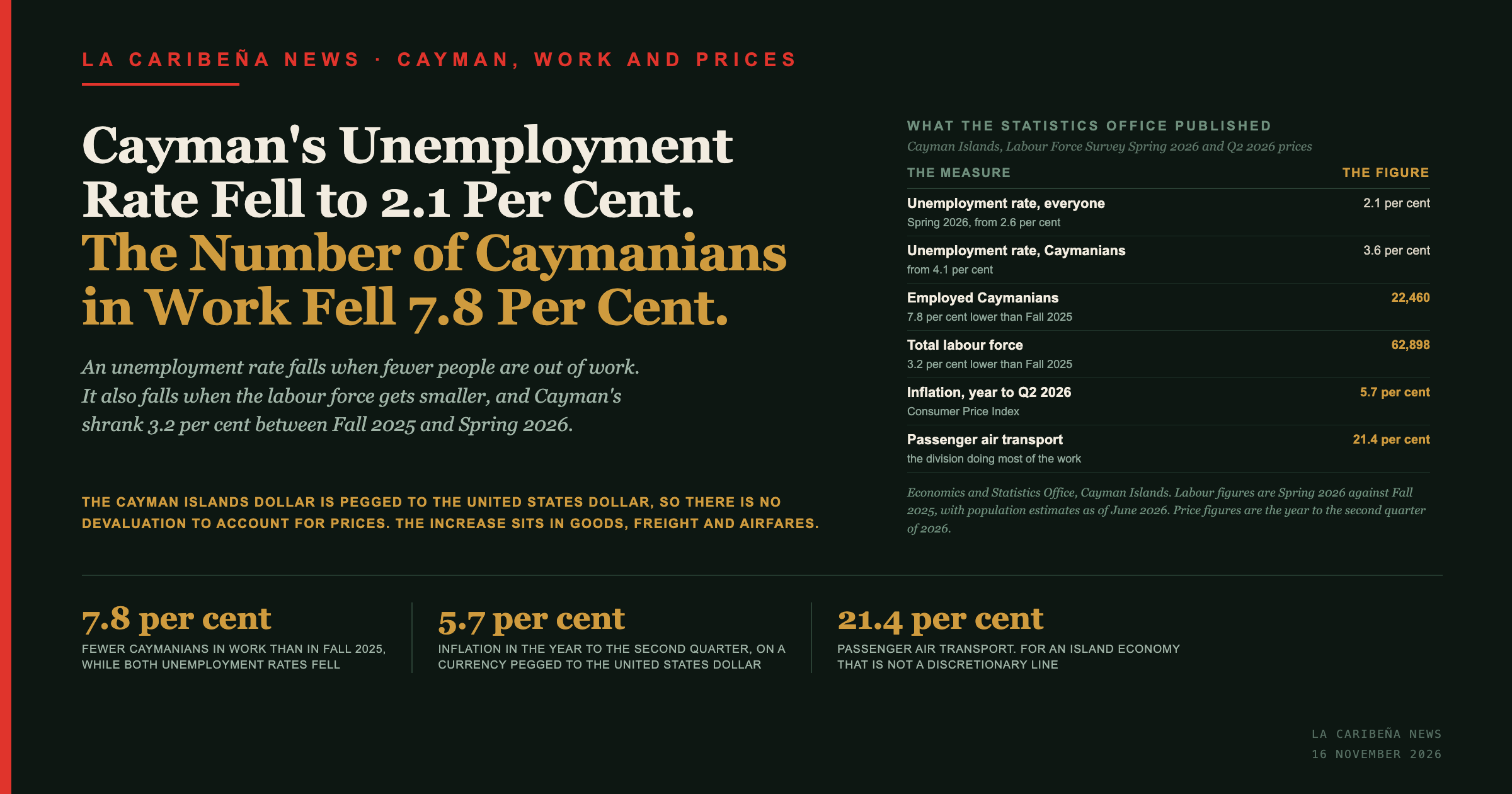
- Headline: Cayman's unemployment rate fell to 2.1 per cent, and the number of Caymanians in work fell 7.8 per cent. - Unemployment rate, everyone, Spring 2026: 2.1 per cent, from 2.6 per cent in Fall 2025. - Unemployment rate, Caymanians: 3.6 per cent, from 4.1 per cent. - Employed labour force: 61,572. Number unemployed: 1,327. Total labour force: 62,898. - Total labour force change: 3.2 per cent lower than Fall 2025. - Employed Caymanians: 22,460, 7.8 per cent lower than Fall 2025. - Inflation, year to Q2 2026: 5.7 per cent. Quarter on quarter: 3.1 per cent. - Passenger air transport, annual: 21.4 per cent. - Q1 2026 inflation: 2.8 per cent. - Divisions that fell: alcoholic beverages and tobacco, and recreation and culture.
Frequently Asked Questions
What is the Cayman Islands unemployment rate?
2.1 per cent in Spring 2026, down from 2.6 per cent in Fall 2025, on the Economics and Statistics Office's Labour Force Survey. That is the overall rate, covering work-permit holders as well as Caymanians.
Why do some reports say 3.6 per cent?
Because that is the Caymanian unemployment rate, reported separately in the same release. It fell from 4.1 per cent. The two figures measure different populations and should not be used interchangeably.
If unemployment fell, did employment rise?
Not for Caymanians. The number of employed Caymanians was 22,460, a 7.8 per cent decline from Fall 2025, and the total labour force was 3.2 per cent smaller. An unemployment rate can fall because the labour force shrinks. The ESO's summary release does not publish a participation rate, so the cause is not established there.
How high is Cayman inflation?
5.7 per cent in the year to the second quarter of 2026, with the CPI up 3.1 per cent on the quarter. The first quarter rate was 2.8 per cent. Passenger air transport rose 21.4 per cent.
Does the currency explain the price rise?
No. The Cayman Islands dollar is pegged to the United States dollar, so there is no devaluation to account for it. The increase sits in the goods, the freight and the airfares rather than in the exchange rate.