By LCN Business Desk
Junior Minister for Tourism and Culture Luce Hodge-Smith said on 10 November 2026 that the Virgin Islands government plans to establish a programme encouraging cruise passengers to return as overnight guests.
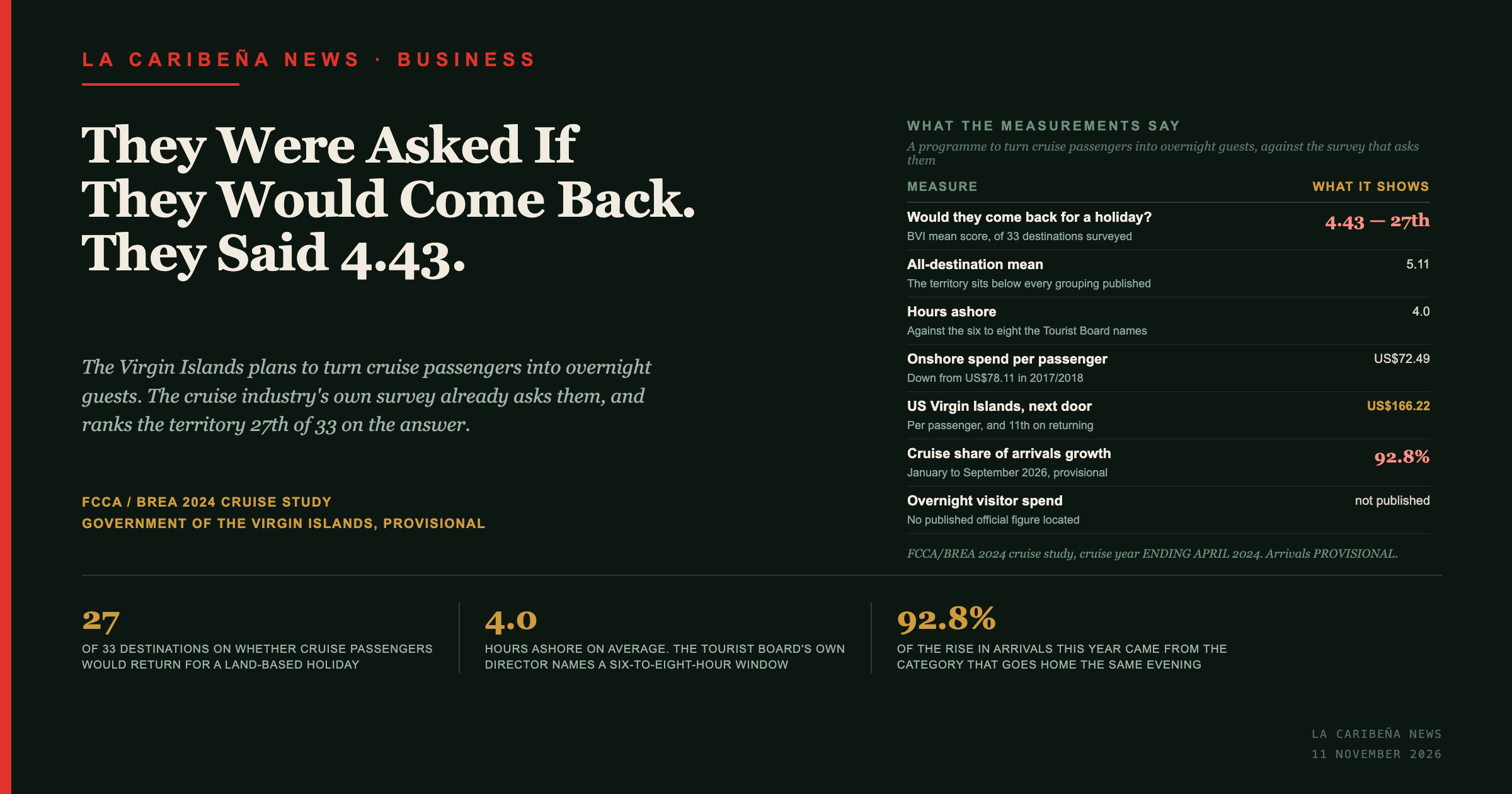
The cruise industry's own survey already asks those passengers that question, on the ship, on the day they leave. Passengers leaving the British Virgin Islands rated their likelihood of returning for a land-based holiday at 4.43 out of ten, placing the territory 27th of the 33 destinations the Florida-Caribbean Cruise Association surveyed. Twenty-six scored higher.
Hodge-Smith told the Virgin Islands Voice programme that she is designing for an appetite she described this way: "They want to immerse themselves in the culture, and they want to immerse themselves in the history, storytelling. They want a taste of food."
Does a breakdown of the figures already exist?
Hodge-Smith said cruise passengers accounted for the largest share of visitor arrivals. BVI News reported that she did not provide a breakdown of the categories, saying only that overnight arrivals had grown while day-tripper numbers had declined slightly.
Her own government published the breakdown a fortnight earlier. Premier and Minister of Finance Natalio D. Wheatley issued provisional arrival figures on 27 October covering January to September.
| Category | Jan to Sep 2026 | Jan to Sep 2025 | Change |
|---|---|---|---|
| Total visitors | 1,071,716 | 835,225 | +28.3% |
| Cruise passengers | 797,784 | 578,315 | +38.0% |
| Overnight visitors | 256,943 | 238,202 | +7.9% |
| Day-trippers | 16,989 | 18,708 | −9.2% |
Source: Government of the Virgin Islands, provisional. Figures as published 27 October 2026.
The statement puts a single ratio on the table that the minister's framing leaves out: cruise arrivals supplied approximately 92.8 per cent of the net increase in total arrivals. The territory passed one million visitors earlier than in any previous year, and the growth is almost entirely the category that goes home the same evening.
The gap widens the closer the figures get to the present. In September alone, cruise arrivals rose about 302 per cent against September 2025 while overnight arrivals rose 3.8 per cent.
What do the passengers say?
The Florida-Caribbean Cruise Association commissions Business Research and Economic Advisors to survey passengers aboard member ships. The 2024 study covers the cruise year from May 2023 to April 2024, with surveys collected between October 2023 and May 2024. More than 650 passengers completed it for the British Virgin Islands. Arrival counts in the study come from the BVI Ports Authority, which recorded 821,990 cruise passengers that year; 685,540 of them, 83 per cent, went ashore.
| Rank | Destination | Mean score |
|---|---|---|
| 1 | Key West | 7.03 |
| 2 | Turks | 6.71 |
| 3 | Cozumel | 6.02 |
| 11 | US Virgin Islands | 5.56 |
| 17 | Jamaica | 5.36 |
| 20 | St Kitts | 5.26 |
| 25 | Antigua | 4.60 |
| 27 | British Virgin Islands | 4.43 |
| 29 | St Vincent | 3.73 |
| 33 | Panama | 3.45 |
| All destinations | 5.11 | |
| Eastern Caribbean | 5.27 |
"How likely are you to return to [destination] for a land-based or resort vacation?" Scale 1 to 10. Selected rows from the full table of 33. Source: FCCA/BREA 2024 study, Table B-9.
Two things follow that the ranking alone does not carry. The territory sits below the mean of every grouping the study publishes, including the Eastern Caribbean sub-region it belongs to. And the study itself declines to treat this as a BVI problem: in its chapter on the territory it notes that both the return score and the recommendation score "are similar to the ratings of other destinations". Across all 33 destinations the answers run from 3.45 to 7.03, and most cluster between 4.5 and 5.7. Conversion intent is the weakest thing the survey measures almost everywhere it is measured.
The programme Hodge-Smith describes is therefore not fighting a local deficiency. It is fighting the business model of the cruise, which is designed to keep the holiday on the ship.
How long do cruise passengers actually stay?
Earlier this year the BVI Tourist Board's Director of Tourism, Clive McCoy, identified the experience offered during cruise passengers' six-to-eight-hour visits as central to encouraging return trips. The window he named is the conversion surface: whatever persuades a passenger to come back has to happen inside it.
The survey measured the window. Passengers who went ashore in the British Virgin Islands spent an average of 4.0 hours there.
Half the assumed time is a different problem from the one the plan is scoped against. Forty-five per cent of those who disembarked made no purchase at all, and 73 per cent were visiting for the first time, which is the audience a conversion programme most needs to reach and the one with the least time to be reached in.
Which way is the money going?
| Measure | 2017/18 | 2023/24 | Change |
|---|---|---|---|
| Average onshore spend per passenger | US$78.11 | US$72.49 | −7% |
| Average onshore spend per crew member | US$34.12 | US$45.06 | +32% |
| Passenger arrivals | 140,760 | 821,990 | more than fourfold |
Source: FCCA/BREA 2024 and 2018 studies, Tables 19 and 7, and the study's BVI chapter.
Of the 31 destinations common to both studies, only five saw passenger spending fall. The British Virgin Islands is one of them, alongside the Dominican Republic, the Bahamas, Honduras and Barbados. Panama rose 148 per cent over the same period, Martinique 39 per cent, Grenada 22 per cent.
Volume carried the total anyway. Passenger expenditure reached US$49.69 million and total cruise tourism expenditure US$85.66 million. What each passenger leaves behind is smaller than it was before the pandemic, and the crew now spend more per head ashore than they did while the passengers spend less.
This is the pattern Norwegian Cruise Line Holdings reported in its own third-quarter results, where Net Yield fell 6.5 per cent against 2025 with a further fall guided, while the company raised its full-year outlook on volume. A line and the islands it calls at can both carry more people and both earn less from each one.
The per-passenger figure is also the destination's only claim. Costa Maya, which earns US$78.17 from the average cruise passenger, was offered nothing when Royal Caribbean cancelled its 28 September call and paid passengers US$300 to US$800 in onboard credit. A destination earns per head on the day, or it does not earn at all.
Where is the plan right?
The same survey supports the minister's diagnosis.
Passengers rate the territory's people highly and its product thinly. Friendliness of residents and courtesy of employees both score 8.2. The two lowest-scoring attributes on the card are variety of things to see and do at 6.6 and overall shopping experience at 6.6. Asked why they bought no shore excursion, 20 per cent said poor value and 16 per cent said they did not like any of the options.
Hodge-Smith named entertainment and nightlife as the gap, and said plans for the National Cultural Arena had gone before the public the evening before the broadcast. "We do have to increase our entertainment events to keep them," she said. "Because you go to other places and there's a lot of nightlife."
The excursion mix points the same way. Beach days account for 44 per cent of excursions sold and historical or cultural experiences 16 per cent, the second-smallest category. The immersion the minister describes is the thinnest part of what is currently on offer, which is an argument for building it rather than against.
One structural figure sits underneath all of this. Seventy per cent of shore excursions were booked through the cruise line and 5 per cent through an onshore tour operator. The channel that reaches the passenger before the ship docks is almost entirely the line's, and a territory that wants to sell a return visit has to find its own way to the same person.
Which number does nobody publish?
A conversion programme is worth the difference between what a cruise passenger spends and what an overnight guest spends. The first half of that sum is published annually and quoted above.
The second half is not. No published figure for average expenditure by an overnight visitor to the British Virgin Islands could be located on the public record. What exists is commercial travel-cost estimators with undisclosed methodology, which cannot carry a policy decision. The BVI Tourist Board and the Government Statistics Department would be the bodies to publish it.
The study does price the territory against its nearest neighbour, which is the next best thing.
| 2023/2024 cruise year | British Virgin Islands | US Virgin Islands |
|---|---|---|
| Passengers ashore | 685,540 | 1,331,600 |
| Spend per passenger | US$72.49 | US$166.22 |
| Passenger expenditure | US$49.69m | US$221.34m |
| Total cruise tourism expenditure | US$85.66m | US$258.09m |
| Return-intent score, rank of 33 | 4.43, 27th | 5.56, 11th |
| Spend per passenger since 2018 | −7% | unchanged |
Source: FCCA/BREA 2024 study, Tables 7, 19 and B-9.
The two territories share an archipelago, a cruising ground and much of an itinerary. The neighbouring one takes a little over twice as much from each passenger who steps ashore and sends them home measurably likelier to return. Whatever is not being captured is therefore not a function of which ships call or how many.
How does this compare across the region?
The pattern is not confined to one territory. Aliyyah Shakeer, Director of Research at the Caribbean Tourism Organization, gave the regional figures at the State of the Tourism Industry Conference in Georgetown in October.
| Measure, first half 2026 | Volume | Change |
|---|---|---|
| Stayover visitors | 18.9m | +1.9% |
| Cruise passenger visits | 21.7m | +11% (record) |
Source: Caribbean Tourism Organization, reported 13 October 2026.
The organisation expects stayovers to grow 2 to 3 per cent for the full year, approaching 36 million, and cruise visits 5 to 7 per cent, to about 38 million. On those forecasts the region ends 2026 hosting more cruise passengers than overnight guests.
Hodge-Smith said cruise conversion was drawing attention across the Caribbean and that the Caribbean Tourism Organization planned a summit on the subject. That conference elected its officers in Georgetown in October, with Antigua and Barbuda taking the chairmanship and the next meeting set for Antigua from 4 to 8 October 2027, and heard Jamaica's Edmund Bartlett propose a visitor-funded resilience fund while President Irfaan Ali called Caribbean investors "too laid-back".
What the region has not yet built is the measurement. When Global Ports Holding signed a 30-year concession for Saint Vincent Cruise Port in October, committing not less than US$20 million in phase one and US$60 million in phase two, the figure on the other side was published too: cruise tourism put US$19.28 million into the country across the 2023/2024 cruise year. That is the exception. Puerto Valparaíso has scheduled 30 cruise calls for the 2026-2027 season against 24 the season before, and its release carries no figure for what any of it earns, and most regional equivalents read the same way.
Calls and arrivals are known months ahead and cost nothing to publish. What a visitor spends, and what a different kind of visitor would spend instead, is the figure that decides whether a conversion programme is worth running.
Key figures
- 4.43. Mean score given by cruise passengers asked how likely they are to return to the British Virgin Islands for a land-based or resort vacation, on a scale of 1 to 10. Rank 27 of 33 destinations. All-destination mean 5.11. Source: FCCA/BREA, 2024 study, Table B-9. - 4.0 hours. Average time ashore for a cruise passenger visiting the territory. Source: as above, BVI chapter. - US$72.49. Average onshore spend per cruise passenger, 2023/2024 cruise year, down from US$78.11 in 2017/2018. - 92.8 per cent. Share of the net increase in total arrivals, January to September 2026, accounted for by cruise passengers. Source: Government of the Virgin Islands, provisional. - 1,071,716. Total visitors January to September 2026, against 835,225 a year earlier. - 256,943. Overnight visitors over the same period, up 7.9 per cent. - 5 per cent. Share of shore excursions booked through an onshore tour operator. Seventy per cent were booked through the cruise line. - US$166.22. Average onshore spend per cruise passenger in the US Virgin Islands over the same cruise year, against US$72.49 in the British Virgin Islands. The US territory ranks 11th of 33 on return intent, at 5.56. - Not published. Average expenditure by an overnight visitor to the British Virgin Islands. No official figure was located. - 21.7 million against 18.9 million. Caribbean cruise passenger visits against stayover visitors, first half of 2026. Source: Caribbean Tourism Organization.
Frequently asked questions
What has the British Virgin Islands government proposed?
Junior Minister for Tourism and Culture Luce Hodge-Smith said on the Virgin Islands Voice programme, in a report published by BVI News on 10 November 2026, that the government plans to establish a programme encouraging cruise passengers to return as overnight guests. The proposal was described alongside efforts to develop cultural experiences, expand entertainment, and plans for a National Cultural Arena. No budget, start date or target was given.
How likely are cruise passengers to return to the British Virgin Islands for a holiday?
They scored it 4.43 out of 10 in the Florida-Caribbean Cruise Association's 2024 study, which surveyed more than 650 passengers for the territory. That ranks the British Virgin Islands 27th of 33 destinations, below the all-destination mean of 5.11 and below the Eastern Caribbean mean of 5.27. The study notes the territory's rating is similar to those of other destinations, and across all 33 the scores run from 3.45 to 7.03.
How long does a cruise passenger spend ashore in the British Virgin Islands?
An average of 4.0 hours, according to the same survey. The BVI Tourist Board's Director of Tourism, Clive McCoy, has described the relevant window as six to eight hours.
How much does a cruise passenger spend in the British Virgin Islands?
US$72.49 on average during the 2023/2024 cruise year, down 7 per cent from US$78.11 in 2017/2018. Of the 31 destinations common to both studies, five recorded a fall. Total cruise tourism expenditure in the territory was US$85.66 million, of which US$49.69 million was passenger spending.
How much does an overnight visitor spend in the British Virgin Islands?
No published official figure could be located. The sources that exist are commercial travel-cost estimators with undisclosed methodology. The BVI Tourist Board and the Government Statistics Department would be the bodies to publish a visitor-expenditure survey.
Is the Caribbean becoming a cruise region rather than a stayover region?
On the Caribbean Tourism Organization's own figures for the first half of 2026, cruise passenger visits reached a record 21.7 million against 18.9 million stayover visitors, growing 11 per cent against 1.9 per cent. The organisation forecasts about 38 million cruise visits and close to 36 million stayovers for the full year.
The entities
- Luce Hodge-Smith is Junior Minister for Tourism and Culture in the Government of the Virgin Islands.
- Natalio D. Wheatley is Premier and Minister of Finance of the Virgin Islands, who issued the provisional arrival statistics on 27 October 2026.
- Clive McCoy is Director of Tourism at the BVI Tourist Board.
- Aliyyah Shakeer is Director of Research at the Caribbean Tourism Organization.
- Florida-Caribbean Cruise Association (FCCA) is the trade association of the cruise lines operating in the region. It commissions the destination economic studies.
- Business Research and Economic Advisors (BREA) is the firm that conducts those studies.
- Caribbean Tourism Organization (CTO) is the region's tourism development body, headquartered in Barbados.
- BVI Ports Authority supplied the passenger and crew arrival counts used in the 2024 study.
- National Cultural Arena is a proposed Virgin Islands venue for cultural activities, taken to public consultation in November 2026.