By LCN Business Desk
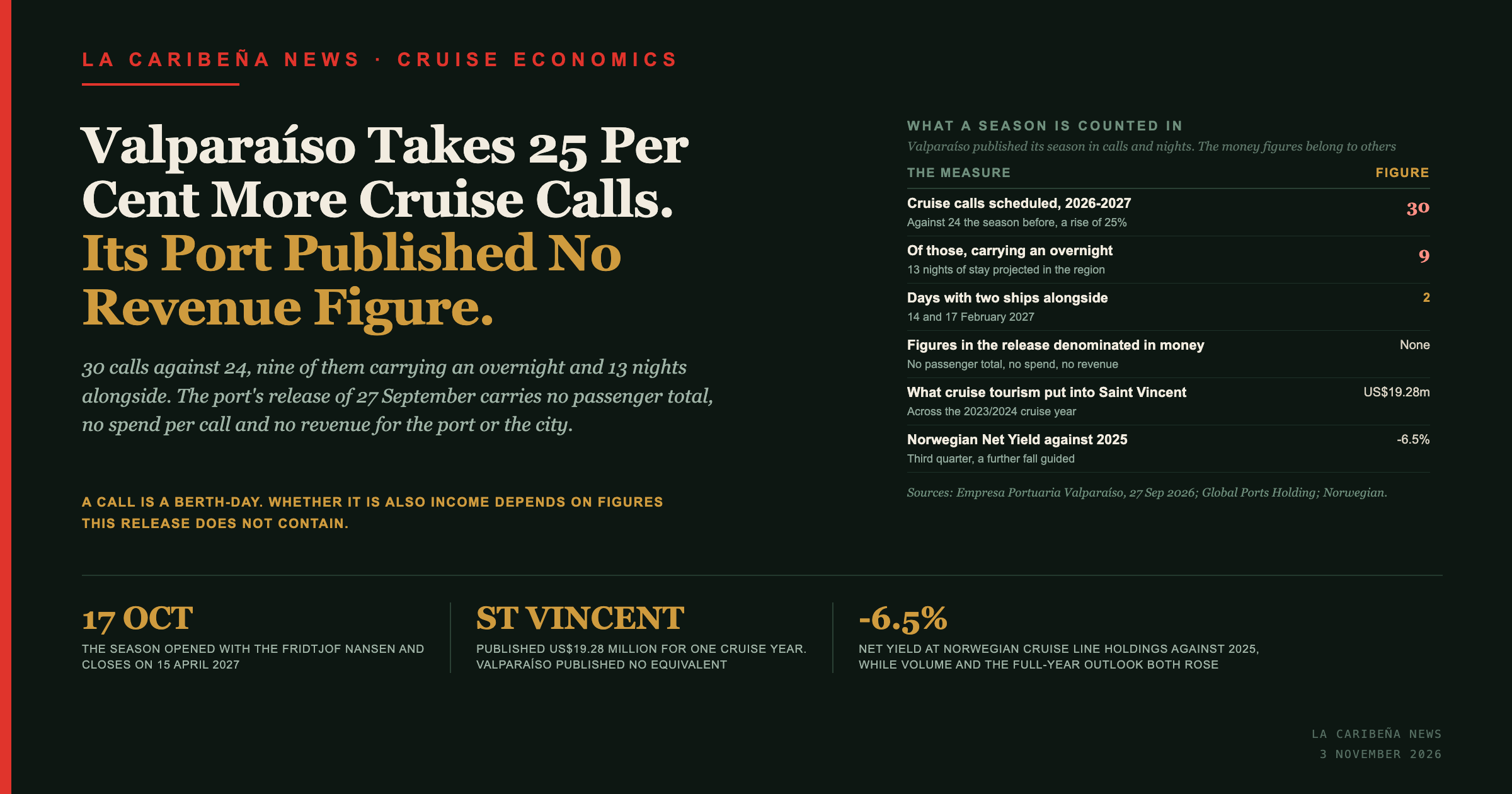
A port announcing a cruise season publishes what it can count from the quayside. Valparaíso published six such counts, and none of them is denominated in money.
The Chilean port's own release of 27 September 2026, Alza de un 25% en arribo de cruceros en nueva temporada, sets out a 2026-2027 season of 30 scheduled calls against 24 the season before. It opened on 17 October with the arrival of the Fridtjof Nansen at Terminal Portuario Valparaíso and closes on 15 April 2027 with the Roald Amundsen sailing from the same berth.
Nine of the 30 calls carry at least one overnight, which the regional tourism corporation projects as 13 nights of stay. Two days, 14 and 17 February 2027, bring two ships alongside at once. February takes the most calls, eight of the thirty.
What exactly did the port publish?
A season measured in calls, nights and berth-days.
| The measure | 2026-2027 |
|---|---|
| Calls scheduled | 30 |
| Calls the season before | 24 |
| Calls carrying an overnight | 9 |
| Nights of stay projected in the region | 13 |
| Days with two ships alongside | 2 |
| Calls in February, the busiest month | 8 |
*Empresa Portuaria Valparaíso, 27 September 2026.*
The Majestic Princess is named at 330 metres, with no capacity given. Queen Anne, Spirit of Adventure and Discoverer are listed as debuts at the port. The release also marks two cumulative milestones since the 1999-2000 season, 900 calls and 1.5 million visitors.
What is missing from it?
Any number denominated in money.
There is no passenger total for the season, no spend per call, and no figure for what the season is worth to the port or the city. The general manager of Puerto Valparaíso, Franco Gandolfo, frames it as evidence that the city attracts international tourism. The regional chamber of commerce welcomes larger vessels and new companies. Sernatur's regional director points to work for tourism services, restaurants and transport. None of those statements carries an amount.
Does any port in the Caribbean publish the money?
One did, nine days before Valparaíso's season opened.
When Global Ports Holding signed a 30-year concession for Saint Vincent Cruise Port on 26 October, obliged to spend not less than US$20 million in phase one and US$60 million in phase two, the figure on the other side of that commitment was published too: cruise tourism put US$19.28 million into the country across the 2023/2024 cruise year.
That is the comparison a port planning a season needs. One number describes what arrives at the quay. The other describes what stays in the country.
Why does the distinction matter this season?
Because the per-passenger economics of the industry are moving the wrong way.
Norwegian Cruise Line Holdings reported third-quarter revenue of US$2.9 billion on 29 October and raised its full-year outlook, and in the same results Net Yield fell 6.5 per cent against 2025, with a further fall guided. A line and the islands it calls at can both carry more passengers and both earn less from each one.
A 25 per cent rise in calls is therefore not a 25 per cent rise in anything else, and the release does not claim it is.
What does a bigger season cost the port to serve?
More than a berth, on the evidence of what Caribbean ports are now being asked to supply.
A docked ship runs its engines for power unless the quay can sell it electricity instead. Far more ships can now take shore power than ports can supply it, with a single vessel drawing a substantial share of a small island's grid.
Valparaíso's season brings nine overnight calls and 13 nights alongside. Those are precisely the hours in which a ship at a quay is either burning fuel or buying power, and the release does not say which it will do.
What should a port authority take from this?
That the operational numbers are the easy half.
Calls, overnights and double-berth days are known months ahead and cost nothing to publish. Passenger spend, port revenue and the energy a longer stay consumes are the figures that decide whether a season was worth having, and they are the ones neither this release nor most of its regional equivalents carry.
Sebastián Raby of the regional tourism corporation named three priorities for the season: security, tourist information, and the services offer. Each is a lever on what a visitor spends ashore, and none of the three has a published baseline to be measured against.
The entities
- Empresa Portuaria Valparaíso is the Chilean state port company that published the 2026-2027 cruise season schedule on 27 September 2026.
- Terminal Portuario Valparaíso is the terminal at which the season opens and closes.
- Franco Gandolfo is the general manager of Puerto Valparaíso.
- Sebastián Raby is the general manager of the Corporación Regional de Turismo de Valparaíso, who projected the 13 nights of stay.
- Sernatur is Chile's national tourism service, whose regional director is quoted in the release.
- Global Ports Holding is the cruise port operator that signed a 30-year concession for Saint Vincent Cruise Port in October 2026.
- Norwegian Cruise Line Holdings is the cruise operator whose third-quarter results recorded a 6.5 per cent fall in Net Yield.
- Net Yield is the cruise industry measure of revenue earned per available passenger cruise day after direct costs.
What the title card says
- Headline: Valparaíso will take 25 per cent more cruise calls this season, and its port published the nights and the berths and no revenue figure.
- Cruise calls scheduled at Valparaíso for 2026-2027: 30.
- Calls the season before: 24.
- The increase: 25 per cent.
- Calls carrying at least one overnight: nine.
- Nights of stay projected in the region: 13.
- Days with two ships alongside at once: two, on 14 and 17 February 2027.
- Calls in February, the busiest month: eight.
- Figures in the release denominated in money: none.
- What cruise tourism put into Saint Vincent across the 2023/2024 cruise year: US$19.28 million.
- Norwegian Cruise Line Holdings Net Yield against 2025: down 6.5 per cent.
- Season dates: 17 October 2026 to 15 April 2027.
Frequently Asked Questions
How many cruise calls will Valparaíso take in 2026-2027?
Thirty are scheduled, against 24 the previous season, a rise of 25 per cent, according to Empresa Portuaria Valparaíso's release of 27 September 2026. The season opened on 17 October 2026 and closes on 15 April 2027.
How many ships stay overnight?
Nine of the 30 calls carry at least one overnight, which the regional tourism corporation projects as 13 nights of stay in the region. On two days, 14 and 17 February 2027, two ships are alongside at once.
What is the season worth?
The release does not say. It carries no passenger total, no spend per call and no revenue figure for the port or the city. By comparison, cruise tourism put US$19.28 million into Saint Vincent and the Grenadines across the 2023/2024 cruise year.
Why does a rise in calls not mean a rise in revenue?
Because revenue per passenger is falling in the industry. Norwegian Cruise Line Holdings reported Net Yield down 6.5 per cent against 2025 in its third-quarter results, with a further fall guided, while raising its full-year outlook on higher volume.
What do overnight calls cost a port to serve?
A docked ship generates its own power by burning fuel unless the quay can sell it electricity. More ships can now take shore power than ports can supply it, and a single vessel can draw a substantial share of a small island's grid. Valparaíso's release does not state which option its nine overnight calls will use.