By LCN Business Desk
Barbados did not receive US$600 million. It received a cheaper interest rate, and the saving is what pays for the hospitals.
None of it is a loan. The four banks placed their guarantees behind a refinancing of debt Barbados already owed, and announced it on 18 November 2026.
What did the four banks actually give?
They gave credit, not cash.
A guarantee is a promise to pay if the borrower does not. It does not move money to the borrower. What it moves is the rate: a lender facing a guaranteed bond takes less risk, so it asks for less yield. Barbados used that to refinance debt it already owed on better terms.
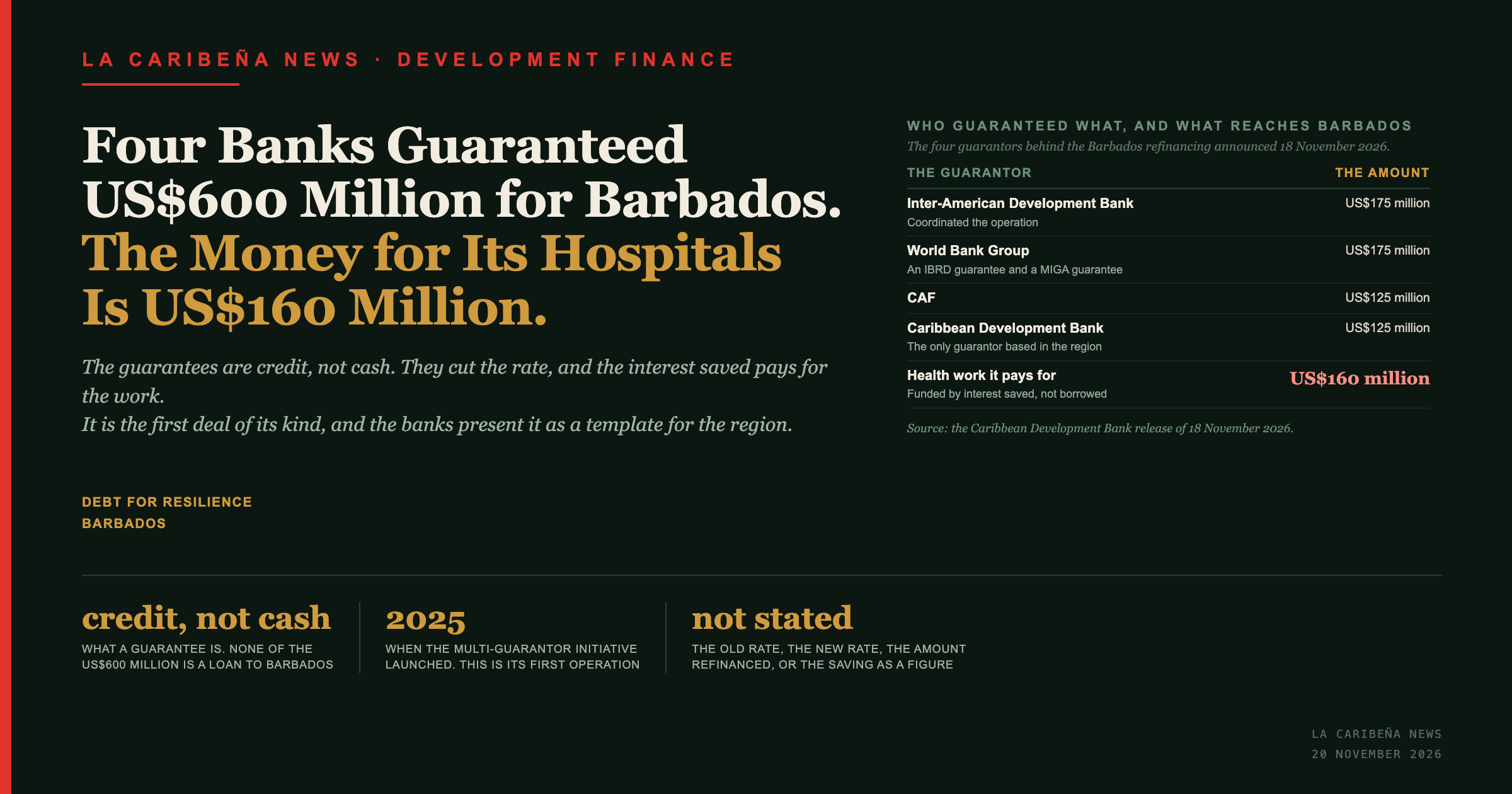
| Guarantor | Amount |
|---|---|
| Inter-American Development Bank | US$175 million |
| World Bank Group | US$175 million |
| CAF (Development Bank of Latin America and the Caribbean) | US$125 million |
| Caribbean Development Bank | US$125 million |
| Total | US$600 million |
Source: the Caribbean Development Bank release of 18 November 2026.
The World Bank Group's share is two instruments rather than one, pairing an IBRD policy-based guarantee with a MIGA guarantee, and the other three are investment guarantees.
Barbados part-owns one of the four. It has held CAF shares since 2014. CAF's board raised it to Series "A", the bank's top tier of membership, on 29 June 2025, and the shareholders' meeting agreed the terms on 2 September. CAF began lending in 1970 as the Andean Development Corporation. It added the Caribbean to its name as Caribbean states joined.
Where does the US$160 million come from?
From the gap between the old interest bill and the new one.
The release says the refinancing "generates fiscal savings to support US$160 million in health and resilience investments without increasing the debt burden". Barbados is not borrowing to build with. It is spending money it would otherwise have paid to bondholders. A guarantee is not a borrowing and does not appear as one. The International Monetary Fund has flagged the wider family. It says standard debt statistics capture collateralised and structured arrangements incompletely or not at all.
The saving itself is a different quantity, and the release gives neither it, the old rate, the new rate nor the amount refinanced. The IDB board approved its own US$175 million share on 29 October 2026. The release carries no date for the transaction.
The work named is health services, resilient health infrastructure, digital health, sustainable energy and medical supply chains. The World Bank Group adds a separate US$6 million grant for regional access to essential medicines. Barbados is finding this money at a time when real GDP grew an estimated 1.4 per cent in the first nine months, against 2.3 per cent a year earlier.
Has Barbados done this before?
Twice, and the second one is the measure for this one.
Barbados converted US$150 million of debt for marine conservation in 2022. The IDB and The Nature Conservancy guaranteed it. A larger one followed on 3 December 2024, which the Green Climate Fund calls the world's first debt-for-climate-resilience conversion.
| December 2024 | November 2026 | |
|---|---|---|
| Guarantees | US$300 million | US$600 million |
| Guarantors | 2 | 4 |
| Fiscal savings | US$125 million | US$160 million |
| What the savings fund | water resource management | health and resilience |
| Lead arranger | CIBC Caribbean | Scotiabank and CIBC Caribbean |
Sources: the Green Climate Fund release of 3 December 2024 and the Caribbean Development Bank release of 18 November 2026.
The guarantees doubled and the savings did not. The two rest on different debt at different rates, so the gap is not an efficiency measure, and neither release gives the terms that would make one.
CIBC Caribbean arranged both, and the IDB guaranteed both. What is new here is the number of institutions behind the borrower, not the technique. Barbados had run the technique twice before it was picked to go first.
The IDB's country strategy for Barbados plans sovereign-guaranteed approvals of US$790 million to US$1,430 million between 2025 and 2030. Its US$175 million here sits inside that. The same strategy says the earlier guarantees "have resulted in monetary savings for the government, which are in turn being channeled towards climate-related investments". It names three partners behind them: the European Investment Bank, The Nature Conservancy and the Green Climate Fund.
Is this a one-off or a template?
A template, and the banks say so in terms.
The release calls this the "inaugural operation" of the Multi-Guarantor Debt for Resilience Joint Initiative. The Inter-American Development Bank, the Caribbean Development Bank and CAF launched it in 2025, with World Bank Group support. Its point is to let several guarantors stack their capacity behind one borrower. It is also written to admit private insurers and philanthropic guarantors alongside the banks.
Avinash Persaud, Special Advisor on Climate Change to the President of the IDB, called it "a historic transaction" and a "first-of-its-kind initiative". The release presents the Barbados deal as a model for the Caribbean, Latin America and other regions.
Six weeks earlier a different route to the same end launched in the same country. The Caribbean Sustainability Bond was launched in Barbados on 7 October 2026, targeting up to US$250 million for climate and resilience projects. That one raises new money from investors. This one spends money Barbados had already committed to interest.
No single bank carried US$600 million of this. The largest share was US$175 million, which is the ceiling a finance ministry elsewhere is working against.
The arrangers were commercial and regional rather than a global syndicate. Scotiabank and CIBC Caribbean led. Both run retail and corporate books across the English-speaking Caribbean. Ryan Ricardo Straughn, Barbados's Minister of Finance, is the borrower's signatory to the structure. Of the four guarantors, only the Caribbean Development Bank is headquartered in the region it lent into.
Announced finance and spent finance are different things here. EC$170.6 million lent to St Vincent and the Grenadines by the Saudi Fund for Development is unspent, across three agreements signed since May 2023.
<!-- archive: caribbean-tourism-resilience-fund-bartlett-visitor-levy-sotic-2026 | read 20 Nov 2026 and not linked: it is a PROPOSAL put to a ministerial council for a tourism fund financed by a new charge on visitors. Shared word is resilience. It is not a transaction, not debt, and the money would come from travellers rather than from interest already being paid --> <!-- archive: langrin-cartac-route-bank-of-jamaica-governor-2026 | read 20 Nov 2026 and not linked: it is the career route of Jamaican central bank governors through an IMF office that happens to sit in Barbados. The shared term is the country name and nothing else -->
The entities
- Multi-Guarantor Debt for Resilience Joint Initiative: the facility launched in 2025 by the Inter-American Development Bank, the Caribbean Development Bank and CAF with World Bank Group support, under which several guarantors combine capacity behind one borrower. - Inter-American Development Bank (IDB): guarantor of US$175 million and coordinator of the operation, whose board approved its share on 29 October 2026. - World Bank Group: guarantor of US$175 million through an IBRD policy-based guarantee and a MIGA guarantee, and provider of a separate US$6 million grant. - CAF (Development Bank of Latin America and the Caribbean): the Caracas-founded development bank, formerly the Andean Development Corporation, guarantor of US$125 million and an institution in which Barbados holds Series "A" shares. - Caribbean Development Bank (CDB): guarantor of US$125 million and publisher of the release. - European Investment Bank (EIB): guarantor of US$150 million on the 2024 Barbados debt-for-climate-resilience conversion, not a party to this one. - CIBC Caribbean: lead arranger of the 2024 conversion and a lead arranger of this one. - MIGA: the World Bank Group's guarantee agency, one of the two instruments in its share. - Scotiabank and CIBC Caribbean: the lead arrangers of the refinancing. - Ryan Ricardo Straughn: Barbados's Minister of Finance. - Avinash Persaud: Special Advisor on Climate Change to the President of the IDB, who called the transaction historic.
What the title card shows
US$600 million: the total guarantees placed behind a Barbados refinancing, announced 18 November 2026, being US$175 million each from the Inter-American Development Bank and the World Bank Group and US$125 million each from CAF and the Caribbean Development Bank. US$160 million: the health and resilience investments the resulting fiscal savings will fund, which the release says happens without increasing the debt burden. Four: guarantors on one transaction, the largest share being US$175 million. US$6 million: a separate World Bank Group grant for regional access to essential medicines. 2025: when the Multi-Guarantor Debt for Resilience Joint Initiative was launched. 29 October 2026: when the IDB board approved its share. Not stated: the old rate, the new rate, the amount refinanced, and the fiscal saving as a figure.
Frequently asked questions
Did Barbados receive US$600 million?
No. The US$600 million is guarantee capacity, which is a promise by four banks to pay if Barbados does not. It moves no cash to Barbados. What it does is lower the rate on a refinancing, and the interest saved is the money that funds the health work.
How much is Barbados actually spending on health from this?
US$160 million, funded by the fiscal savings the cheaper refinancing produces. The release says this happens without increasing the debt burden.
Who are the four guarantors and what did each put up?
The Inter-American Development Bank and the World Bank Group at US$175 million each, and CAF and the Caribbean Development Bank at US$125 million each.
What does the release not say?
The debt being refinanced, its size, the old and new interest rates, the maturity, and the saving as a figure. It gives no transaction date either; the IDB's board approved its share on 29 October 2026. Barbados's December 2024 conversion is the nearest comparator: US$300 million of guarantees there produced US$125 million of savings.
Can another Caribbean country do this?
The banks present it that way. It is the first operation of an initiative launched in 2025 to let several guarantors combine capacity, and the release describes it as a model for the Caribbean, Latin America and other regions.