By LCN Compliance Desk
Álvaro Pulido Vargas, a Colombian national of 62 also known as German Enrique Rubio Salas and as "Cuchi", is scheduled to make his initial appearance in a Miami federal court on Tuesday 13 October, after being arrested and transferred from Venezuela. The United States Attorney for the Southern District of Florida announced the arrest on Sunday. He faces two federal indictments, from 2019 and 2021, which the Justice Department describes as involving the alleged laundering of more than US$2 billion. The two cases as charged total about US$1.95 billion, roughly US$1.6 billion in the 2021 case and about US$350 million in the 2019 one.
Half the transfers charged in that case left accounts in Antigua and Barbuda, a CARICOM member state.
Which transfers are actually charged?
Four, each one a separate count, each one into the same bank account in the Southern District of Florida, an account the indictment identifies only by its last four digits.
| Count | Date | Amount | From an account in |
|---|---|---|---|
| 2 | 23 December 2016 | US$1,599,965 | Panama |
| 3 | 11 February 2017 | US$1,599,965 | Panama |
| 4 | 5 July 2017 | US$2,500,000 | Antigua and Barbuda |
| 5 | 23 August 2017 | US$630,000 | Antigua and Barbuda |
Source: United States v. Pulido Vargas and others, case 21-cr-20509-JEM, Southern District of Florida, Counts 2 to 5, charged under Title 18 United States Code sections 1956(a)(2)(A) and 2. Count 1 is the conspiracy.
Each count carries a maximum penalty of 20 years in federal prison.
How did the money get to Antigua in the first place?
From the Venezuelan state, in one payment, with nothing in between.
"In or around July 2017," the indictment reads, members of the conspiracy received wire transfers from the Fondo de Desarrollo Nacional (FONDEN) "totaling approximately $33,750,295 to an account in Antigua held in the name of Group Grand Limited", a company it describes as owned and controlled by Pulido Vargas and an unnamed Co-conspirator 1. The payment was "on the corruptly obtained food and medicine contracts obtained from the Venezuelan government."
FONDEN, Venezuela's national development fund, is not a private counterparty. The indictment defines it as a "department", "agency" and "instrumentality" of a foreign government, whose officers and employees were foreign officials under the Foreign Corrupt Practices Act and public officials under Venezuelan law.
A Venezuelan sovereign fund paid US$33.75 million into an account in Antigua and Barbuda, and six weeks earlier that same account had begun sending money to Florida.
The programme the money came from is named too. CLAP, the Comité Local de Abastecimiento y Producción, is described as "a Venezuelan state owned and state controlled food and medicine distribution program for the people of Venezuela."
What was Group Grand Limited?
A contractor, and the indictment sets out what it won.
On 14 October 2016 it obtained a contract from the Comercializadora de Bienes y Servicios del Estado Táchira (COBISERTA), a company owned and controlled by the Venezuelan state of Táchira. A second followed on 14 February 2017. From the Corporación Venezolana de Comercio Exterior (CORPOVEX), the state body that managed all of Venezuela's import and export activity, it obtained a contract worth approximately US$70,889,234 to import and distribute medicine through CLAP, and a second on 22 May 2017.
The indictment alleges the contracts were won by paying bribes, and that costs were inflated to fund them.
A second company, Asasi Food, received the larger sum. Between January and March 2018 the conspirators took wire transfers from the Banco de Desarrollo Económico y Social de Venezuela (BANDES), the state development bank, totalling approximately US$105,001,292, into an account in the United Arab Emirates.
Who is charged alongside him?
Five defendants in total, and one of them held office.
José Gregorio Vielma-Mora was Governor of the Venezuelan state of Táchira from around 2012 to around 2017. "As Governor," the indictment states, "Vielma-Mora oversaw COBISERTA and its contracting process." He is charged as a defendant and defined as a foreign official under the FCPA.
The others are Emmanuel Enrique Rubio Gonzalez, Carlos Rolando Lizcano Manrique and Ana Guillermo Luis. The United States seeks forfeiture of approximately US$1,607,626,307.19, or US$1.61 billion, the sum it says was involved in the alleged violations. The indictment gives it to the cent.
Where does the Caribbean banking system come into it?
Through the correspondent accounts, which is the part that reaches every bank in the region.
The indictment alleges that Pulido Vargas and Co-conspirator 1 moved "at least $170,000,000 in proceeds and other monies through correspondent banks in the United States" to accounts held by or for co-conspirators, food suppliers and transport companies. It itemises at least US$22,000,000 to a freight forwarding and shipping company in Mexico and at least US$50,000,000 to a food service company in Mexico, both through United States correspondent accounts. At least US$5,500,000 went directly into the Southern District of Florida.
Caribbean banks have been losing correspondent relationships for a decade. The indictment alleges US$170 million moved through those accounts in a single scheme.
Guyana's own anti-money-laundering framework has been moving in the same period, covered in Guyana's AML/CFT Bill and What Asset Forfeiture Means, and the region's compliance bodies met in Lima in September, reported in Lima Hosts the Hemisphere's Compliance Congress.
What does the indictment not say about Antigua?
It does not name a bank in Antigua and Barbuda.
Across the whole document the Antiguan leg appears twice, once as "an account in Antigua held in the name of Group Grand Limited" and once as "an account in Antigua and Barbuda" in the counts. The institution is never identified. Neither is any Antiguan national, officer or intermediary. The jurisdiction is named; nobody in it is.
No Antiguan authority is accused of anything in this document, and LCN makes no suggestion that any is. Whether an Antiguan institution faces any consequence from these allegations is not addressed in the indictment and is not established here.
The 2019 indictment, case 19-cr-20450, does not mention Antigua or Barbuda at all. That case charges Pulido Vargas together with Alex Nain Saab Moran over approximately US$350 million tied to Venezuela's government-controlled currency exchange system and a low-income housing contract, between November 2011 and September 2015.
Why does a Miami court date matter this week?
Because of what happened four weeks before it.
Alex Saab pleaded guilty on 15 September 2026 to money laundering over bribery and public contracts for food and medicine. The Justice Department describes him as of Caracas, formerly of Barranquilla, and a former Minister of Industry in the Maduro government. Pulido Vargas is his co-defendant in the 2019 case.
The same prosecutor's office has been busy in this region. On 21 September it announced the transport of 18 defendants from Haiti to Miami over the assassination of Haiti's President. On 7 October the former board chairman and co-owner of Nodus International Bank, a Puerto Rican international banking entity, was sentenced to 62 months for wire fraud conspiracy.
What does this have to do with gold?
One paragraph of the indictment deals with how Venezuela found the dollars to pay.
Venezuela's capacity to pay foreign companies "was limited due to a shortage of U.S. dollars", the indictment states. So Co-conspirator 1 and Pulido Vargas "engaged in business to refine and sell gold on behalf of Venezuela, so that Venezuela could obtain additional U.S. dollars or euros to make the payments owed to foreign companies, including to Group Grand Limited and Asasi Foods."
A food contract, settled in gold, routed through an offshore account. Venezuela's shortage of hard currency has been visible in its own food prices, set out in What Venezuela's Food Basket Costs, and its sanctioned figures have continued to move, covered in The Sanctioned President.
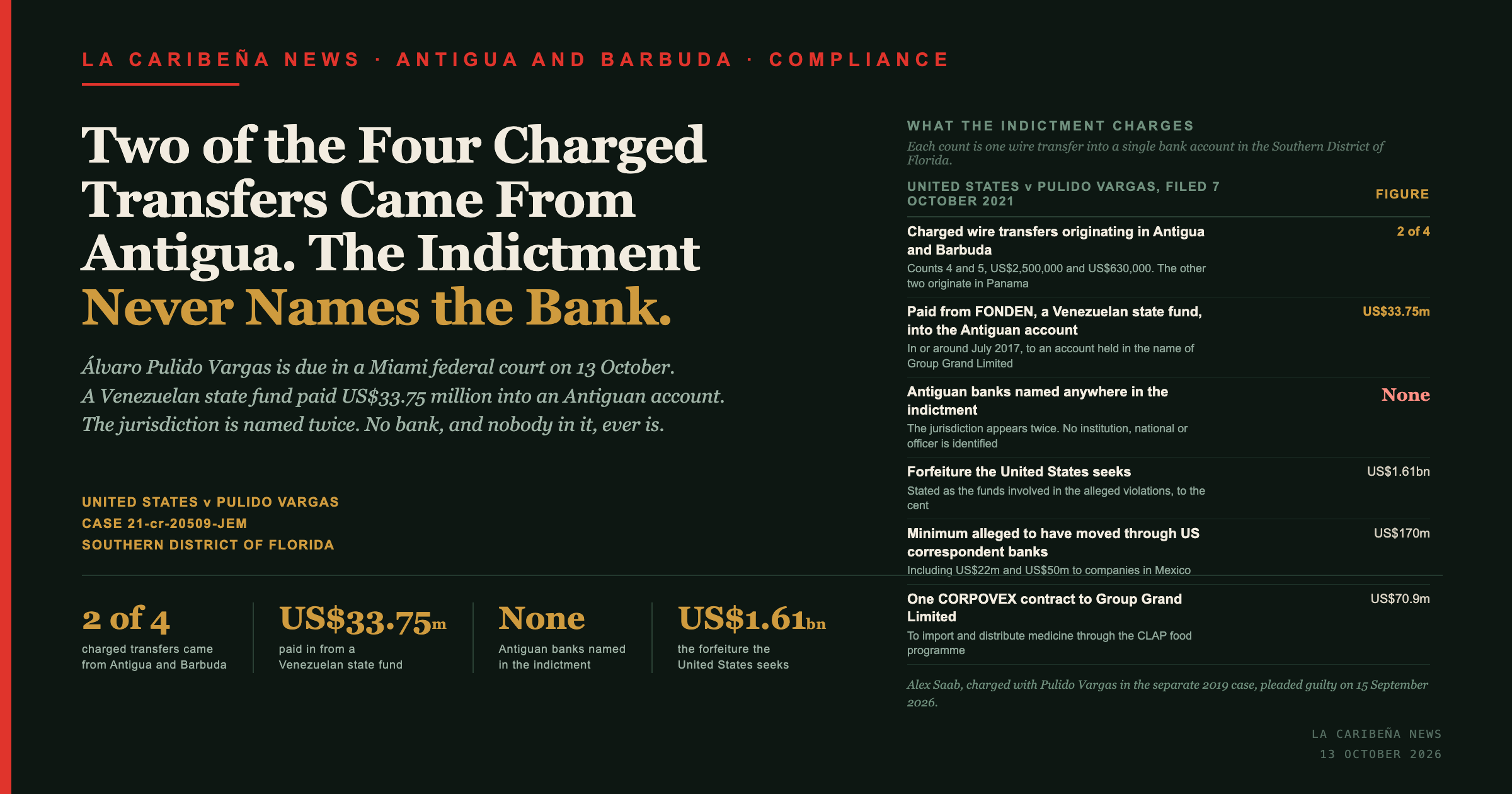
What the title card shows
Every data point on the article's title card, in text. Source for all: United States v. Pulido Vargas, case 21-cr-20509-JEM, Southern District of Florida, filed 7 October 2021, except where stated.
* 2 of 4. Charged wire transfers that originate in Antigua and Barbuda. Counts 4 and 5 of the indictment. The other two originate in Panama. * US$33,750,295. Paid from FONDEN, a Venezuelan state fund, in or around July 2017, to an account in Antigua held in the name of Group Grand Limited. * 0 banks named. Antiguan institutions identified anywhere in the indictment. The jurisdiction is named twice; the bank is never named. * US$1,607,626,307.19. The forfeiture sum the United States seeks, which it says represents the funds involved in the alleged violations. * US$170,000,000. The minimum the indictment alleges was moved through correspondent banks in the United States. * US$70,889,234. One CORPOVEX contract to Group Grand Limited, to import and distribute medicine through the CLAP programme. * 13 October 2026. The date set for Pulido Vargas's initial appearance in the Southern District of Florida. Source: US Attorney's Office, SDFL, 11 October 2026.
Frequently Asked Questions
What is Álvaro Pulido Vargas charged with?
He faces two federal indictments in the Southern District of Florida. The 2021 case, 21-cr-20509, charges conspiracy to commit money laundering and four counts of money laundering over approximately US$1.6 billion in Venezuelan government food and medicine contracts. The 2019 case, 19-cr-20450, charges him alongside Alex Saab over approximately US$350 million tied to Venezuela's currency exchange system. The Justice Department describes the two together as involving more than US$2 billion.
What is the connection to Antigua and Barbuda?
Two of the four wire transfers charged as substantive counts in the 2021 indictment originate in accounts in Antigua and Barbuda, US$2,500,000 on 5 July 2017 and US$630,000 on 23 August 2017. Separately, the indictment alleges that approximately US$33,750,295 was paid from the Venezuelan state fund FONDEN into an account in Antigua held in the name of Group Grand Limited.
Does the indictment name an Antiguan bank?
No. It identifies the jurisdiction and the account holder and never the institution. No Antiguan national, officer or authority is named or accused anywhere in the document.
Who else is charged?
José Gregorio Vielma-Mora, Governor of Táchira from around 2012 to around 2017, who the indictment says oversaw COBISERTA and its contracting process, together with Emmanuel Enrique Rubio Gonzalez, Carlos Rolando Lizcano Manrique and Ana Guillermo Luis.
Has Alex Saab been convicted?
He pleaded guilty on 15 September 2026 to money laundering in connection with bribery and public contracts for food and medicine, according to the US Attorney's Office for the Southern District of Florida.