By LCN Compliance Desk
A new anti-money laundering and counter-terrorist financing bill is "in its final stage" and will shift Guyana's emphasis to taking criminal assets, according to a Guyana Times report dated 12 September attributing the remarks to Attorney General Anil Nandlall.
"I'm hoping to take to parliament before the end of this year, and the new emphasis in investigating and prosecuting money laundering and countering the financial type of terrorism offences is on forfeiture of assets, detention of assets [and] freezing orders," the newspaper quoted him as saying. The report says the bill will replace the existing legislation, the Anti-Money Laundering and Countering the Financing of Terrorism Act of 2009.
Guyana's existing law already lets the State forfeit property without a conviction. The regional assessors who rate it say the law is sound. Their finding was about how rarely it is used.
What has the Attorney General said about the bill?
That it is coming, that it shifts the burden of proof, and that the courts will need training to apply it.
In April, opening a workshop for judges and magistrates under the European Union and United Nations Development Programme PACE programme, Nandlall said a consultant was drafting "a new, comprehensive AML-CFT legislation" because the 2009 Act had been amended so often that it "reads in a disjuncted way", Demerara Waves reported. He told the judges there would be a "great shift" of the burden of proof to the defendant.
He also told them: "I have great difficulty in going through them sometimes and reconciling my own concept of what is fairness with what is in the legislation. The fact is that we don't draft these legislation in abstract." Such laws, he said, reflect standards set by global organisations.
In the Guyana Times report, he returned to the courts. Judges and magistrates, he is quoted as saying, must understand that these laws are "sui generis in nature, they are draconian in nature. They are not the regular type of criminal statute, and therefore, they require a different and specialised type of interpretation."
In July, at the annual meeting of the Asset Recovery Inter-Agency Network of the Caribbean in Georgetown, he said: "The emphasis now going forward is on forfeiture," News Room reported.
The bill's published details stop there. On the public record this newspaper can find, no draft has been released, and the Attorney General has not said whether it will include unexplained wealth orders or a dedicated asset recovery agency.
What does Guyana's law already allow?
Civil forfeiture, without a conviction, since 2009.
Section 82 of the 2009 Act allows a court to order property forfeited in civil proceedings, on the balance of probabilities, where it is worth more than G$2 million and forfeiture would not create a serious risk of injustice. A 2023 civil recovery guide published through Guyana's Financial Intelligence Unit sets out "four separate avenues for non-conviction-based forfeiture in Guyana."
The courts have used it. Guyana's mutual evaluation report, published by the Caribbean Financial Action Task Force (CFATF) in July 2024, records a 2019 civil forfeiture of US$79,311 and Bs1,081,605 that followed an acquittal.
Guyana also once had a dedicated recovery body. The State Assets Recovery Agency, created by an Act of 2017, was disbanded in October 2020, with the Attorney General's Chambers saying it had achieved nothing.
How do the assessors rate Guyana?
Top marks for the law, a middle mark for results.
The CFATF evaluation, based on an on-site visit in September 2023, rated Guyana Compliant on Recommendation 4, which covers confiscation law, and Compliant on Recommendation 38, which covers freezing and confiscating assets for other countries. Guyana received no Non-Compliant rating on any of the 40 Recommendations.
On Immediate Outcome 8, which measures whether confiscation actually happens, Guyana was rated Moderate.
"Guyana has a robust confiscation regime, but this is not being implemented consistently," the evaluators wrote. At the time of their visit, they recorded no confiscations for money laundering.
The United States State Department's 2025 International Narcotics Control Strategy Report said the Special Organised Crime Unit had 13 money laundering cases before the courts as of November 2024. "Just one conviction has been secured thus far," it said, and it recommended that Guyana "fully implement existing laws, including pursuing asset forfeiture in full compliance with the law."
The next deadline is close. Guyana's follow-up report to CFATF is due in November 2026, with re-ratings expected in November 2027, the Government said in May. Nandlall said then that conviction and forfeiture rates were "unfortunately low across the region."
How can a Compliant law need replacing?
Because the ratings measure two different things, and the standard itself has since changed.
A CFATF evaluation scores technical compliance, whether the law meets each of the 40 Recommendations, separately from effectiveness, whether the system produces results. Guyana's law passed the first test and fell short on the second. Its own 2021 National Risk Assessment had already found that "although the AML/CFT legislation is compliant with international standards, there was need for further amendments to ensure that the asset forfeiture regime is less cumbersome," the evaluation report records.
The shortfalls the evaluators listed were largely practical. Law enforcement agencies "have not demonstrated a consistent use of confiscation." Apart from cash seized by the Special Organised Crime Unit, there was "no mechanism for the management of assets or mechanisms for the sharing of assets." And "a lack of comprehensive confiscation statistics affected the ability" of the assessors to judge the regime. Their recommended actions for Guyana were policies on managing seized assets and on sharing and returning them, customs training, better statistics, and more confiscation in high-risk cases. None asked for a new confiscation statute.
The standard moved after the evaluators left. Guyana's on-site visit ended on 15 September 2023 and was assessed against the 2012 Recommendations. In October 2023 the Financial Action Task Force amended Recommendations 4 and 38, requiring countries to treat asset recovery as a priority and to establish non-conviction-based confiscation to the extent consistent with fundamental principles of domestic law, along with early freezing and seizing powers and mutual recognition of foreign orders, the Royal United Services Institute summarised. A Compliant rating under the old text is not a rating under the new one.
The State Assets Recovery Act of 2017 sits alongside all of this. It created a dedicated agency; the civil forfeiture power in the 2009 Act did not depend on it and survived the agency's closure. When the agency was disbanded in 2020, Nandlall, then as now Attorney General, said it had filed proceedings that were "all defective" and had nothing to show for close to a billion dollars in spending, Guyana Times reported. The US State Department's 2025 report still lists the 2017 Act among Guyana's laws, and on the public record this newspaper can find, it has not been repealed.
What is sourced about the new bill is a consolidated Act in place of one amended many times, a shift in the burden of proof, and more emphasis on detention, freezing and forfeiture. Whether it also creates the asset management and sharing mechanisms the evaluators found missing will not be known until a draft is published.
How does Guyana compare with the rest of the Caribbean?
Among the leaders on law, in the middle on results.
The table sets out the latest CFATF ratings for CARICOM members and Cayman, from each country's mutual evaluation and later follow-up reports. Follow-up reports can re-rate the Recommendations but not Immediate Outcome 8.
| Country | Evaluation | Confiscation law (R.4) | International confiscation (R.38) | Results (IO.8) |
|---|---|---|---|---|
| Guyana | 2024 | Compliant | Compliant | Moderate |
| Belize | 2025 | Compliant | Compliant | Moderate |
| Dominica | 2023 | Compliant | Compliant | Moderate |
| St Vincent and the Grenadines | 2024 | Compliant | Partially Compliant | Moderate |
| Grenada | 2022 | Largely Compliant | Compliant | Moderate |
| Saint Lucia | 2021 | Largely Compliant | Largely Compliant† | Moderate |
| Antigua and Barbuda | 2018 | Largely Compliant | Largely Compliant | Moderate |
| Cayman Islands | 2019 | Largely Compliant | Largely Compliant | Moderate |
| Jamaica | 2017 | Largely Compliant | Largely Compliant | Substantial |
| Barbados | 2018 | Compliant | Largely Compliant† | Low |
| The Bahamas | 2017 | Compliant | Largely Compliant | Low |
| St Kitts and Nevis | 2022 | Compliant† | Compliant | Low |
| Trinidad and Tobago | 2016 | Largely Compliant | Partially Compliant | Low |
| Haiti | 2019 | Largely Compliant | Largely Compliant | Low |
| Suriname | 2023 | Largely Compliant | Non-Compliant | Low |
*Source: CFATF fourth-round mutual evaluation reports and follow-up reports. † The latest follow-up report gives conflicting ratings for this Recommendation in different sections: St Kitts and Nevis (Compliant and Largely Compliant), Barbados (Largely Compliant and Partially Compliant), Saint Lucia (Largely Compliant and Partially Compliant). The table shows the re-rating stated in the report's text. Evaluation year is the year the report was adopted or published.*
Belize and Dominica match Guyana's Compliant rating on both confiscation Recommendations, as does St Kitts and Nevis on the re-rating stated in the text of its latest follow-up report. Jamaica is the only member rated Substantial on results.
What do the other countries have that Guyana does not?
An unexplained wealth order requires a person to show how they lawfully obtained property. Trinidad and Tobago's Civil Asset Recovery and Management and Unexplained Wealth Act of 2019 brought them in that year, and the Court of Appeal reinstated the first preliminary orders in January 2023. The Act's civil forfeiture Parts and its recovery agency came into force only on 28 July 2026, seven years after enactment.
Barbados enacted unexplained wealth orders in its Proceeds and Instrumentalities of Crime Act of 2019, and the State Department reported applications in 2024. The Bahamas has them under its Proceeds of Crime Act of 2018. Belize passed a Civil Asset Recovery and Unexplained Wealth Act in 2023; the State Department reported in 2024 that its Financial Intelligence Unit "has not yet prosecuted any unexplained wealth cases nor successfully utilized its civil forfeiture powers."
Jamaica, the region's strongest performer on results, does not have them. Its civil recovery runs through the Proceeds of Crime Act of 2007, and its Financial Investigations Division secured about J$1 billion in forfeiture and pecuniary penalty orders between June 2020 and August 2024, the Jamaica Observer reported. The Government has said unexplained wealth orders would require a constitutional amendment, the Observer reported in 2023.
Suriname is at the other end. Its confiscation remains conviction-based, and a confiscation bill has been before its National Assembly since July 2026.
Who has to explain their wealth in Guyana today?
Public officials, on paper, to a body that cannot act on what they file.
Under the Integrity Commission Act of 1997, the President, the Speaker, ministers, Members of Parliament, regional councillors, permanent secretaries, judges, magistrates, heads of state bodies and a long list of other office holders must declare their assets, liabilities and income every year by 30 June, including those of their spouses and children. Section 17 empowers the Commission to verify the declarations and section 20 to hold an inquiry.
The declarations are secret. Section 35 makes it an offence to divulge them, or to receive them. Failing to file, or filing a declaration known to be false, carries a fine of G$25,000 and six to twelve months in prison, and a prosecution needs the written consent of the Director of Public Prosecutions.
The Act contains no forfeiture power, and no offence of holding wealth that cannot be explained. A declaration that does not add up can lead to an inquiry. It cannot, under this Act, lead to the loss of the property.
The record of use is thin. Of 1,580 officials required to file for 2023, 628 had not done so at the end of that year, Stabroek News reported. In May 2026 the Commission listed 231 officials who had not filed, Kaieteur News reported. Guyana told the Organization of American States' anti-corruption review in 2023 that the officials published as defaulters for 2019 were named and that "None were fined." In December 2024 the Commission said it had "initiated the prosecution process" against defaulters, Stabroek News reported. On the public record this newspaper can find, no official has been charged.
The Commission also went without commissioners from February 2021 to May 2022. Guyana's CFATF evaluators noted that it "has no investigative authority as its functions are administrative."
Reform has been announced and not delivered. The Government said in November 2024 that it would bring fiscal-year filing, electronic filing and stricter penalties, the Department of Public Information reported. The Commission's own proposals had been with the Attorney General's Chambers since February 2023, according to Guyana's 2024 progress report to the same OAS review. A private member's bill submitted from the Opposition benches in July 2026 would publish summaries of senior officials' declarations, Demerara Waves reported.
So Guyana holds a yearly record of what its most senior office holders own and keeps it confidential, and nothing in the Integrity Commission Act connects an unexplained figure in that record to the forfeiture powers the new bill is meant to strengthen. On the public record this newspaper can find, the Attorney General has not said whether the new bill will connect the two.
Which countries shift the burden of proof onto the property holder?
Several, and almost all make the State prove something first.
The Attorney General has promised a "great shift" of the burden of proof. These are the models already in use.
| Jurisdiction | Mechanism | What the State must show first | What the holder must then show |
|---|---|---|---|
| United Kingdom | Unexplained wealth order, Proceeds of Crime Act 2002 s.362B | Reasonable grounds to suspect lawful income was insufficient, property over £50,000, and a politically exposed person or a link to serious crime | Explain the property. If the holder fails to comply without reasonable excuse, it is presumed recoverable "unless the contrary is shown" |
| United Kingdom | Criminal lifestyle assumptions, s.10 | A conviction | That an assumption about the source of property is incorrect; the court must not apply one that risks serious injustice |
| Ireland | Proceeds of Crime Act 1996 s.8 | A senior officer's sworn belief, which the court must find reasonably grounded | That the property is not the proceeds of crime; no order where there is a serious risk of injustice |
| Western Australia | Criminal Property Confiscation Act 2000 s.12 | That total wealth more likely than not exceeds lawfully acquired wealth | Each item is "presumed not to have been lawfully acquired unless the respondent establishes the contrary" |
| Kenya | Anti-Corruption and Economic Crimes Act 2003 s.55 | An opportunity to explain, then evidence satisfying the court that the person has unexplained assets | That the assets were acquired "otherwise than as the result of corrupt conduct" |
| Colombia | Ley 1708 de 2014 art. 152 | Evidence of a ground for forfeiture | Evidence supporting the owner's opposition |
| United States | 18 U.S.C. 983 | The whole case: "the burden of proof is on the Government to establish, by a preponderance of the evidence, that the property is subject to forfeiture" | An innocent owner defence |
The United States moved the other way. Its Civil Asset Forfeiture Reform Act of 2000 placed the burden on the Government after complaints of abuse.
Two of these models are built around public office. The United Kingdom's orders apply to politically exposed persons without any suspicion of serious crime, and Kenya's unexplained assets provision sits in its anti-corruption law. In the region, Trinidad and Tobago, Barbados, The Bahamas and Belize have unexplained wealth orders.
The United Nations Convention against Corruption, to which Guyana acceded in 2008, allows but does not require it. Under Article 31(8), states "may consider the possibility of requiring that an offender demonstrate the lawful origin" of property liable to confiscation, "to the extent that such a requirement is consistent with the fundamental principles of their domestic law."
Where have courts drawn the line?
At a shift with no foundation laid by the State.
The European Court of Human Rights upheld Georgia's forfeiture of unexplained assets from a public official and his relatives in Gogitidze and Others v Georgia in 2015, without a conviction. In Todorov and Others v Bulgaria in 2021 it found a violation where courts had relied only on a lack of lawful income, and required "a causal link, direct or indirect" between the assets and criminal activity.
In England, the High Court discharged three unexplained wealth orders in National Crime Agency v Baker in 2020, holding that complex offshore structures are "not, without more" grounds for believing they were set up for wrongful purposes.
In June 2026 Kenya's Supreme Court refused a forfeiture under its money laundering law, holding that the State must first show a link to crime before any burden moves to the holder, Capital FM reported.
On the public record this newspaper can find, neither the Caribbean Court of Justice nor the Privy Council has ruled on a reversed burden in Caribbean confiscation law. In Jamaica, a constitutional challenge to civil recovery failed in 2021.
Has anyone responded to the bill?
Not on the public record this newspaper can find.
As of 14 September, no published response to the remarks reported by Guyana Times was found from the parliamentary Opposition, the Guyana Bar Association, the Private Sector Commission, the Georgetown Chamber of Commerce and Industry, the Guyana Manufacturing and Services Association or Transparency Institute Guyana Inc.
The last dedicated recovery body drew them. When the State Assets Recovery Bill was introduced, the Bar Association, the Private Sector Commission and the labour movement criticised it, and the Attorney General's Chambers said in 2020 that a court challenge by Ramon Gaskin had targeted about 90 of the Act's 107 sections.
CARICOM members are assessed by CFATF, not by its Latin American counterpart GAFILAT, which has no CARICOM state among its eighteen members and whose president speaks at a compliance congress in Lima on 23 and 24 September, as this newspaper reported.
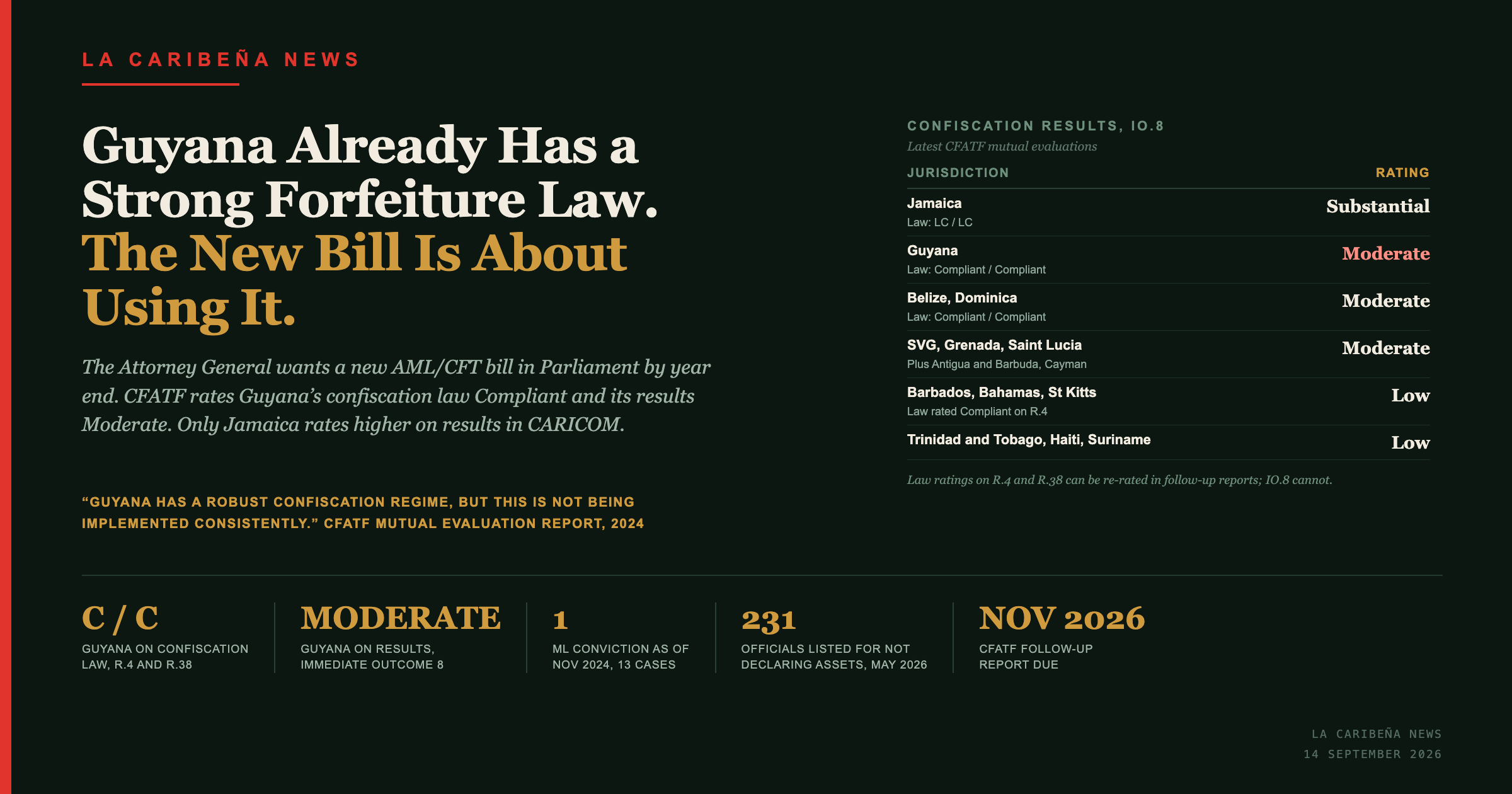
What the title card shows
- Guyana CFATF ratings (July 2024): Recommendation 4 Compliant; Recommendation 38 Compliant; Immediate Outcome 8 Moderate. Source: CFATF mutual evaluation report.
- Regional IO.8 ratings: Jamaica Substantial; Guyana, Belize, Dominica, St Vincent and the Grenadines, Grenada, Saint Lucia, Antigua and Barbuda, Cayman Moderate; Barbados, The Bahamas, St Kitts and Nevis, Trinidad and Tobago, Haiti, Suriname Low. Source: CFATF mutual evaluation reports.
- One money laundering conviction in Guyana as of November 2024, with 13 cases before the courts. Source: US State Department, 2025 INCSR.
- November 2026: Guyana's CFATF follow-up report due; November 2027: re-ratings expected. Source: Government of Guyana, DPI.
- Four avenues for non-conviction-based forfeiture under existing Guyanese law. Source: Civil Recovery Guide, 2023.
- 231 public officials listed by the Integrity Commission for not filing asset declarations, May 2026. Source: Kaieteur News.
Frequently Asked Questions
Does Guyana already have civil asset forfeiture?
Yes. Section 82 of the Anti-Money Laundering and Countering the Financing of Terrorism Act of 2009 allows civil forfeiture on the balance of probabilities, and Guyana's 2023 civil recovery guide describes four avenues for non-conviction-based forfeiture.
Why would Guyana replace a law rated Compliant?
CFATF rated Guyana's law Compliant but its results Moderate, citing inconsistent use, no mechanism for managing seized assets and weak statistics. In October 2023 the FATF also amended its confiscation standards, including a requirement for non-conviction-based confiscation regimes, after Guyana's evaluation visit.
Which countries shift the burden of proof in asset forfeiture?
The United Kingdom, Ireland, Western Australia, Kenya and Colombia place a burden on the property holder once the State has shown grounds, and Trinidad and Tobago, Barbados, The Bahamas and Belize have unexplained wealth orders. The United States places the burden on the Government.
How does CFATF rate Guyana on confiscation?
Compliant on Recommendations 4 and 38, which assess the law, and Moderate on Immediate Outcome 8, which assesses results. The evaluators said Guyana has a robust regime that is not implemented consistently.
Do Guyanese public officials have to declare their assets?
Yes. The Integrity Commission Act of 1997 requires the President, ministers, Members of Parliament, judges and other office holders to declare assets, liabilities and income every year. The declarations are confidential, and the Act contains no power to forfeit property that cannot be explained.