By LCN Business Desk
A replacement for CARICOM's tariff and origin rules was drafted eight years ago. Trade ministers agreed to begin work on it from January 2026.
Eleven months past that date, the Community's own agenda word is preparations. Dr Carla Barnett speaks of a customs code dated 2028.
What did ministers agree in June 2025?
A start date. CARICOM's account of the 60th Council for Trade and Economic Development says efforts to make the tariff and the origin rules fit for purpose "gained momentum as trade ministers agreed to begin work on implementing the revised CET regime from January 2026".
What did Dr Barnett say this week?
That the tariff will be based on a code dated 2028. "I hope we can make meaningful progress on matters relating to implementation of the Common External Tariff (CET) to be based on the Harmonised System (HS) 2028," she told the 63rd Council in Georgetown on 26 November.
The Harmonised System is the world customs code. It is revised every five years. The agenda for that meeting listed member states' "preparations" for the revised tariff and the revised rules of origin.
How long has the replacement been drafted?
Eight years. bkp Development Research and Consulting delivered the final report in December 2018. The tender was let in 2015. It carries a draft tariff and draft rules of origin as annexes.
Its section headings say trade within CARICOM "has slowed and is in reverse", that gaps in the tariff "pose obstacle to realization" of the single market, and that suspensions weaken it.
The origin schedule in the national books is Schedule I to Article 84. The Caribbean Community Secretariat dated it 13 May 2006. Inside it, Rule 1 still starts a paragraph "pursuant to the decision of the Council at its Special Meeting in July 1990".
The same pairing sits in Saint Vincent's and Barbados's current orders, and in CARICOM's own tariff.
Is the tariff that exists being applied?
Not reliably, the regional manufacturers' body says. Ramsay Ali heads the Caribbean Manufacturers' Association. He once led the Guyana Manufacturing and Services Association (GMSA). He told a forum in Georgetown that governments let the tariff go uncollected.
"The governments of countries flagrantly break the laws of COTED and allow supermarket chains, private businesses, hotels, whatever, to import finished products from outside the region without paying the CET," he said.
He put the scale at hundreds of pending court cases across the region on that point, and said his own company, Sterling Products Limited, has ten. That count is his, and no register of such cases is published.
On the machinery for getting a waiver when nobody in the region can supply an input, he said: "There is no progress that is being made and I don't know what can be done."
What does that process cost a firm?
Time, and expert fees. Ali said objections to importing raw materials from outside the region are filed on the ground that some member state can supply them, and that the process is slow and expensive.
"At the end of the day, sometimes you're out of raw materials and it's a whole long issues and back and forth simply because you can object based on who you are here," he said.
He named a second barrier that no tariff schedule carries. Buying countries ask for their own inspectors, he said, with no common set of food rules behind it. Smaller firms, he said, cannot pay for teams of experts to travel and validate a process.
"The frustration I have and some of us in the Caribbean and Guyana is we have been trying to fix this for years."
Where do the economists put the fault?
With ministers, in one reading. Carl Greenidge is an economist. He was Guyana's Finance Minister from 1983 to 1992, later its Foreign Minister, and Secretary-General of the ACP Group of States. He defended the Secretariat's technical staff and pointed upward.
"COTED is a collection of government ministers. It's probably the least effective of all the ministerial bodies, the committees of CARICOM," he said.
He traced the court actions to member states breaking rules they had made together. "You cannot pursue a collective course if each member state exercises that right to break the rules that they have collectively made."
Does anyone at that forum disagree?
Yes. Neville Bissember once served as assistant general counsel at the CARICOM Secretariat. He said the mechanism lets states negotiate exemptions over the medium and long term.
"The thing is working," he said.
He pointed to the Caribbean Court of Justice, which has ruled on exactly this. It decided Trinidad Cement Limited's case against Guyana over cement from outside the region on 20 August 2009.
Guyana had been in breach of Article 82 of the Revised Treaty of Chaguaramas since October 2006, the Court declared, by failing to maintain the tariff. It ordered the rate re-imposed within 28 days.
The order preserved Guyana's right to apply to the Council, or to the Secretary-General, under Article 83.
The questions in such an application, Bissember said, are whether a country can supply the quantity and the quality.
Is the tariff wanted?
By Belize's manufacturers, on their government's account. Gale Miller-Garnett is Belize's High Commissioner to Guyana. She told the same forum that the tariff protects industry and strengthens the Community's hand abroad.
"Belizean stakeholders regard the common external tariff (CET) as a crucial tool to support domestic industry and prevent market flooding by cheaper external imports," she said.
What should a Caribbean reader take from this?
A firm pricing imported inputs for 2027 pays rates set under Schedule I of 13 May 2006. The replacement was drafted in 2018. Work on it was to begin in January 2026. Dr Barnett now names a code dated 2028.
For a CELAC exporter the live instrument is a tariff schedule, not a declaration. The landed cost of a Caribbean shipment turns on the heading the goods move under.
CARICOM set four assessment teams on four goods in October, to examine whether the region can meet its own demand. And a 20 per cent rate still falls on sanitary towels and tampons, a rate kept for goods the region makes.
An application to suspend the tariff goes to the Council, under Article 83.
Title card, text equivalent
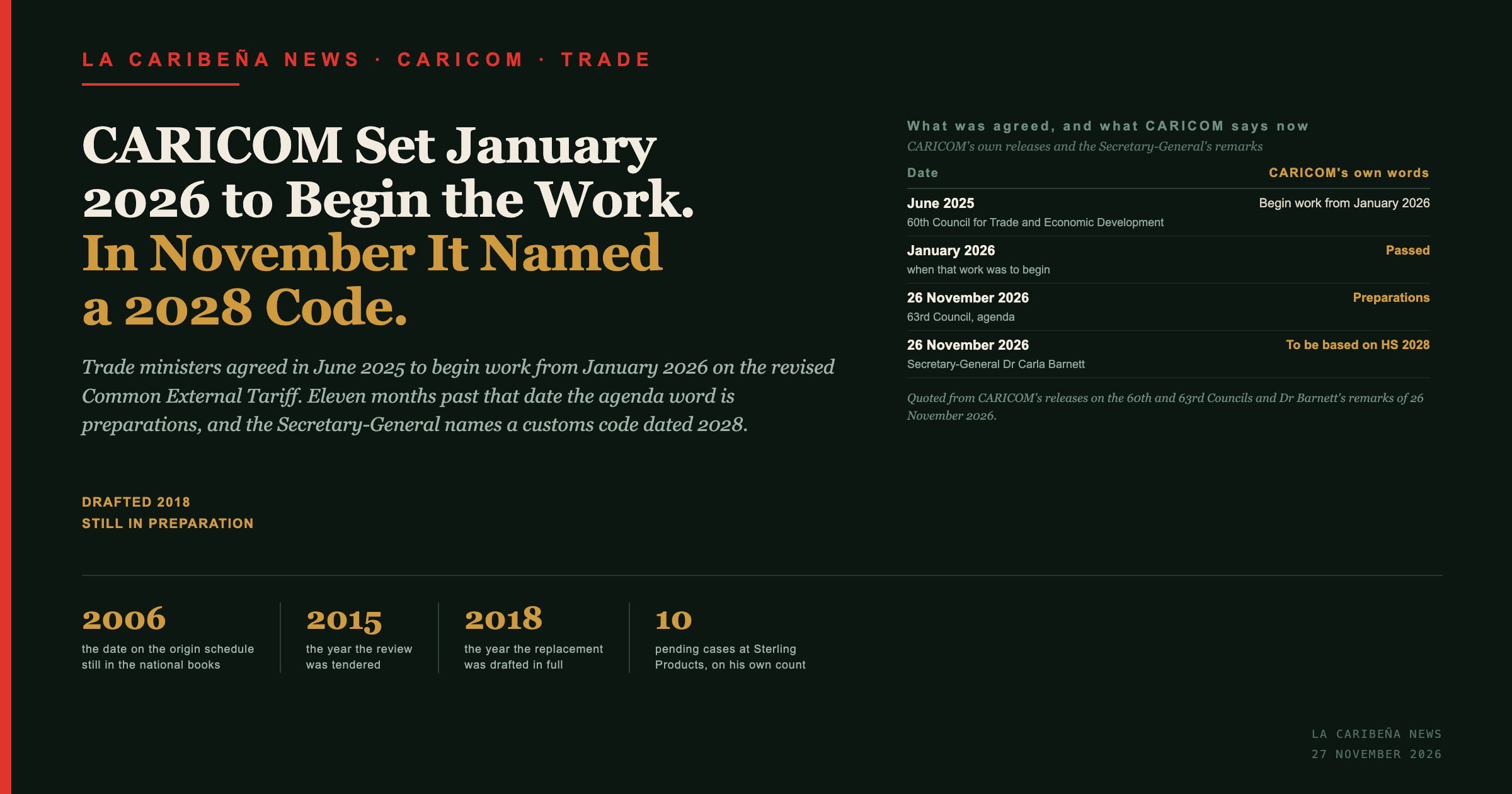
All figures on the title card, with their sources.
The panel sets what was agreed against where it stands. June 2025, the 60th Council agreed to begin work on implementing the revised tariff regime from January 2026. January 2026, the agreed start. November 2026, the 63rd Council's agenda says preparations, and the Secretary-General names the Harmonised System 2028. Sources: CARICOM's releases on the 60th and 63rd Councils, and Dr Carla Barnett's remarks of 26 November 2026.
The four figures in the bottom strip:
- 2006: the date on the Caribbean Community Secretariat's origin schedule still carried in national tariff books, 13 May. Inside it, Rule 1 commences a paragraph from a Council decision of July 1990. Source: the current schedules of Saint Lucia and Saint Vincent and the Grenadines, Barbados's 2023 order, and CARICOM's own tariff on the 2022 customs code.
- 2015: the year the review was tendered, from the reference number on the report. Source: the report's title page.
- 2018: the year the consultancy delivered its final report, with a draft tariff and draft rules of origin annexed. Source: the same.
- 10: pending court cases on tariff non-collection at Sterling Products Limited, on Ramsay Ali's own count. Source: Ramsay Ali, reported by Demerara Waves, 7 December 2025.
Entities named in this report
- The Caribbean Community (CARICOM) sets the Common External Tariff and the Rules of Origin.
- The Council for Trade and Economic Development (COTED) is its ministerial trade body; its 60th meeting sat in June 2025 and its 63rd in November 2026.
- The Common External Tariff (CET) is the rate the Community applies to goods entering from outside it.
- The Harmonised System (HS) is the World Customs Organisation's commodity code, revised every five years.
- Dr Carla Barnett is CARICOM's Secretary-General.
- Ramsay Ali is President of the Caribbean Manufacturers' Association, a former President of the Guyana Manufacturing and Services Association, and chief executive of Sterling Products Limited.
- Carl Greenidge is an economist, Guyana's Finance Minister from 1983 to 1992, later its Foreign Minister, and a former Secretary-General of the ACP Group of States.
- Neville Bissember is a former assistant general counsel at the CARICOM Secretariat.
- Gale Miller-Garnett is Belize's High Commissioner to Guyana.
- The Caribbean Court of Justice (CCJ) ruled in 2009 that Guyana had breached the Treaty by not maintaining the tariff on cement.
- Article 82 of the Revised Treaty of Chaguaramas requires member states to implement and maintain the tariff; Article 83 is the route for applying to suspend it.
- Schedule I to Article 84 is the list of conditions and the rules regarding Community origin, published by the Secretariat on 13 May 2006.
- bkp Development Research and Consulting wrote the 2018 review.
Frequently asked questions
What timing did CARICOM agree for the revised tariff?
Trade ministers agreed in June 2025 to begin work on it from January 2026. At the 63rd Council in November 2026 the agenda named member states' preparations. The Secretary-General spoke of the tariff resting on the Harmonised System 2028.
How old is the replacement?
The consultancy's final report is dated December 2018 and carries a draft tariff and draft rules of origin as annexes. Its reference number dates the tender to 2015.
What are manufacturers complaining about?
Ramsay Ali of the Caribbean Manufacturers' Association says governments let finished goods in from outside the region without collecting the tariff. He says the waiver process is slow and costly when no regional supplier exists. He puts the count at hundreds of pending court cases region-wide, and ten at his own firm.
Does everyone agree the system is failing?
No. Neville Bissember once served as assistant general counsel at the CARICOM Secretariat. At the same forum he said the mechanism lets states negotiate exemptions, and that "the thing is working". Belize's High Commissioner called the tariff a crucial tool for local industry.
What is the Harmonised System?
The World Customs Organisation's commodity code, used to set tariff lines. It is revised every five years. The edition the Secretary-General named is dated 2028.