By LCN Business Desk
Hurricane Melissa struck Jamaica on 28 October 2025. Money followed it. Jamaicans at home and abroad gave. So did businesses and foreign partners. The cash went into accounts run by the Office of Disaster Preparedness and Emergency Management, or ODPEM.
Jamaica's Auditor General did something unusual. She audited the relief while it ran. Her fourth report, tabled on 17 November, could validate 2.2 per cent of J$859 million in donated consumables. The Real-Time Audit of the Hurricane Melissa Relief Initiative came out in May 2026. It asked one question: whether all hurricane relief funds and in-kind donations were accurately accounted for.
Its conclusion runs to four sentences. The first says weaknesses in financial management, governance and accountability "limited transparency over Hurricane Melissa relief resources".
The entities
- Office of Disaster Preparedness and Emergency Management is Jamaica's disaster agency, ODPEM, which held the donated cash. - Auditor General's Department is Jamaica's supreme audit institution, which ran the real-time audit. - Disaster Risk Management Act 2015 is the Jamaican statute whose section 37 creates the National Disaster Fund and whose section 42 sets its reporting duties. - National Disaster Fund is that statutory fund, the NDF. - Jamaica Defence Force is the JDF, whose platform tracked roof repairs. - Ministry of Labour and Social Security is the MLSS, named in the audit on beneficiary verification. - Jamaica Constabulary Force is the JCF, the police force, covered by a second audit report. - Alvin Gayle is ODPEM's Director General. - Andrew Holness is Jamaica's Prime Minister. - Civil Defence Commission is Guyana's disaster agency, the CDC.
How much was donated, and how much was spent?
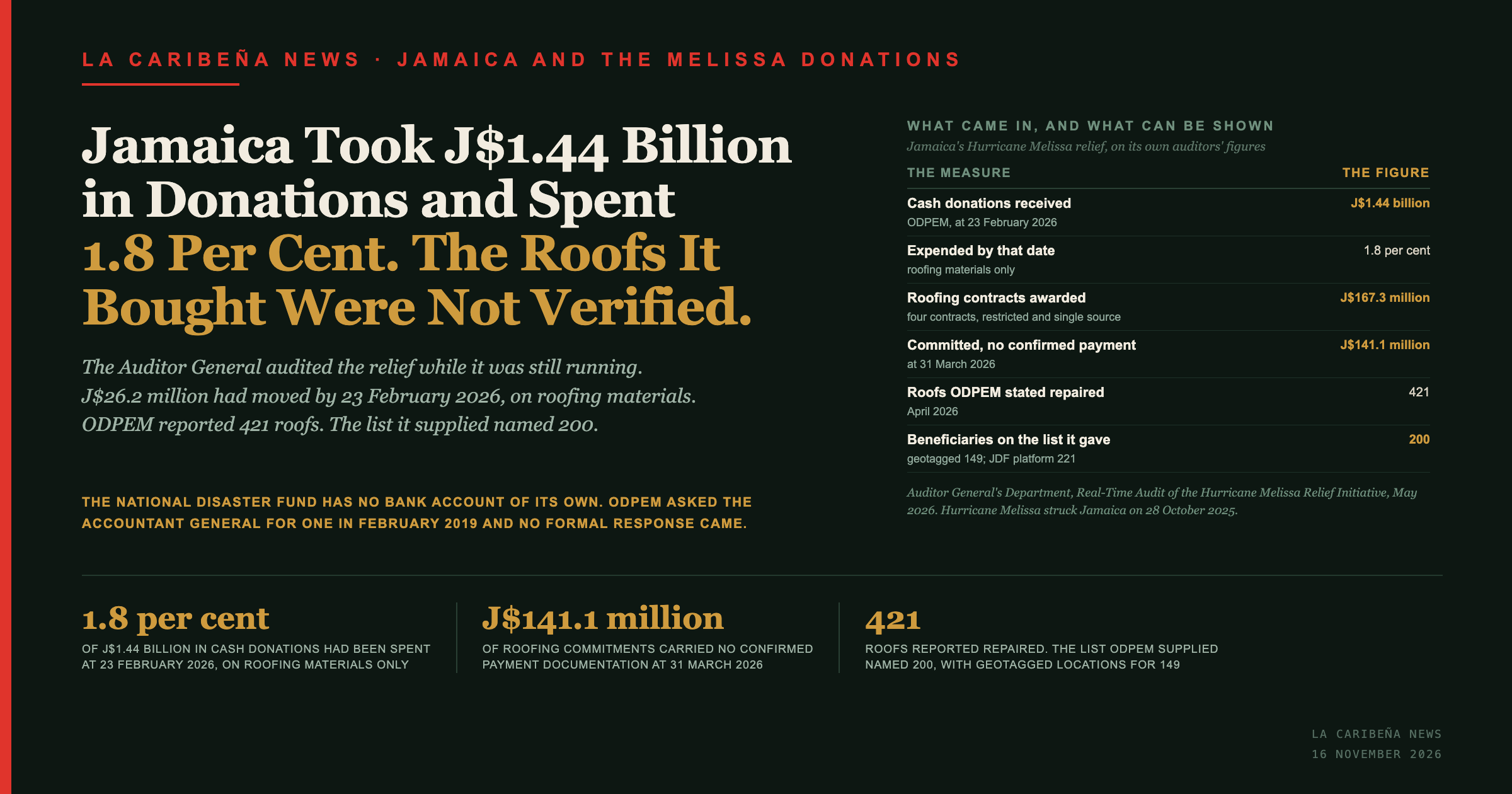
J$1.44 billion came in. J$26.2 million went out, which is 1.8 per cent.
| ODPEM, Hurricane Melissa relief | Jamaican dollars | About, in US dollars |
|---|---|---|
| Cash donations received, at 23 February 2026 | J$1.44 billion | US$9.0 million |
| Of which, Support Jamaica and direct donations | J$473.4 million and US$6.1 million | US$9.0 million combined |
| Expended, at 23 February 2026 | J$26.2 million, 1.8% | US$164,000 |
| Still held in hurricane donation accounts | J$569.6 million and US$5.9 million | US$9.5 million combined |
| Hurricane Beryl cash donations, still unspent | J$138.8 million and US$101,974 | US$968,000 combined |
Figures from the Auditor General's Department, Real-Time Audit of the Hurricane Melissa Relief Initiative, May 2026. US equivalents are struck at J$160 to the dollar and are this newspaper's conversion, given for regional readers. The audit reports Jamaican and United States dollar balances separately, and they are shown that way here.
The audit records what ODPEM said about it. In its April 2026 response the agency put the low rate down to "the absence of authorisation from the Ministry of Finance and the Public Service to expend the funds".
Jamaica's public spending machinery is not generally slow. This newspaper reported its capital budget execution rate as 94.6 per cent. The donated money is the part that did not move.
On the Beryl balances the audit is blunter. ODPEM "did not provide information on the total funds collected and expended for that hurricane". Beryl was the previous storm. That money was carried forward unspent into this one.
What did the 1.8 per cent buy?
Roofing materials, and nothing else.
The audit labels the J$26.2 million "roofing materials only". ODPEM used restricted bidding and single source procurement to award four contracts for roofing materials. Those contracts total J$167.3 million, about US$1.05 million.
So the commitments are six times the verified spending. As at 31 March 2026 the audit could confirm payment for J$26.2 million of the J$167.3 million. That leaves J$141.1 million in committed expenditure without corresponding confirmed payment documentation, about US$882,000.
Two contracts account for much of it. Payment confirmation was not provided for Supplier No. 2 under Procurement Round 1, valued at J$52.3 million, or for Supplier No. 3, at J$56.2 million.
Can the roof programme's own numbers be reconciled?
No. Four counts exist and no two agree.
| The count | Figure |
|---|---|
| Roofs ODPEM stated were repaired, April 2026 | 421 |
| Beneficiaries on the list ODPEM submitted | 200 |
| Of those, with geotagged locations provided | 149 |
| Roof repairs the JDF platform showed completed by the military | 221 |
All four from the same audit. The list of 200 was prepared by a foreign military support team.
The gap between the first and the last is the one to hold. ODPEM reported 421. The Jamaica Defence Force's own tracking platform indicated 221 completed by the military. Documentation on the extent of the foreign military's involvement "was not provided".
The auditors tried to check a sample of the repaired roofs and could not finish. The audit gives three reasons, and each is an absence rather than a discrepancy.
No documentation showed how beneficiaries were categorised by damage assessment. The Jamaica Household Damage, Impact and Needs Assessment was cited as the basis for identifying them, but "the methodology for translating assessment data into actual beneficiary selection was not presented". Neither ODPEM nor the Ministry of Labour and Social Security provided anything setting out how households were independently verified and approved before work started. And no formal completion reports were presented to show the work was done at the identified households using the J$167.3 million of materials.
What happened to the donations a financial institution held?
It kept 30 per cent of them for longer than it said it would, under no binding agreement.
A financial services institution processing donations proposed, by email, to retain 30 per cent of net donations for 45 days against potential chargebacks. ODPEM produced that correspondence. It produced no evidence that anyone approved the proposal, and no formal binding agreement existed.
The institution then missed its own deadline. J$15.7 million and US$298,429 withheld between 28 October and 31 December 2025 were due to reach ODPEM by 15 February 2026. On 9 March 2026 the institution confirmed none of it had been transferred.
ODPEM produced a transfer receipt dated 9 March for J$16.1 million and US$305,292. The auditors could not confirm the money reached ODPEM. The receipt did not show the recipient account numbers, and the bank statements were not submitted for review.
Does Jamaica's disaster fund meet its own statute?
No, in three ways the audit calls material.
The National Disaster Fund is a statutory fund under section 37 of the Disaster Risk Management Act 2015. At 23 February 2026 its bank account held J$163 million, with investments of J$293 million at 28 February.
It has no bank account of its own. ODPEM's capital account is used instead, commingling disaster fund transactions with a project funded by the Japan International Cooperation Agency. ODPEM asked the Accountant General for a separate account in February 2019. No formal response came, and no follow-up was made.
Its accounts were not prepared. For 2023 to 2024 and 2024 to 2025 ODPEM did not produce the statement of accounts and annual report the Act requires, because there was no functioning Fund Committee and no appointed Chairman. ODPEM's own annual reports were not prepared for seven financial years, from 2018 to 2019 through 2024 to 2025, so the statutory duty to publish the fund's accounts inside them could not be met either.
Updated balances were not supplied. The auditors wrote on 26 March 2026 asking for current figures. By ODPEM's response to the draft report on 21 April, nothing had arrived.
Is the 1.8 per cent figure still current?
No. It is a measurement taken on 23 February 2026, and it should not be read as today's position.
ODPEM has disputed what the figure means rather than the figure itself. In May 2026 the agency said the low cash spending "was not due to inaction or a lack of recovery activity", pointing to donated building materials and goods it put at close to J$400 million.
Alvin Gayle gave larger numbers at the one-year mark in late October 2026. He put total donations at about J$1.69 billion. He put spending on building materials at about J$194 million, for the first phase of the roof repair programme.
Those figures do not sit on a common base with the audit's. The audit counts cash donations and cash spent to a fixed date. ODPEM counts cash plus goods in kind, to later dates. Both can be accurate and they are not the same measurement. What has not been published is an audited figure later than February.
Two further things are on the record. The Gleaner reported on 29 October 2026 that 136 Jamaicans remained in shelters a year after the storm. And Holness has put total government spending on the Melissa response at about J$84 billion, roughly US$525 million, which is about 58 times the donated cash this audit examined.
What is still to come?
A second audit, covering ODPEM and the police, which has been with Parliament since 3 November.
A second report is already with Parliament. The Auditor General's Department sent it to Gordon House on 3 November 2026, during a sitting. It was not tabled that day. It asks whether ODPEM and the Jamaica Constabulary Force managed relief resources transparently.
It covers ground the first one did not. In-kind goods and assets from local and international donors. The funds used to clear those goods through the ports. The handing out of donated Starlink devices held by the police. It also asks whether internal controls at both bodies could prevent and detect fraud and waste.
What would the same question look like in Guyana?
Harder to answer, because the duties Jamaica breached have no Guyanese counterpart on the statute book.
Jamaica's failures are failures against a law. Section 37 creates the fund, section 42 requires the committee, the chairman, the statement of accounts and the annual report. The audit could name each duty and show it unmet. That is what a statute buys a reader: something to measure against.
Guyana's disaster agency is the Civil Defence Commission. It was set up in 1982 under the Office of the Prime Minister. It has sat under the Office of the President since 1992. A Cabinet decision reconstituted it in 1997. Its basis is administrative, not statutory.
A disaster statute has been in prospect for years and has not arrived. The instrument is a draft, and its vintage is unsettled even among the bodies tracking it. The International Federation of Red Cross and Red Crescent Societies, reporting in August 2025, calls it the "Draft Disaster Risk Management Bill 2019/2020". The Commission said in 2019 it hoped for passage by year end. The Prime Minister said in 2021 it would go to the National Assembly shortly. The Guyana Chronicle reported in January 2025 that reform was still ongoing. In June 2026 the Prime Minister named the oil pollution Act as the recent milestone, and no disaster Act.
What the draft would establish is on the record, and a fund is not part of it. The Federation's own summary lists the Commission itself, the Director General's powers, a National Disaster Risk Management Platform with its committees, a national strategy and policy, a National Emergency Operations Centre, an early warning system, regional committees and operations centres, and the procedures for declaring a disaster. No fund appears in that summary, and the word does not appear anywhere in the report.
The Inter-American Development Bank's governance index found that no national disaster fund existed. So the Guyanese position is not a fund without accounts. It is no fund, and no statute creating one.
One recent Act needs separating out, because it answers a different question. The Oil Pollution Preparedness, Response and Responsibility Act of 2025 made the Commission the competent national authority for oil spill response. Stabroek News reported that as an authority it "did not previously hold in law". That is operational command in one hazard. It creates no fund, no accounts and no audit duty. It does not bear on the comparison below.
Guyana does run statutory funds, and their own accounts repay reading. This newspaper reported that for the National Insurance Fund, the ninth actuarial review's recommendations were not implemented.
On the sources. Guyana's Acts are not publicly searchable, and this newspaper has not read the statute book directly. Nor has it seen the draft bill. What is set out above is what the named bodies carry, between 2019 and June 2026.
| Jamaica | Guyana | |
|---|---|---|
| Disaster statute | Disaster Risk Management Act 2015, in force | a draft the Federation dates 2019/2020, no Act reported as passed |
| Statutory disaster fund | National Disaster Fund, section 37 | none, and no fund in the draft's published summary |
| Dedicated bank account required | yes, and it does not exist | not in force |
| Statement of accounts and annual report | required by section 42, not prepared for two years | not in force |
| Supreme audit institution engagement | real-time audit published May 2026 | the IDB found no evidence of Audit Office assessments of disaster risk management |
Jamaica from the Auditor General's Department audit. Guyana from the International Federation of Red Cross and Red Crescent Societies report of August 2025, the Inter-American Development Bank's Index of Governance and Public Policy in Disaster Risk Management, and Guyanese press reporting. The draft bill itself was not obtained. The 2013 instrument the Federation names is a disaster risk management POLICY, not a bill.
The IDB's index recommended a role for the Audit Office of Guyana. It also found no evidence of the Audit Office assessing disaster risk management. That is no reflection on the office. Guyana's Auditor General met his statutory deadline for the fourteenth consecutive year on the public accounts. Disaster risk management is a different question, and the index found it unexamined.
A recorded absence is not a finding of absence. The draft itself was not obtained, so this rests on the Federation's summary of it.
What does a business reader take from this?
Donated money needs an account with a name on it before the money arrives.
Every failing the audit names is administrative and each one was fixable in advance. An account of its own. A committee with a chairman. A signed agreement with the institution processing the donations. A completion report for each house. None of that is disaster response. It is the bookkeeping that lets disaster response be counted afterwards.
The cost of not having it is visible in one line of the audit. Jamaica can say it received J$1.44 billion. It cannot yet show, to its own auditors' satisfaction, what the J$26.2 million it spent actually built.
What the title card says
- Headline: Jamaica took J$1.44 billion in Melissa donations and spent 1.8 per cent, and its auditors could not verify the one thing it bought. - Cash donations received at 23 February 2026: J$1.44 billion, about US$9.0 million. - Expended at that date: J$26.2 million, 1.8 per cent, about US$164,000, roofing materials only. - Roofing contracts awarded: J$167.3 million across four contracts, by restricted bidding and single source. - Committed with no confirmed payment documentation at 31 March 2026: J$141.1 million. - Roofs ODPEM stated repaired in April 2026: 421. - Beneficiaries on the submitted list: 200. Geotagged: 149. JDF platform figure: 221. - Donations withheld by a financial services institution: 30 per cent of net donations for 45 days, no binding agreement. - National Disaster Fund balance at 23 February 2026: J$163 million, plus J$293 million of investments at 28 February. - ODPEM annual reports not prepared: seven financial years, 2018-19 to 2024-25. - Hurricane Beryl donations still unspent: J$138.8 million and US$101,974. - Total government spending on the Melissa response, per Andrew Holness: about J$84 billion. - Guyana: a draft disaster bill the Red Cross Federation dates 2019/2020, no Act reported as passed; no fund in the draft's published summary; the Civil Defence Commission dates from 1982 and was reconstituted by Cabinet decision in 1997.
Frequently Asked Questions
How much was donated to Jamaica after Hurricane Melissa, and how much was spent?
ODPEM received J$1.44 billion in cash donations as at 23 February 2026, about US$9.0 million. It had spent J$26.2 million by that date, which is 1.8 per cent, about US$164,000. The audit records that this went on roofing materials only.
Why was so little spent?
ODPEM told the auditors in April 2026 that it lacked authorisation from the Ministry of Finance and the Public Service to spend the funds. The agency has separately said the cash figure understates activity, because it also received close to J$400 million in donated building materials and goods.
What could the auditors not verify?
The roof programme. ODPEM stated 421 roofs were repaired, submitted a list of 200 beneficiaries prepared by a foreign military support team, and provided geotagged locations for 149 of them, while the Jamaica Defence Force platform showed 221 repairs completed by the military. No beneficiary selection documentation, no independent verification records and no formal completion reports were provided.
Is the 1.8 per cent figure current?
No. It is measured at 23 February 2026. Alvin Gayle said in late October 2026 that about J$1.69 billion had been donated and about J$194 million spent on building materials for the first phase of roof repairs. Those are not on the same base as the audit's cash measurement, and no audited figure later than February has been published.
Does Guyana have the same framework?
No. Jamaica's Disaster Risk Management Act 2015 creates a National Disaster Fund and requires accounts and reports for it. On the sources this newspaper could reach, Guyana has a draft bill the Red Cross Federation dates 2019/2020, and no Act reported as passed. The Inter-American Development Bank found that no national disaster fund existed, and no fund appears in the published summary of what the draft would establish. Guyana's Acts are not publicly searchable, so the statute book was not checked directly.