By LCN Business Desk
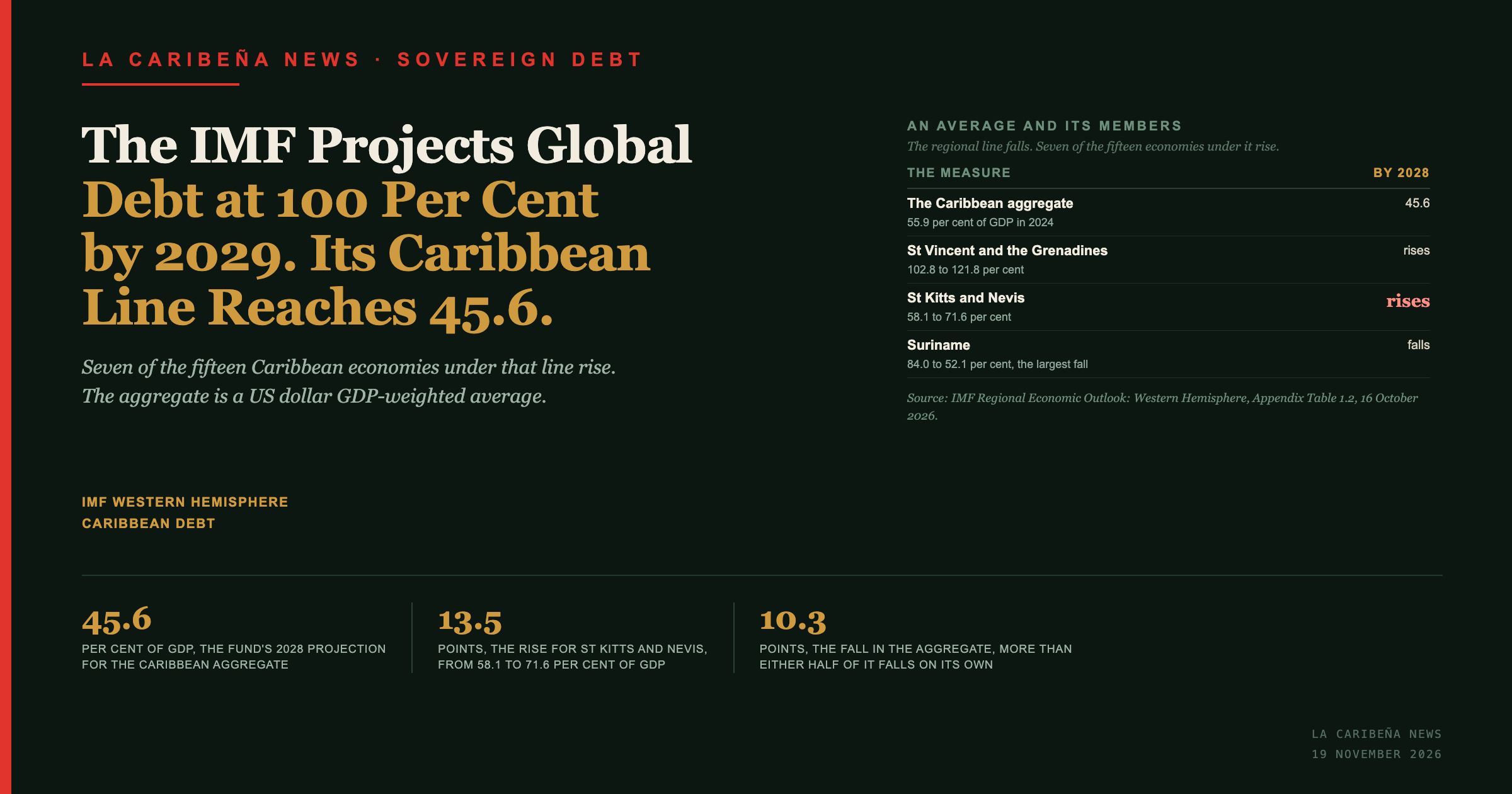
The Fund puts the world at 100 per cent of GDP and the Caribbean at 45.6. One of those is a forecast of debt. The other is an average, and an average moves when its weights do.
What does the Fund's table say?
That the Caribbean line falls while North America's climbs. The source is Appendix Table 1.2 of the Regional Economic Outlook: Western Hemisphere, published on 16 October 2026. It carries general government gross debt as a percentage of GDP. Everything from 2026 is marked a projection.
| Grouping | 2024 | 2025 | 2026p | 2027p | 2028p |
|---|---|---|---|---|---|
| North America | 117.7 | 120.0 | 121.9 | 123.4 | 126.5 |
| Latin America and the Caribbean | 70.4 | 74.1 | 72.9 | 73.7 | 73.6 |
| Eastern Caribbean Currency Union | 74.2 | 73.8 | 74.3 | 74.9 | 75.2 |
| Caribbean: tourism dependent | 72.7 | 73.0 | 71.1 | 69.1 | 67.6 |
| Caribbean | 55.9 | 55.2 | 50.2 | 47.4 | 45.6 |
| Caribbean: non-tourism dependent | 42.8 | 42.5 | 37.4 | 34.9 | 33.4 |
Why does the headline line fall further than either half of it?
Because the weights move. The Caribbean aggregate drops 10.3 points across the window. Its tourism-dependent half drops 5.1 and its non-tourism half drops 9.4. No average can fall further than both of its components unless the components are changing size relative to each other.
The table's own note explains how: "Regional aggregates are fiscal year US dollar nominal GDP-weighted averages." The non-tourism group is Haiti plus the commodity exporters, Guyana, Suriname and Trinidad and Tobago. It carries the lowest debt ratios in the region, and Guyana's dollar GDP is the fastest growing in the hemisphere. As that economy becomes a larger share of the Caribbean denominator, it pulls the regional average toward its own 27.1 per cent.
Which Caribbean economies does the Fund project rising?
Seven of the fifteen it lists.
| Rising, 2024 to 2028 | From | To | Change |
|---|---|---|---|
| St Vincent and the Grenadines | 102.8 | 121.8 | +19.0 |
| St Kitts and Nevis | 58.1 | 71.6 | +13.5 |
| Guyana | 24.3 | 27.1 | +2.8 |
| St Lucia | 75.9 | 78.4 | +2.5 |
| Belize | 64.3 | 66.5 | +2.2 |
| Jamaica | 62.5 | 63.2 | +0.7 |
| Trinidad and Tobago | 81.0 | 81.6 | +0.6 |
St Kitts and Nevis is the sharpest reversal in the set, and the Fund's own country work carries it further: its 2026 assessment put debt at 58.4 per cent of GDP at the end of 2025 and projected 78.2 per cent by 2031. The same government is holding a 20-pound cooking gas cylinder at EC$30, the lowest price in the currency union, and subsidising electricity alongside it.
Where does the fall actually come from?
Four economies, and one of them does most of the work. Suriname is projected down 31.9 points, from 84.0 to 52.1. Aruba falls 19.2, Dominica 14.8 and Barbados 14.6.
Those four carry the aggregate. Haiti, already the lowest in the hemisphere at 9.3 per cent by 2028, falls a further 5.8. Guyana is not second lowest in the hemisphere: Puerto Rico is projected at 18.6, below Guyana's 27.1. The outlook publishes no debt figure for Venezuela in any year.
Does the Fund present this as the Caribbean deleveraging?
No, and its own officials say the opposite. Nigel Chalk heads the IMF's Western Hemisphere Department. In prepared remarks at the release he said that for the region as a whole "public debt continues to rise", and that favourable financing conditions "may not last".
The report's text runs the same way. The tailwinds "are not able to resolve the region's fundamental challenges of high public debt and weak productivity growth". Fiscal space "remains limited across much of the region". Adjustment "has stalled in 2026". The Fund also records a measure pulling the other way. Brazil, Canada and many Caribbean economies are cushioning higher energy prices, which runs counter to fiscal consolidation. Its October outlook puts the fifteen Caribbean economies it covers at 3.9 per cent of the region's output, with growth rates spanning 24 points.
What is the global number behind this?
A projection, not a measurement. The April 2026 Fiscal Monitor states: "Global gross government debt rose to nearly 94 percent of GDP in 2025, and on current trajectories, it will reach 100 percent by 2029, a level previously reached only in the aftermath of World War II."
Ninety-four per cent measures 2025. One hundred per cent forecasts 2029, and the Fund attaches no figure and no year to the post-war comparison it draws. World interest payments move from 2 per cent of global GDP toward 3 per cent within four years. The Fund also names sovereign total return swaps as a frontier risk standard debt statistics cannot fully capture. Guyana's distance from the rest of the region was set out on the World Bank's figures in this newspaper, on a different base.
<!-- archive: antigua-cip-120-million-2026-budget-against-69-5-million-surplus-2026 | read 19 Nov 2026 and not linked: it is one country's budget receipts from citizenship sales. This piece is a regional debt aggregate and its members --> <!-- archive: langrin-cartac-route-bank-of-jamaica-governor-2026 | read 19 Nov 2026 and not linked: shared term is IMF, as the employer in a career history. No debt figure in it --> <!-- archive: st-kitts-cbi-wind-down-revenue-fell-first-imf-deficit-2026 | read 19 Nov 2026 and not linked: the St Kitts fiscal position is already carried here through its subsidies piece, which is linked on the energy-cushioning point the Fund itself names --> <!-- archive: brazil-rural-debt-23-of-100-billion-eligibility-test-loosened-2026 | read 19 Nov 2026 and not linked: it is Brazilian rural credit eligibility. Shared word debt, different instrument and not in the Caribbean table --> <!-- archive: imf-fdi-exports-benchmark-not-forecast-cepal-2026 | read 19 Nov 2026 and not linked: it is foreign investment and export growth. Same publisher, no debt ratio --> <!-- archive: guyana-inflation-cpi-basket-2006-survey-imf-prices-rating-c-2026 | read 19 Nov 2026 and not linked: it is a consumer price basket and its survey vintage. Shared term IMF only --> <!-- archive: imf-guyana-fx-market-tight-investment-imports-measures-2026 | read 19 Nov 2026 and not linked: it is Guyana's foreign exchange market. Shared term IMF only --> <!-- archive: suriname-slm-subsidy-debt-audit-accounts-2026 | read 19 Nov 2026 and not linked: it is an airline subsidy and unapproved accounts. Shared word debt, a company rather than a sovereign -->
The entities
- International Monetary Fund (IMF): publisher of both the Fiscal Monitor and the Regional Economic Outlook. - Regional Economic Outlook: Western Hemisphere: the October 2026 report whose Appendix Table 1.2 carries the Caribbean debt aggregate, compiled on information to 30 September 2026. - Nigel Chalk: head of the IMF's Western Hemisphere Department, who said regional public debt continues to rise. - April 2026 Fiscal Monitor: the report carrying the 94 per cent measure for 2025 and the 100 per cent projection for 2029. - Eastern Caribbean Currency Union (ECCU): the grouping the Fund projects rising to 75.2 per cent by 2028. - Caribbean: non-tourism dependent: the Fund's sub-group of Haiti plus the commodity exporters Guyana, Suriname and Trinidad and Tobago.
Frequently asked questions
Is Caribbean debt falling?
The Fund's Caribbean aggregate falls from 55.9 per cent of GDP in 2024 to a projected 45.6 by 2028. Seven of the fifteen individual Caribbean economies in the same table rise over that period, and eight fall.
Why do those two facts sit together?
The aggregate is a US dollar nominal GDP-weighted average, as the table's own note states. Economies with low debt ratios and fast-growing dollar GDP take a larger share of the weighting over time, which moves the average without any government reducing its debt.
Which economies rise most?
St Vincent and the Grenadines, by 19.0 points to 121.8 per cent, and St Kitts and Nevis, by 13.5 points to 71.6 per cent.
Which fall most?
Suriname, by 31.9 points to 52.1 per cent, followed by Aruba at 19.2, Dominica at 14.8 and Barbados at 14.6.
Does Guyana have the second-lowest debt in the hemisphere?
No. Haiti is projected at 9.3 per cent by 2028 and Puerto Rico at 18.6, both below Guyana's 27.1. The Fund's October Article IV describes Guyana as having one of the lowest debt ratios in the Western Hemisphere.
What does the IMF itself say about regional debt?
The head of its Western Hemisphere Department said at the report's release that public debt for the region as a whole continues to rise, and that favourable financing conditions may not last.
Has global debt reached 100 per cent of GDP?
No. The Fund measured it at nearly 94 per cent in 2025 and projects 100 per cent by 2029 on current trajectories.