SMALL CAPS | La Caribeña News | Sunday May 31, 2026
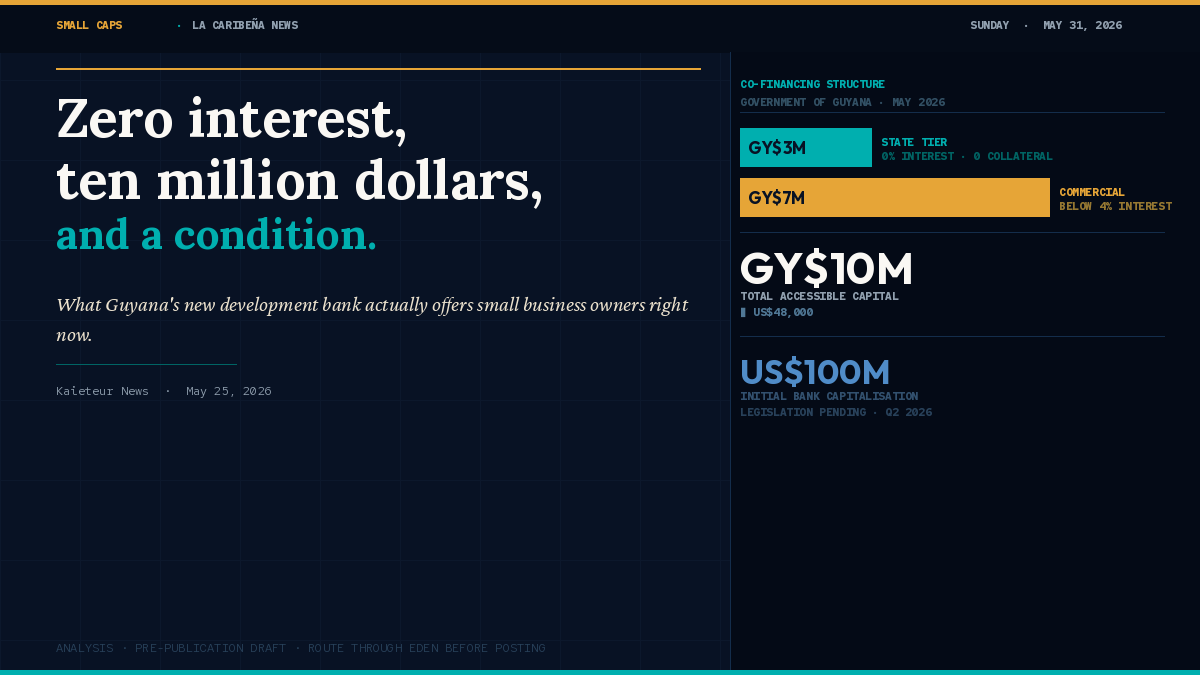
Guyana's new development bank arrives with a co-financing promise, pending legislation, and no confirmed launch date. For the MSME owner watching from the other side of the counter, the question is simple: when?
La Caribeña News |
“The government offers GY$3 million at zero interest and zero collateral. The bank unlocks up to GY$7 million more at below 4 percent. Total accessible capital: GY$10 million. A firm launch date has not been announced.” Co-financing structure, Kaieteur News, May 25, 2026 WHAT EQUITY SUPPORT LOOKS LIKE HERE India, in its 2026-27 Union Budget, created a 10,000-crore-rupee SME Growth Fund, roughly equivalent to more than US$1.1 billion, designed specifically to provide equity rather than debt to growing firms. The distinction is not semantic. Equity does not require repayment. It is a stake in the upside. Every rupee of equity reduces the fixed burden on a business in its early years, when cash is tightest and the risk of failure is highest. The Guyana Development Bank, as currently structured, is a debt instrument. The GY$3 million tier is labeled interest-free, but it is a loan with a repayment obligation. The co-financing tier at below 4 percent is competitive by local commercial bank standards, where rates have historically run well above that. Neither tier creates equity participation in the businesses it finances. The Small Business Bureau of Guyana operates a grants programme, but public reporting on disbursement volumes and approval rates is limited. How many businesses received grants in 2025? How many applicants were rejected? GO-Invest highlighted the Development Bank at HerVenture 2026 in May, but neither agency has published a current MSME headcount for Guyana. India recites five MSME statistics in every government release: 74.7 million registered enterprises, 328.2 million people employed. Guyana cannot quote an equivalent figure from its own records, at least not one that is publicly accessible and current. THE CASH-FLOW PROBLEM THE BANK DOES NOT ADDRESS The co-financing mechanism targets startup capital and early-growth capital. It does not address the working-capital crunch that hits operating MSMEs when a large buyer takes 60 to 90 days to pay an invoice. India built a platform called TReDS, the Trade Receivables Discounting System, which allows a small supplier to sell an unpaid invoice to a financier at a small discount and receive cash within days. India made TReDS participation mandatory for Central Public Sector Enterprises in its 2026-27 budget cycle. The platform has unlocked the equivalent of trillions of Guyanese dollars in working capital for small manufacturers and service providers who would otherwise wait months for payment from large buyers. No CARICOM state has a TReDS equivalent. Finance Minister Ashni Singh, speaking on May 30, urged Guyanese business owners to pursue investment and expansion opportunities abroad, arguing that local firms should match the ambition of foreign companies entering Guyana. That is a reasonable long-term aim. The working-capital gap that makes scaling difficult enough to reach export readiness remains unaddressed by either the Development Bank structure or any announced CARICOM mechanism. WHAT THE REGION IS DOING IN PARALLEL The Caribbean Development Bank is advancing MSME financing reform in Barbados through a US$350,000 technical assistance grant aimed at preparing at least 20 firms to list on the country's Innovation and Growth Market, a dedicated equity-raising platform for smaller companies. In the same period, CDB approved a US$10 million line of credit to support small and medium enterprises in Trinidad and Tobago. Project THRIVE, run jointly by Republic Financial Holdings and the Caribbean Export Development Agency, reported in May 2026 that 420 MSMEs across 14 Caribbean territories had completed Phase 1. Guyana was among the participating countries. Breakdown by territory has not been published. India, under its 2026 Union Budget, is funding Corporate Mitras: trained compliance helpers who make regulatory filings affordable for small businesses that cannot retain a full-time accountant. No equivalent model exists in Guyana or, to the best of available evidence, elsewhere in CARICOM. THE ACCOUNTABILITY QUESTION The Guyana Development Bank, if it launches and if the co-financing mechanism functions as described, would fill part of the equity and liquidity gap for early-stage MSMEs. Legislation was still being finalized as of February 2026. A launch date remained unannounced as of late May. A small business owner who heard the 2025 budget speech and then the 2026 budget speech and then the Kaieteur News report on May 25 is still waiting for the actual bank to open. That wait is measurable: in loans not taken, in suppliers not hired, in export markets not reached. India benchmarks its MSME results in every press release. It publishes the number of firms that received credit guarantees under CGTMSE. It publishes the volume of invoices discounted through TReDS. It publishes the count of Corporate Mitras trained. Caribbean governments tend to announce the programme and leave the results for later, if they come at all. The Development Bank deserves a fair launch. It also deserves, built into its mandate before the first disbursement clears, a clear reporting obligation: loans disbursed, businesses served, sectors reached, default rates. Without that framework, the bank's impact will be as hard to verify as the MSME headcount that nobody currently publishes. Get Caribbean business news and MSME insights delivered to your inbox every Thursday. Get the LCN Intelligence Brief: five essential items every Monday covering regulatory moves, trade signals, MSME trends, energy and climate finance, and South-South stories. Interpreted for the operators and investors who need to act on them. |