By LCN Wire
Two numbers were given at the same symposium in Georgetown this week, and they do not describe the same country.
One is in the millions. The other is nought.
Where does the attack figure come from?
A security vendor's count of attack attempts, relayed by the police.
Kaieteur News reported that Martina Johnson, Public Relations Consultant of the Guyana Police Force, gave the figure while hosting the Building Cyber Resilient Guyana 2026 symposium on Wednesday 21 October. She said it came from one of the force's partners, Brava Fortinet, "who reported the attacks based on its evaluation of Guyana for the first half of the year".
The force’s public relations consultant set it against the past. "Imagine 1.1 million attacks in six months, when comparatively in 2007, we didn't even have 500,000 attacks for the whole year," she said, adding that a faster-growing economy draws more attempts because of the information it holds: police, government, company and investors' records.
An attack attempt is not a breach, and a vendor's telemetry is not a national crime statistic. It measures what was thrown at a perimeter, not what got through or what was prosecuted.
What do the prosecution figures say?
That 50 cases produced 15 convictions, and the business crime produced none of them.
Commissioner of Police Clifton Hicken told the same symposium that in 2025, 50 cases were instituted for cybercrime offences across the police divisions, resulting in 15 convictions.
The 50 break down as 25 computer-related fraud, 10 for the use of computer systems for the humiliation and embarrassment of persons, six for the publication or transmission of images of persons' private areas, three involving child sexual abuse material, one of child luring, and five against the State.
The 15 convictions break down differently. Thirteen were for the use of computer systems for humiliation and embarrassment. Two were for child sexual abuse material.
What does that arithmetic mean for a business?
Computer-related fraud was half the caseload and none of the result.
Twenty-five fraud cases were brought. On the Commissioner's own figures, not one of the fifteen convictions is in that category. Nor is any of the five cases brought against the State.
So the single offence most likely to reach a Guyanese company, the one that takes money, is the one where the published outcome is a blank. A business that reports an online fraud in Guyana is entering a process with 25 instituted cases behind it and no recorded conviction at the other end.
The offence that did convict concerns speech, not money.
What does the Act look like in use?
A businessman was charged in January over a video about bribery, held his passport for two months, and the prosecution service then advised the charge away.
Stanley Basdeo, a car dealer based in the United States who had been doing business in Guyana since 2013, was arrested and charged under the cybercrime legislation after posting a video on TikTok in which he expressed frustration at delays in obtaining a firearm licence and referred to what he said he had been told about bribery. Kaieteur News reported that he identified no official. He appeared at the Leonora Magistrate's Court, was released on $200,000 bail and required to lodge his United States passport, which kept him in Guyana for almost two months.
The charge was dismissed on 26 February 2026, following advice from the Chambers of the Director of Public Prosecutions. Stabroek News reported that the prosecutor told the court no cybercrime elements were present in the video, and that its content warranted investigation by the relevant authorities rather than cybercrime proceedings.
The Government, through the Attorney General, has given public assurances that cybercrime reforms are not intended to suppress freedom of the press or freedom of expression.
The Act's most visible use this year ended with the prosecution service saying the offence was not there.
Why does the gap matter now rather than last year?
Because the exposure is being built this month.
About a hundred small businesses opened at the Railway Courtyard this week, some of them selling through a QR code and taking payment by mobile money. A Georgetown salon took a deposit online with no card and no screenshot. A United States security firm reported ghost tapping claims up 150 per cent as Guyana built its national tap-to-pay system.
Every one of those is a new way to be paid and a new way to be defrauded. The payment rails are arriving faster than the prosecutions behind them.
What is the government's stated position?
Resilience, with institutions able to resist, respond and recover.
Minister of Home Affairs Oneidge Walrond told the symposium the ambition extends beyond responding to and investigating attacks after they occur. "The vision is a Guyana that can confidently embrace technology because our people trust the systems they use, our institutions are prepared for the threats they face and our country has the capacity not only to withstand destruction but to recover from it," she said.
She said building a cyber-resilient country requires institutions strong enough to resist attacks, prepared to respond to incidents, and equipped to recover swiftly.
Guyana already holds one of the Caribbean's strongest forfeiture regimes on paper, which is a different question from whether a case reaches a conviction. Regionally, CARICOM has a cyber plan and critical infrastructure remains the gap in it, and The Bahamas spent this month warning its own businesses about a ransomware group.
The entities
- Guyana Police Force (GPF) hosted the Building Cyber Resilient Guyana 2026 symposium.
- Martina Johnson is the force's Public Relations Consultant, who gave the attack figure.
- Brava Fortinet is the GPF partner the figure is attributed to.
- Clifton Hicken is the Commissioner of Police, who gave the 2025 prosecution figures.
- Oneidge Walrond is Minister of Home Affairs.
- Computer-related fraud is the offence category accounting for 25 of the 50 cases instituted.
- Use of computer systems for the humiliation and embarrassment of persons is the category accounting for 13 of the 15 convictions.
- Building Cyber Resilient Guyana 2026 is the symposium at which both sets of figures were given.
- Stanley Basdeo is the car dealer charged under the cybercrime legislation in January 2026 over a TikTok video about a firearm licence and bribery. The charge was dismissed on 26 February 2026 on the advice of the Chambers of the Director of Public Prosecutions.
- Leonora Magistrate's Court is where he appeared and was granted bail.
What the title card shows
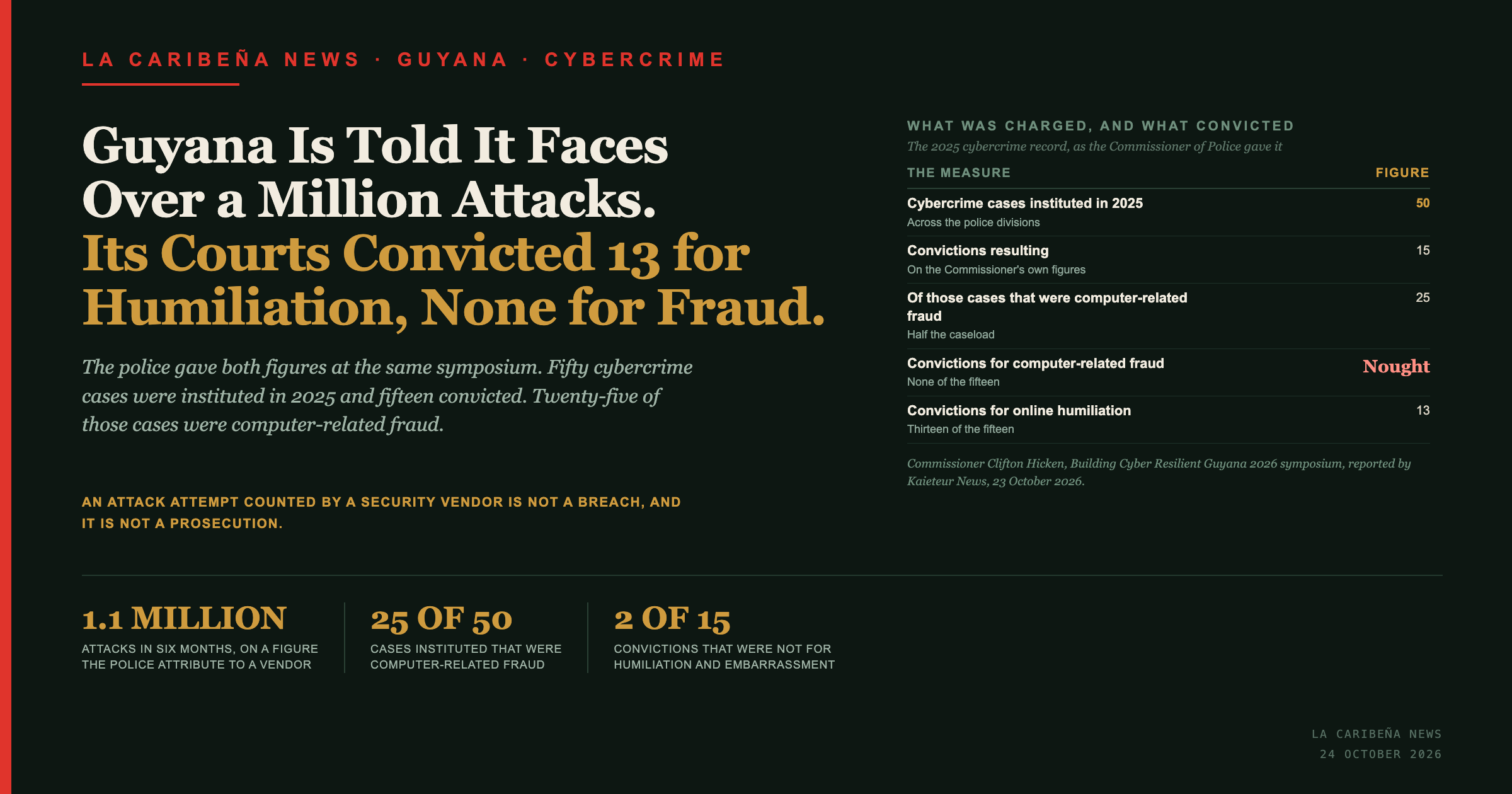
Every data point on the article's title card, in text.
- 1.1 million. Cyber-attacks recorded in Guyana in the first half of 2026, on a figure the police attribute to Brava Fortinet. Source: Kaieteur News.
- 50. Cybercrime cases instituted in 2025 across the police divisions. Source: Commissioner Clifton Hicken.
- 15. Convictions resulting. Source: Commissioner Clifton Hicken.
- 25. Of those cases that were computer-related fraud. Source: Commissioner Clifton Hicken.
- None. Of the 15 convictions that were for computer-related fraud. Source: La Caribeña News, from the Commissioner's two lists.
- 13. Convictions for the use of computer systems for humiliation and embarrassment. Source: Commissioner Clifton Hicken.
Frequently Asked Questions
Where does the 1.1 million cyber-attack figure come from?
From Brava Fortinet, a partner of the Guyana Police Force, which the force's Public Relations Consultant Martina Johnson said reported the attacks based on its evaluation of Guyana for the first half of 2026. It counts attack attempts detected by a security vendor, not breaches and not prosecutions.
How many cybercrime convictions did Guyana record in 2025?
Fifteen, from 50 cases instituted across the police divisions, according to Commissioner of Police Clifton Hicken. Thirteen were for the use of computer systems for the humiliation and embarrassment of persons and two involved child sexual abuse material.
What is the Stanley Basdeo case?
A car dealer based in the United States was arrested and charged under the cybercrime legislation in January 2026 after posting a TikTok video about delays in obtaining a firearm licence and what he said he had been told about bribery, identifying no official. He was granted $200,000 bail at the Leonora Magistrate's Court and required to lodge his United States passport, which kept him in Guyana for almost two months. The charge was dismissed on 26 February 2026 following advice from the Chambers of the Director of Public Prosecutions, the prosecutor telling the court that no cybercrime elements were present in the video.
Were there any convictions for computer-related fraud?
Not among the fifteen the Commissioner listed, although computer-related fraud accounted for 25 of the 50 cases instituted. None of the five cases brought against the State appears among the convictions either.
What did the Minister of Home Affairs say?
Oneidge Walrond said the government's ambition extends beyond responding to and investigating attacks after they occur, and that a cyber-resilient country needs institutions strong enough to resist attacks, prepared to respond, and equipped to recover swiftly.