By LCN Wire
What did Fitch change after ueno bank collapsed?
Fitch dropped Paraguay's positive outlook. It put the BB+ rating on watch for a possible cut. The agency said the collapse could affect public finances, growth, banking confidence and policy, according to Reuters’ report on the rating action.
BB+ sits one step below Fitch’s investment grade. After Fitch’s September review, Paraguay’s Ministry of Economy listed the rating with a positive outlook. It sat alongside Moody’s Baa3 and S&P Global’s BBB-, both investment grade.
Fitch has not cut the rating. It is weighing whether the government’s response, its fiscal exposure and the change of president justify a lower one.
Why did one bank threaten the sovereign rating?
The Banco Central del Paraguay began resolving ueno bank on 2 November. Changes to the bank’s accounts had left its solvency ratio below half the regulatory minimum. The regulator named intervenors, froze the bank and began counting what it owned and owed.
The bank’s size made this a national event. It had nearly three million customers. It held roughly US$850 million in public money, pension assets among it. Previous LCN reporting found that Paraguay’s deposit guarantee stops at about US$38,600 per depositor. The ceiling is the same for a person, a company or a state body.
Fitch said it did not expect the trouble to spread, because Paraguay’s other large banks were still solvent and liquid. It still sees a risk to its 4.5 per cent growth forecast for 2026.
How much public money is exposed?
The Instituto de Previsión Social, Paraguay’s social security fund, held about US$364 million at ueno bank at the April 2026 peak. The figure comes from a prosecutor’s evidence to the Senate. Itaipú Binacional held about US$182.5 million when the bank closed.
Paraguay’s creditor order puts the pension fund ahead of other depositors for claims above the ceiling. LCN’s comparison found that Guyana excludes pension-fund deposits from its own insurance scheme. The same kind of public money is treated differently in each country.
Prosecutors have also asked the United States, Luxembourg and Argentina to find and freeze assets. That search covers money above the ceiling, while domestic payments have reached depositors separately.
Why do the rating agencies disagree?
Moody’s said the crisis exposed lasting weakness in how Paraguay controls corruption and runs government. It did not expect an immediate effect on the sovereign rating. Its Baa3 rating remains investment grade with a stable outlook.
S&P Global also held Paraguay at BBB- with a stable outlook. It saw risks to investor confidence and to the budget, but said the change of president did not move the rating now.
Fitch’s BB+ already sat below both rivals. The watch tests whether ueno widens that gap rather than closing it.
What should Caribbean public treasurers examine?
The Paraguayan case ties bank supervision straight to sovereign risk. State bodies left balances far above the legal guarantee in one bank. What they get back now turns on what the bank still owns and where they rank among creditors.
The number of covered accounts can also mislead. A guarantee can cover most small savers and still leave the largest state balances at risk. The central bank said it had paid advances to 1,738,804 people by 9 November. That is 93.1 per cent of depositors, and G.2.126 trillion paid out.
The entities
- Fitch Ratings: the agency that placed Paraguay's BB+ rating on negative watch.
- ueno bank: the intervened Paraguayan lender holding the public deposits.
- Banco Central del Paraguay: the central bank that intervened and is paying guarantee advances.
What the title card says
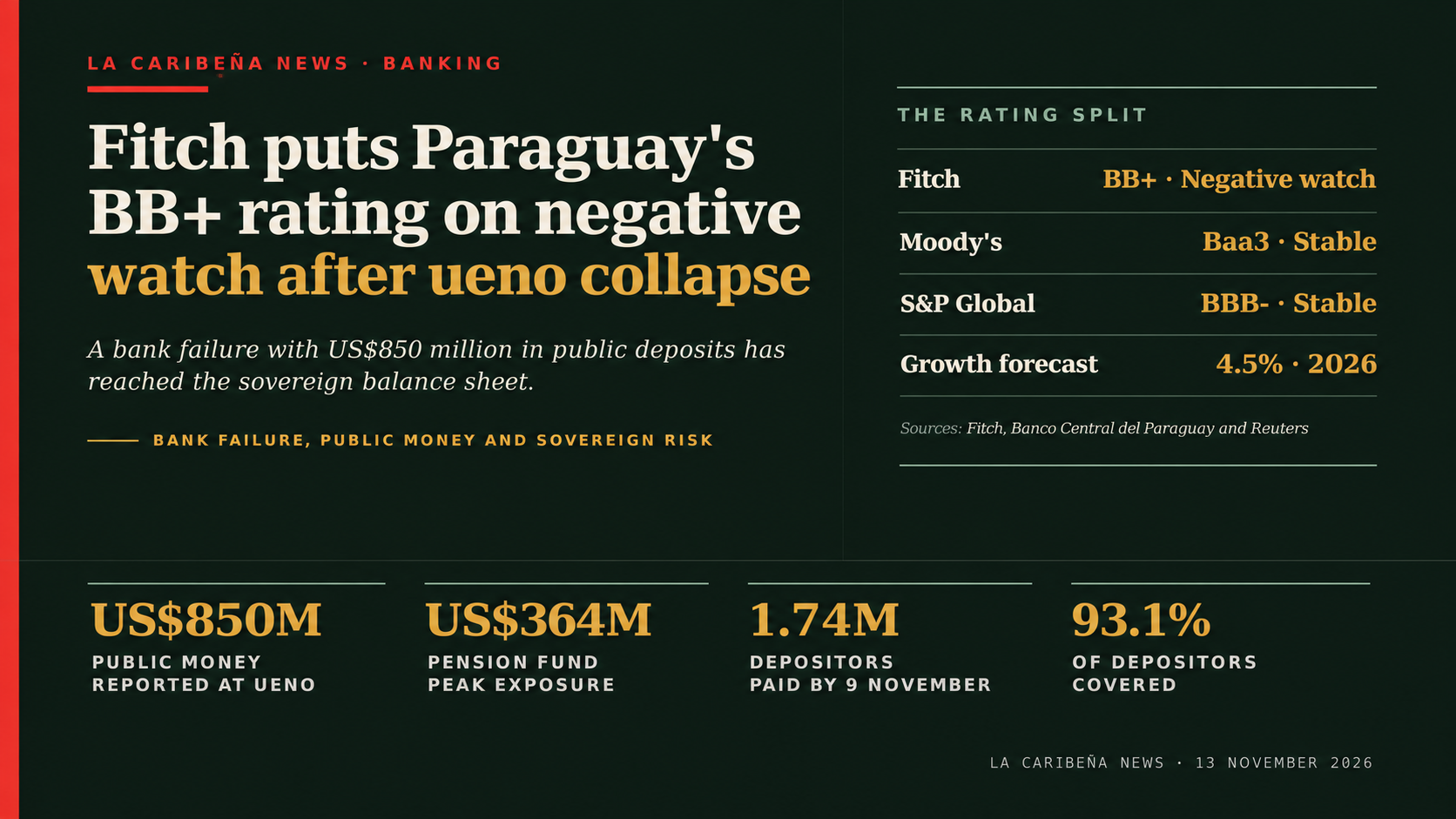
- Fitch: BB+, negative watch.
- Moody's: Baa3, stable.
- S&P Global: BBB-, stable.
- Growth forecast: 4.5 per cent for 2026.
- Public money reported at ueno: US$850 million.
- Pension fund peak exposure: US$364 million.
- Depositors paid by 9 November: 1.74 million, reported precisely as 1,738,804.
- Share of depositors covered: 93.1 per cent.
- Sources: Fitch, Banco Central del Paraguay and Reuters.
Frequently asked questions
Did Fitch downgrade Paraguay?
No. Fitch retained the BB+ sovereign rating but placed it on negative watch, meaning a downgrade is under consideration.
Is Paraguay still investment grade?
Moody’s rates Paraguay Baa3 and S&P Global rates it BBB-, both investment grade. Fitch’s BB+ rating remains one step below investment grade.
How much public money was held at ueno bank?
Reports put the total at roughly US$850 million, including pension assets and money held by public institutions.
Are other Paraguayan banks in danger?
Fitch said it did not presently expect broader financial stability problems because other systemically important banks had sound solvency and liquidity positions.
How many depositors have received payments?
The Banco Central del Paraguay reported that 1,738,804 depositors had received guarantee advances by 9 November 2026, representing 93.1 per cent of depositors.