By LCN Wire
What stopped working at Chase?
Chase's fault crossed its digital and its physical counters on 16 November 2026.
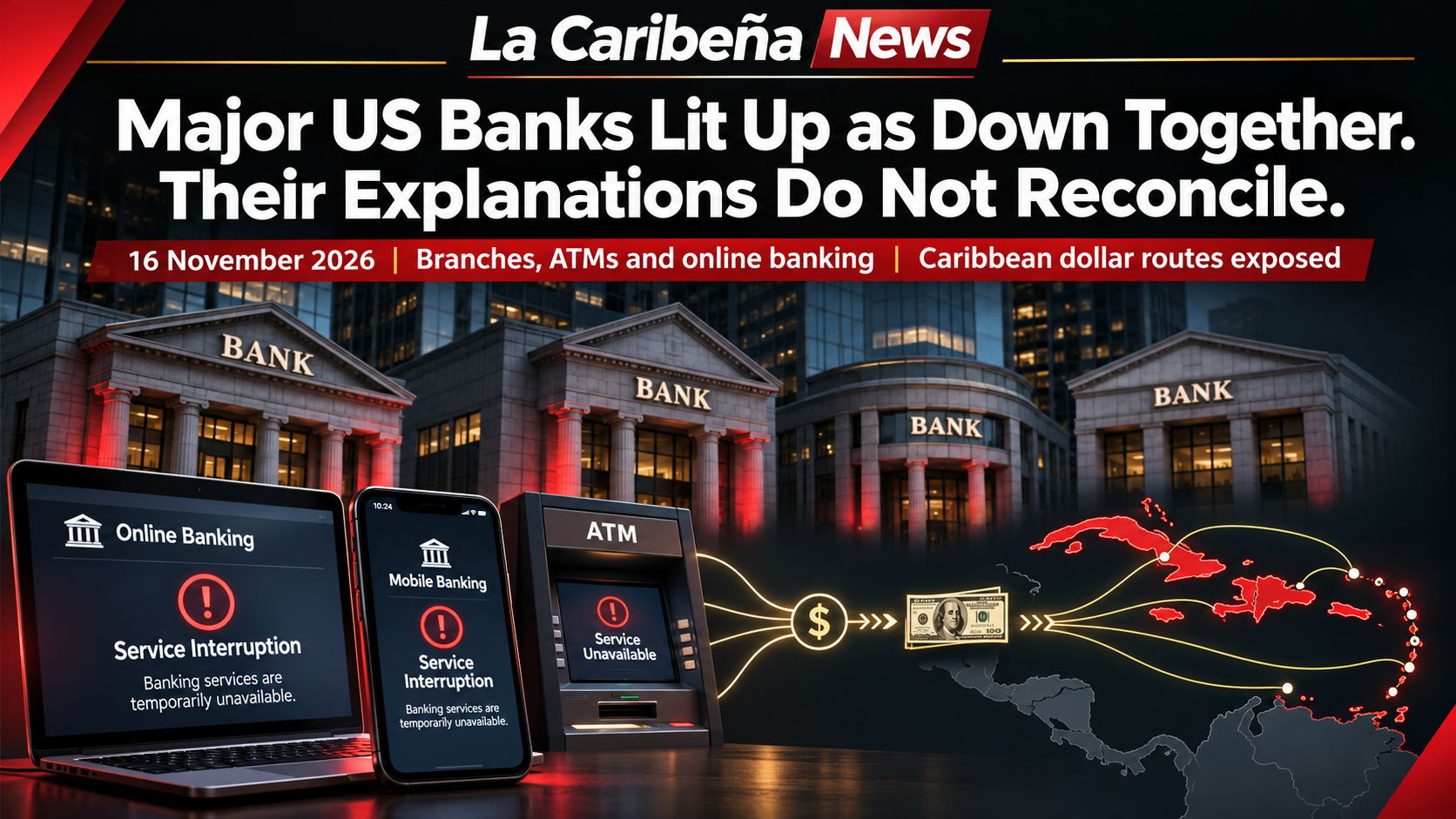
Customers reported trouble with online banking, the mobile app, balances, transfers and card payments. Others could not pay in or take out money at branches and cash machines, the San Francisco Chronicle reported. Associated Press photographs showed an out-of-service Chase cash machine in Texas, and a customer unable to use another one.
Reddit users said branches turned customers away. Cash-machine deposits went missing from account histories. Balances changed, then went back. Those posts are not bank records, but they describe a wider failure than a slow website.
Chase spokesman Joe Evangelisti told The Associated Press the bank had a short-lived software bug in an on-site hardware system. He said it was not cyber-related, and that it stopped at Chase.
Why do the banks' explanations not reconcile?
Reports rose at nine firms over the same hours, on Downdetector's count as reported by Yahoo Finance. They were Chase, Bank of America, Wells Fargo, U.S. Bank, PNC, Citigroup, Truist, Capital One and Zelle. Shares in Bank of America, Citigroup, Wells Fargo and JPMorgan Chase each fell about 2 per cent.
Chase said the fault was not a systemic issue, and that other banks may have been hit “only to the extent that they were a party to a transaction with us”. Four banks said it had not reached them. U.S. Bank and PNC said their systems were not directly affected. Capital One said it had not been hit. Truist said it knew of no broad outage. Zelle said its network was running. Citigroup said nothing: NBC News reported that it declined to comment, and Yahoo Finance that it did not reply. Wells Fargo and Bank of America did not reply at once to requests for comment, The New York Times reported.
Wells Fargo answered only on its own site. It said online banking was down for a time, while its cash machines, branches and phone banking stayed open, NBC Washington reported.
The Associated Press met that point head on, in copy carried by The Independent: customers at Bank of America, Citigroup and other banks “trying to transact with Chase may have seen their transactions slow, even though those banks were not having issues with their services”. A Caribbean customer sits in the same place when a dollar payment stalls. The local bank is fine. The payment is not.
The size of the reports fits that reading. The Guardian put it the same way, saying the banks caught up in it, Bank of America and Citigroup among them, “were not having issues with their banking services”. On Downdetector's own 24-hour chart, read at about 7pm Eastern on 16 November, Citi's reports sat flat overnight, rose from around midday and peaked a little above 100. Chase's peaked near 4,800 in the early afternoon. A spillover and a fault do not look alike.
Each denial describes a bank's own platform, not its customers' money. None of them says whether a payment went through. A bank whose software never faltered can still have customers whose payments did not, because Chase sat on the other side of the deal. More than a hundred Citi customers said so while Citigroup said nothing, to anyone, all day. For a firm waiting on a transfer, “our systems are operating normally” and “your payment has settled” are different sentences, and only the second is an answer.
A Chase-centred fault explains failed payments involving Chase. It does not explain Wells Fargo's own online outage. Chase, Wells Fargo, U.S. Bank, PNC, Capital One and Truist have named no cause they share.
Was this connected to the Microsoft and air traffic failures?
Three systems failed in five days. Each operator has given its own cause, and no two name a shared supplier.
Microsoft's first post-incident report, dated 15 November, traces its outage to a hidden flaw in a fix “prepared specifically for Microsoft 365 networking gateway servers”, and says that “neither the underlying defect nor the fix applies to broader Windows deployments”. It logs the incident as closed at 4.10pm UTC on 13 November, three days before the Chase fault. An unchecked post on a customer forum blamed Microsoft for the bank's failure. Neither firm's account backs that, and Chase named its own on-site hardware.
The Federal Aviation Administration's questions and answers are also dated 15 November. Data flooded its network at 1,000 connection attempts every four to five seconds, it says, and 17 of its 22 air route traffic control centres went unstable. Its network supplier had put a new router in at a radio site in El Dorado, Arkansas. The agency then switched the same function off on about 60 like routers, and says it sees no sign of a cyberattack.
What the accounts share is the direction the failure ran. Microsoft says automatic rerouting to healthy servers spread the fault to those servers, and that “the normal bulkheads between these different partitions did not stop the cascading failure” because of a separate issue it does not set out. The FAA's flood began at new kit during routine work. In both, the machinery meant to hold or renew the system is where the spread came from.
Mike Chapple, a professor of IT at the University of Notre Dame, put it this way to The New York Times: “When we dig into the details, each one has an explanation that makes sense on its own, but they all point to a common theme: the complexity and fragility of the systems that we depend on every day.”
Which shared networks carried the failure?
Zelle and Plaid show how one bank's failure can travel past its own customers.
Zelle links accounts held at member banks. Its owner, Early Warning Services, said the network was running normally, but that trouble at one bank could delay payments for customers elsewhere.
Chase co-owns Early Warning Services, and so do most of the banks whose customers reported faults. The owners include Bank of America, Capital One, JPMorgan Chase, PNC, Truist, U.S. Bank and Wells Fargo. Citigroup is not one of them, which is why its customers' exposure ran through deals with Chase rather than through the network. Chase also co-owns The Clearing House, which runs core United States payment systems, The New York Times reports. The two statements describe one position from opposite ends. A network can run exactly as built while a payment across it fails, because the bank that payment leans on holds shares in the network carrying it.
Scale is part of why. JPMorgan Chase is the largest American bank, with more than 86 million customers and about 5,000 branches, as LCN set out on the backup that spread the failure.
Plaid's status page reported patchy errors on Chase links. It said account links and software calls failed because of trouble on Chase's side.
None of that proves the banks share the faulty Chase software. It shows that one bank can fail while shared payment and data services throw up symptoms at several others.
What does this mean for Caribbean business?
A local bank's app can keep running while its US-dollar correspondent holds up a payment.
No Caribbean bank is named as hit in the published US reports. The regional exposure runs through correspondent banking, not through shared Chase software.
Scotiabank Bahamas and Scotiabank Cayman tell customers to route incoming US dollars through JPMorgan Chase in New York. Republic Bank in Trinidad and Tobago lists Chase among its US-dollar correspondents. FirstCaribbean International Bank and Trust Company in Cayman names Chase as its US-dollar correspondent. Those routes put Chase between Caribbean customers and some dollar payments in or out.
Importers, exporters, hotels and families receiving remittances should keep their transfer references. Before sending a late payment again, they should establish whether it is pending, rejected or paid. They should also ask which correspondent carried it, and whether the receiving bank has posted the funds.
The cost of that route is measurable. The International Monetary Fund found correspondent banking costs of 4 to 6 per cent in the Eastern Caribbean, as LCN reported on the regional rails. The reliance is structural. Even a Guyana-dollar business loan enters the correspondent system once the borrower pays an overseas supplier in US dollars, as LCN examined in Guyana's October payments.
The exposure runs the other way when the third party is breached rather than broken. Hackers reached Crédit Mutuel Arkéa through one of its own suppliers and moved about €100 million out of the French bank's own account, as LCN reported on the supplier's platform.
A planned CARICOM payment system would move payments between member states in local money. It is not live anywhere. Under the Eastern Caribbean Central Bank's own description, central banks would still settle with each other in US dollars, as LCN set out on the regional rails.
The entities
- JPMorgan Chase: the largest American bank, which named a software bug in its own on-site hardware and is the US-dollar correspondent for several Caribbean banks. - Joe Evangelisti: Chase spokesman, who said the fault was short-lived and not cyber-related. - Citigroup: US bank whose customers reported faults while it issued no statement all day. - Wells Fargo: US bank that posted its own online banking outage notice, which Chase's account does not explain. - Early Warning Services: owner of the Zelle network, co-owned by Chase and six other US banks. - Plaid: data network that reported patchy errors on its Chase links. - The Clearing House: operator of core United States payment systems, co-owned by Chase. - Federal Aviation Administration: US agency whose 15 November account traces its ground stop to data flooding its own network. - Mike Chapple: professor of information technology at the University of Notre Dame. - CAPSS: planned CARICOM system for payments between member states in local money.
Frequently asked questions
Were all the banks hit by the same bug?
Chase, Wells Fargo, U.S. Bank, PNC, Capital One and Truist have named no cause they share. Chase named an internal software bug. Wells Fargo posted its own online banking notice. U.S. Bank, PNC, Capital One and Truist each said the fault had not reached their systems, which is a claim about their platforms and not about their customers' payments. Citigroup said nothing at all, and its customers reported faults anyway. Bank of America did not reply at once.
Did the Chase problem affect branches?
Customers and news organisations reported failed payments at some Chase branches and cash machines, on top of mobile and online banking faults.
Was this the same fault as the Microsoft and air traffic outages?
No shared supplier or common cause has been named. Microsoft blames a flaw in a fix written for its own Microsoft 365 gateway servers, and logs it as closed three days before the Chase fault. The FAA blames data flooding its own network after a router was replaced. Chase named a bug in its own on-site hardware.
Was it a cyberattack?
Chase said its problem was not cyber-related.
Were Caribbean banks confirmed as down?
No Caribbean bank was named as hit. Several Caribbean banks route US-dollar payments through JPMorgan Chase, which creates payment exposure without sharing Chase's internal software.
What should customers do with a missing transfer?
Keep the transfer reference. Ask the bank to confirm whether the payment is pending, paid or rejected before sending another instruction.