By LCN Business Desk
Japan's Prime Minister held a summit in Tokyo on 20 November. Sanae Takaichi met President Keiko Fujimori of Peru. President José Antonio Kast of Chile was in Japan on an official working visit the same week.
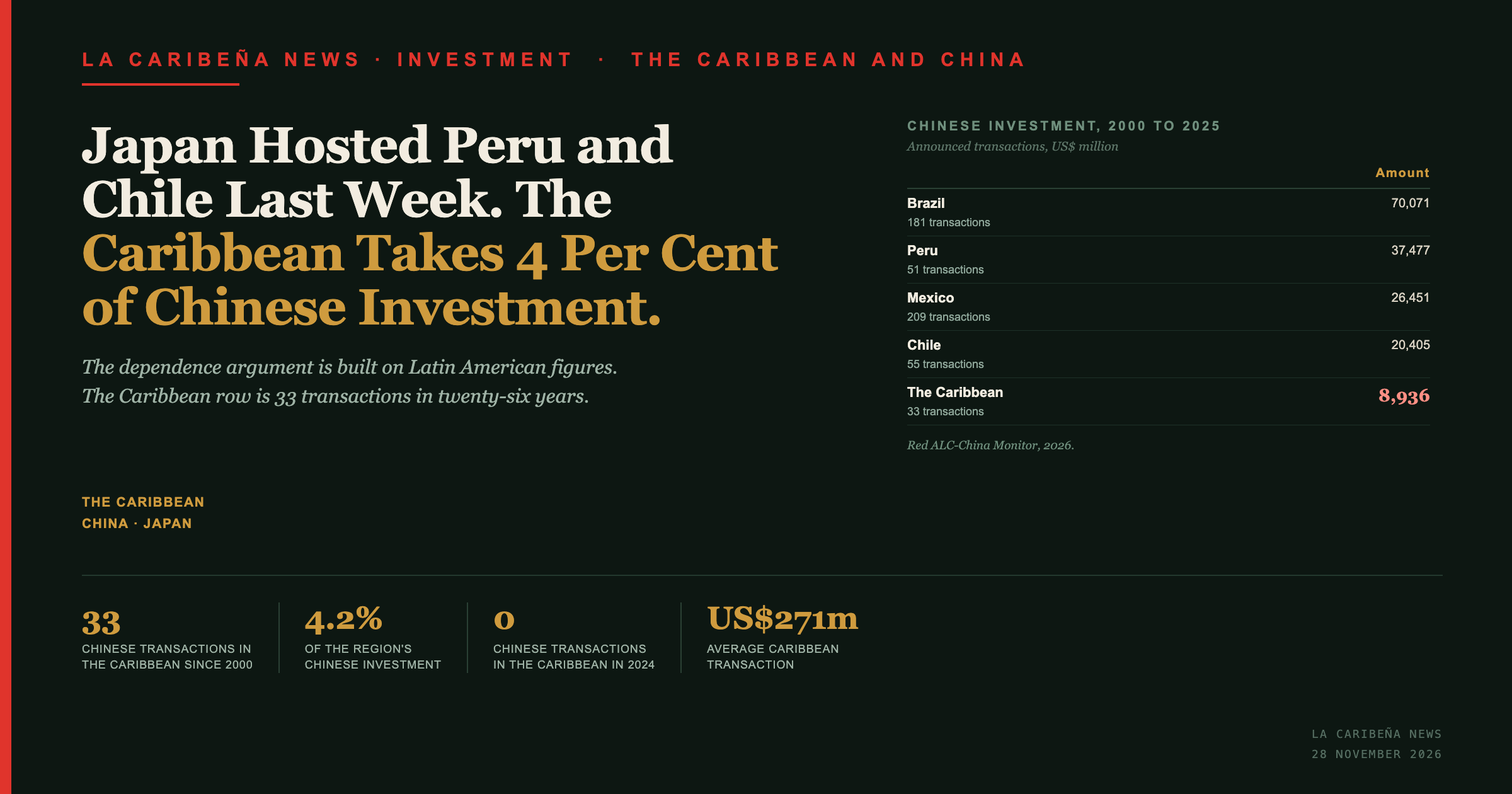
Both countries sit in the top five recipients of Chinese investment in Latin America and the Caribbean. The Caribbean sits sixth, on 4.2 per cent of the money.
What is the argument Japan is answering?
That the region's economic reliance on China has become a risk, and that Tokyo is the available alternative.
Efraín Vázquez-Vera set it out in Política Exterior on 26 November. He is an international relations scholar and a former rector of the University of Puerto Rico. His case is that the region played the China card out of financial narrowness, and that the retreat of the United States and Europe left it little else.
He cites the International Monetary Fund's finding that the region's gross public debt reaches 72.9 per cent of GDP in 2026, leaving thin fiscal room. He cites its October 2026 warning that Chinese manufactures are pressing on the region. Beijing lifted exports to the main economies by up to 5 per cent after Washington's 2025 tariffs, he writes, and passed 32 per cent of their car imports. That surplus, he argues, pushes them toward deindustrialisation.
Japan cannot match Beijing on volume, he writes, because its credit agencies work to viability and scale tests. So Tokyo competes on the quality of what it funds, and advances country by country.
He wants that turned into something binding. He names three vehicles. One is a Japan-Latin America and Caribbean summit. The others are the Pacific Alliance and a wider pact with the Inter-American Development Bank.
How much Chinese investment has the Caribbean actually received?
US$8.936 billion, across 33 transactions, over twenty-six years.
The Academic Network of Latin America and the Caribbean on China publishes the database his figures rest on. Its tenth edition, dated 15 April 2026 and compiled by Enrique Dussel Peters, counts every announced Chinese transaction in the region. It records the Caribbean as a line of its own.
| 2000 to 2025 | Transactions | US$ million | Jobs |
|---|---|---|---|
| Brazil | 181 | 70,071 | 190,121 |
| Peru | 51 | 37,477 | 53,000 |
| Mexico | 209 | 26,451 | 267,167 |
| Argentina | 73 | 25,038 | 44,143 |
| Chile | 55 | 20,405 | 25,891 |
| The Caribbean | 33 | 8,936 | 24,011 |
| Colombia | 35 | 6,902 | 111,073 |
| Venezuela | 17 | 4,219 | 11,733 |
| Central America | 20 | 2,038 | 15,148 |
| All of Latin America and the Caribbean | 742 | 213,553 | 771,115 |
Source: Monitor of Chinese OFDI in Latin America and the Caribbean 2026. Shares below are this newspaper's arithmetic on those rows.
Peru alone has taken more than four times what the Caribbean has. Brazil has taken nearly eight times.
Are Caribbean projects smaller, or just rarer?
Rarer. The ones that arrive are an ordinary size.
A Caribbean transaction averages US$271 million. The figure across the whole region is US$288 million. The gap is small enough to be noise.
The count is where the distance sits. Thirty-three transactions in twenty-six years is slightly more than one a year, into a sub-region of fifteen CARICOM members and several more states beside.
So the deficit is one of frequency, and frequency responds to different things than scale does.
What happened in 2024?
Nothing. The monitor records no Chinese transaction in the Caribbean that year.
| Year | Caribbean transactions | US$ million |
|---|---|---|
| 2020 | 2 | 284 |
| 2021 | 2 | 2,100 |
| 2022 | 1 | 300 |
| 2023 | 2 | 105 |
| 2024 | 0 | 0 |
| 2025, preliminary | 1 | 100 |
Source: the same monitor.
A single year of nil is thin evidence on its own. Set against twenty-six years that produced 33 transactions, it is the shape of the series rather than a break in it.
Where does that leave the argument?
Intact for Latin America, and describing something the Caribbean has not had.
The case needs two things. Chinese goods must land where there are industries to displace. The investment must be heavy enough to shape them. Both are measured at the top of that table. The Caribbean is at 4.2 per cent of the money and 3.1 per cent of the jobs.
That is not a correction to Vázquez-Vera, whose subject is the region's large economies and who names the Caribbean in his title rather than in his figures. It is the part of the ledger his sources do not break out.
It also bears on what he recommends. If Japan wants the binding architecture he calls for, the Caribbean is the part of the region with least Chinese presence to balance, and it is where Japan's foreign minister actually went. Toshimitsu Motegi went to Port of Spain on 7 August. Japan's foreign minister spent 70 minutes with Sean Sobers, who holds the Foreign and CARICOM Affairs portfolio. They agreed to work on natural gas, water and disaster risk, the ministry recorded. No figure appears in that readout.
What does this mean for a Caribbean business?
That the money arriving here comes through other doors, and they are named.
The regional debate about Chinese capital is an argument about five countries. They are Brazil, Peru, Mexico, Argentina and Chile. On all foreign investment, not China's alone, Mexico takes 22.3 per cent of all the foreign investment going into Latin America and the Caribbean.
Asian capital has reached the Caribbean recently by a different route. Guyana built its national payment rail with NPCI International Payments Ltd of India, and launched Fast Pay on the Indian model.
Japan named three sectors in Port of Spain and attached no money to them. For a contractor in gas, water or disaster resilience, the sectors are the signal, and the framework that would carry money behind them has not been agreed.
Title card, text equivalent
All figures on the title card, with their sources.
- US$8.936 billion and 33: Chinese investment in the Caribbean and the transactions behind it, 2000 to 2025. Source: Monitor of Chinese OFDI in Latin America and the Caribbean 2026.
- US$213.553 billion and 742: the same, for all of Latin America and the Caribbean. Source: the same.
- 4.2 per cent: the Caribbean's share of the money, and 3.1 per cent its share of the jobs. Source: La Caribeña News arithmetic on those rows.
- Zero: Chinese transactions recorded in the Caribbean in 2024. Source: the same monitor.
- 20 November 2026: the Japan-Peru summit in Tokyo. Source: Ministry of Foreign Affairs of Japan.
Entities named in this report
- The Academic Network of Latin America and the Caribbean on China publishes the investment monitor.
- Enrique Dussel Peters compiled its 2026 edition.
- Efraín Vázquez-Vera is an international relations scholar and former rector of the University of Puerto Rico, and made the argument in Política Exterior.
- Sanae Takaichi is Japan's Prime Minister and held the Tokyo summit.
- Keiko Fujimori is President of Peru and José Antonio Kast is President of Chile.
- Toshimitsu Motegi is Japan's Minister for Foreign Affairs and went to Port of Spain.
- Sean Sobers is Trinidad and Tobago's Minister of Foreign and CARICOM Affairs.
- The International Monetary Fund (IMF) is the source of the debt and trade findings he cites.
- The Inter-American Development Bank (IDB) is one of the vehicles he proposes for a Japan pact.
Frequently asked questions
How much has China invested in the Caribbean?
US$8.936 billion across 33 transactions between 2000 and 2025, carrying 24,011 jobs, on the Monitor of Chinese OFDI in Latin America and the Caribbean 2026.
What share of regional Chinese investment is that?
4.2 per cent of the money and 3.1 per cent of the jobs, against a regional total of US$213.553 billion and 771,115 jobs.
Are Chinese projects in the Caribbean smaller than elsewhere?
No. A Caribbean transaction averages US$271 million against US$288 million across the region. The difference is in how often they happen, not how big they are.
Which Caribbean countries received it?
The monitor reports the Caribbean as one line and does not break it into countries, so its figures support no per-country statement.
What did Japan offer Trinidad and Tobago?
Cooperation on natural gas, water infrastructure, disaster risk reduction, environmental challenges and people-to-people exchanges, agreed between the two foreign ministers on 7 August 2026. No figure appears in Japan's readout.