By LCN Business Desk
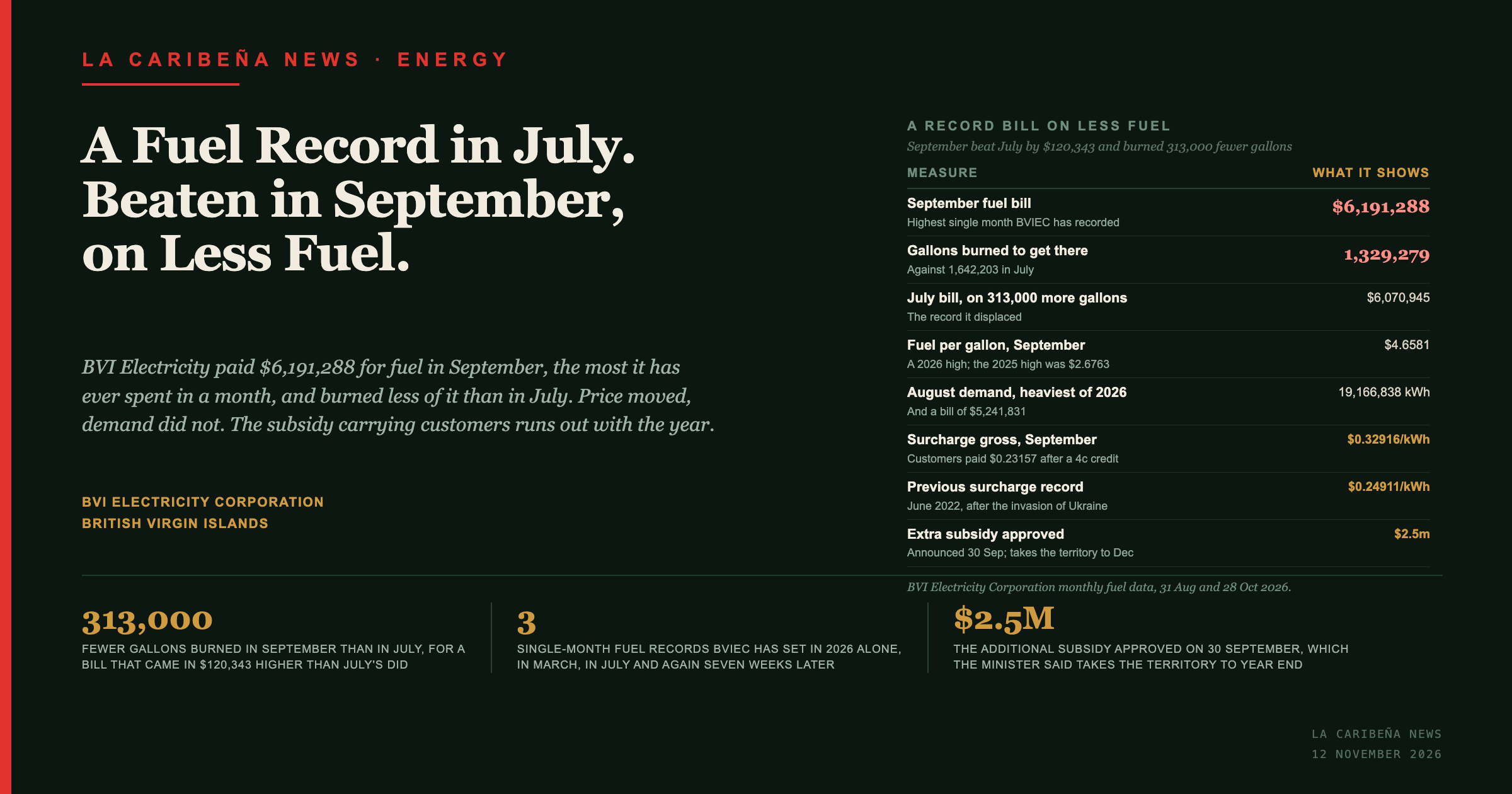
The British Virgin Islands Electricity Corporation spent $6,191,288 on fuel in September, the most it has ever spent in a month. It bought less fuel than it had in July.
What did September cost, and on how much fuel?
A record bill on the third-largest volume of the year.
| 2026 | Fuel per gallon | Value of fuel consumed | Gallons consumed | Units sold |
|---|---|---|---|---|
| April | $4.0961 | $5,125,133 | 1,221,906 | 17,252,929 kWh |
| May | $4.0051 | $5,586,749 | 1,354,923 | 16,645,119 kWh |
| June | $3.4052 | $4,901,361 | 1,382,723 | 18,039,745 kWh |
| July | $3.9609 | $6,070,945 | 1,642,203 | 18,602,364 kWh |
| August | $4.2450 | $5,241,831 | 1,220,773 | 19,166,838 kWh |
| September | $4.6581 | $6,191,288 | 1,329,279 | 18,731,791 kWh |
Source: BVI Electricity Corporation monthly fuel data, published 31 August and 28 October 2026.
September is the third record of the year. In May the corporation reported March, above $4.3 million, as its highest single-month fuel expenditure in at least two years. July took the title at $6,070,945. September took it again seven weeks later.
The record is a price record wearing a spending record. September's bill beat July's by $120,343 on 312,924 fewer gallons, and the corporation describes $4.6581 as a 2026 high against a 2025 high of $2.6763. August is the control that proves the point: it carried the heaviest demand of the year and cost nearly a million dollars less than September.
One figure in that table is not what it appears. The per-gallon price is struck on fuel purchased, from the supplier invoice, while the value column is struck on fuel consumed, and the two volumes differ. July's invoice was $5,214,075.64 for 1,316,392 gallons purchased, against 1,642,203 gallons burned. Dividing one column by the other will not reproduce the price.
Who carries the increase?
Customers, less whatever the government puts in that month.
The fuel surcharge is the mechanism. In September it was set at a gross $0.32916 per kilowatt hour and reached customers at $0.23157 after a four-cent government credit, which the corporation calls the highest customer rate of the year. August's gross was $0.26924 and customers paid $0.20775 after a one-cent credit.
The gross September rate is the number to hold. The previous surcharge record in the corporation's available figures was $0.24911 per kilowatt hour, set in June 2022 after the invasion of Ukraine. September's gross rate exceeds that by a third, and the only reason the bill landing on a customer did not is the credit.
What is the government putting in?
A million a month from April, then another $2.5 million to reach December.
Kye M. Rymer, Minister for Communications and Works, said on 30 September that Cabinet had approved an additional $2.5 million for fuel subsidies, telling the Virgin Islands Voice broadcast: "That will take us to the end of the year." An earlier programme ran for three months from April 2026 at $1 million a month.
Rymer has also set out the limit of the instrument. Repeatedly subsidising imported diesel, he has said, is not a sustainable solution.
Why does a price move hit this hard?
Because the whole bill is imported diesel, and nothing between the price and the customer absorbs it.
The corporation reports no hedge. On its own figures the fuel line moved from $3.4052 a gallon in June to $4.6581 in September, a rise of $1.2529 inside one quarter, and every cent of that arrives in the surcharge or in the subsidy. The territory is not alone in the exposure. Bahamian motorists were warned in October to brace for petrol at US$7.50 a gallon while regular petrol in the British Virgin Islands sold at US$5.15, and Dr Terrance Drew, Prime Minister of St Kitts and Nevis, has said Caribbean governments cannot dictate fuel prices.
What a government can dictate is who pays, and for how long. The $2.5 million is scheduled to run out with the year.
The entities
- BVI Electricity Corporation is the territory's electricity utility and the publisher of the monthly fuel data this report draws on.
- Kye M. Rymer is the Virgin Islands Minister for Communications and Works.
- Virgin Islands Voice is the government broadcast on which the additional subsidy was announced.
- Fuel surcharge is the per-kilowatt-hour charge through which the corporation passes fuel costs to customers.
Figures
- $6,191,288: value of fuel consumed in September 2026, the highest single-month fuel bill the corporation has recorded, and the third record of the year after March, above $4.3 million, and July at $6,070,945. - 1,329,279: gallons consumed in September, against 1,642,203 in July. - $4.6581: fuel per gallon in September, a 2026 high, against a 2025 high of $2.6763. - 19,166,838 kWh: August units sold, the heaviest demand of 2026, on a bill of $5,241,831. - $0.32916 and $0.23157: the September fuel surcharge per kilowatt hour, gross and as it reached customers after a four-cent credit. - $0.24911: the previous surcharge record, June 2022. - $2.5 million: additional fuel subsidy approved by Cabinet, announced 30 September 2026. - $1 million a month: the earlier subsidy programme, three months from April 2026.
Frequently Asked Questions
Why was the BVI's September electricity bill so high? Fuel reached $4.6581 a gallon, a 2026 high, and the corporation's fuel bill came to $6,191,288, the most it has recorded in a month. Consumption was lower than July's, so the increase was price rather than demand.
What is the fuel surcharge and what was it in September? It is the per-kilowatt-hour charge through which fuel costs reach customers. In September it was a gross $0.32916, reaching customers at $0.23157 after a four-cent government credit.
How much is the government subsidising? An earlier programme ran at $1 million a month for three months from April 2026, and Cabinet approved an additional $2.5 million announced on 30 September, which the minister said takes the territory to the end of the year.
Did the BVI use more electricity in September? No. August carried the heaviest demand of 2026 at 19,166,838 kWh, and cost $5,241,831, nearly a million dollars less than September.