By LCN Business Desk
Ghana's foreign minister said in Antigua last week that his ministry had begun examining the legal options for bringing Caribbean countries into Africa's continental trade agreement. The agreement's own text sets out what those options are, and accession is not among them.
Samuel Okudzeto Ablakwa, Ghana's Minister of Foreign Affairs, told the Commonwealth Business Forum in St John's, Antigua and Barbuda on Wednesday 4 November that Ghana is pushing to expand the African Continental Free Trade Area to include Caribbean countries, a proposal he said was championed by President John Dramani Mahama. The ministry, he said, "had begun examining legal and institutional options for an AU-CARICOM partnership".
Can a Caribbean country join AfCFTA as the agreement stands?
No. The accession clause is written for one class of state, and CARICOM members are not in it.
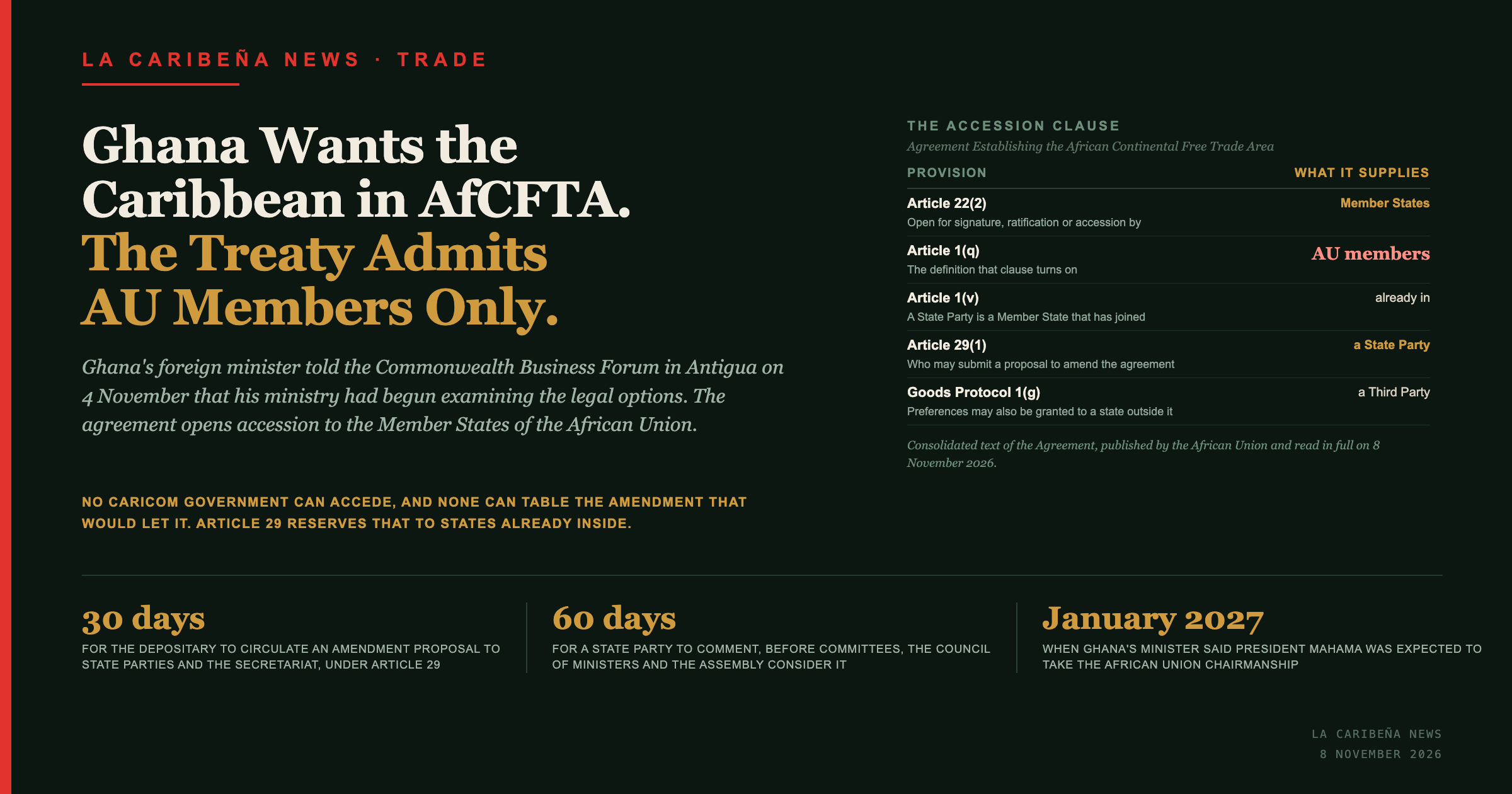
Article 22 of the Agreement Establishing the African Continental Free Trade Area provides that it "shall be open for signature and ratification or accession by the Member States, in accordance with their respective constitutional procedures". Article 1 defines the term it turns on: "'Member States' means the Member States of the African Union."
The same article defines a State Party as "a Member State that has ratified or acceded to this Agreement and for which the Agreement is in force", so the two definitions close on each other. The depositary, under Article 24, is the Chairperson of the African Union Commission.
Whether a state outside Africa could become an African Union member is governed by the Constitutive Act of the Union, a separate instrument not read here. What the trade agreement settles is narrower and firm: as drafted, it admits AU members and nobody else.
Who is allowed to propose the change?
A State Party, which means an African Union member that has already joined.
Article 29 governs amendments. Its first paragraph reads: "Any State Party may submit proposal(s) for amendment to this Agreement to the Depositary." The depositary then has thirty days to circulate the proposal, State Parties have sixty days to comment, the relevant committees and sub-committees make recommendations through the Secretariat to the Council of Ministers, a recommendation may go to the Assembly through the Executive Council, and the Assembly adopts.
Against Article 1, that sequence has a consequence for the region the proposal is about. No CARICOM government can accede, and none can table the amendment that would let it accede. The right to propose belongs to states that are already inside. Ghana is one of them, which is what makes a Ghanaian minister's remarks in Antigua a different kind of event from a Caribbean government asking to be let in.
Is there a route that needs no amendment at all?
Yes, and the agreement names the category it would use.
Article 1 defines a Third Party as "a State(s) that is not a party to this Agreement". The Protocol on Trade in Goods then defines a Preferential Trade Arrangement as "any trade arrangement by which a State Party grants preferences to imports from another State Party or a Third Party", and includes a non-reciprocal preferential scheme granted by way of waiver.
So the text already contemplates African state parties extending preferences to states outside the agreement. An arrangement of that kind between African members and CARICOM would not require the accession clause to be touched. It would also not give Caribbean exporters the thing accession would give them, which is a seat at the table where the rules are made.
The distinction matters for how a business reads the next year of announcements. An AU-CARICOM partnership, a preferential arrangement, a memorandum of understanding and accession to the agreement are four different instruments conferring four different things, and only the last makes a Caribbean state a party.
Are Caribbean central banks already on Africa's payment rail?
Eleven of them adopted it three years ago, and nothing in the trade agreement had to change.
On 26 October 2023 the governors of eleven Caribbean central banks unanimously adopted the Pan-African Payment and Settlement System as the preferred system for settling intra-regional trade transactions, and Afreximbank, which developed PAPSS, agreed to guide implementation. PAPSS was then operating in the six countries of the West African Monetary Zone.
That work has continued. Cairo-based PAPSS representatives visited Port of Spain on 18 September 2026 to show Caribbean governors how the African system was built and run, as this newspaper reported at the time. The Central Bank of Trinidad and Tobago named Governor Larry Howai as host, alongside Dr Kevin Greenidge of the Central Bank of Barbados, Timothy Antoine of the Eastern Caribbean Central Bank and John Rolle of the Central Bank of The Bahamas, with consultations continuing toward a pilot of the CARICOM Payment and Settlement System.
Dr Dorian Noel, the Trinidadian deputy governor who chairs the CAPSS Steering Committee, put the reason in the release: "The PAPSS experience offers valuable practical insights for the Caribbean as we continue to explore better options for regional payments that are less reliant on our foreign reserve currencies."
None of that required accession, an amendment, or a seat in the African Union. It is the plumbing of an Africa-Caribbean corridor being laid under the arrangements that already exist, which is the same category of instrument the Trade in Goods Protocol contemplates for preferences.
Guyana sits outside it. The Trinidadian release named no representative of the Bank of Guyana, and Guyana is not in the regional system's pilot group. Its cross-border payments work went to a different partner: the Government of Guyana signed with India's NPCI International Payments Ltd on 20 November 2024, one of ten memoranda signed when Prime Minister Narendra Modi visited Georgetown, and the Fast Pay system built on that design was announced for 2 June 2026. As this newspaper reported in September, that date passed without confirmation and the Guyana Chronicle recorded a year-end 2026 target on 3 August. On the public record this newspaper can find, no notice from the Bank of Guyana sets out Fast Pay's fees, transaction limits or participating banks, and none confirms a first day of transactions.
So the country with the region's fastest-growing economy is the one not in the group wiring itself to Africa's settlement system. Why the Bank of Guyana is absent from that group is not stated in any release this newspaper has read.
What else did Ghana put on the table?
Transport, ports, visas and labour, each of which moves without any treaty change.
Ablakwa said Ghana hoped to revive Ghana Airways in 2027 to establish direct air connectivity between the two regions. He said Ghana has signed visa waiver agreements with virtually all CARICOM member states, but that travellers often transit through countries requiring additional visas, which limits the benefit. He pointed to a port cooperation agreement recently signed between Ghana and Jamaica covering the Port of Tema and the Port of Kingston.
On labour, he said Ghanaian nurses had been deployed to Jamaica, Barbados and Antigua and Barbuda, and that President Mahama was expected to meet about 120 Ghanaian nurses who arrived in Antigua and Barbuda earlier in the year.
He proposed a phased approach led by willing countries, naming Ghana, Kenya, South Africa and Nigeria alongside Jamaica, Barbados, Antigua and Barbuda, and Trinidad and Tobago. He also said the African Union had designated CARICOM as the sixth region of Africa. That designation is a separate instrument from the trade agreement and is not read here; on the agreement's own text it confers no accession right.
Why does January 2027 matter?
Ablakwa said Mahama was expected to take the African Union chairmanship then.
The amendment path in Article 29 ends at the Assembly of Heads of State and Government, and the depositary who starts it is the Chairperson of the Commission. A head of government who holds the Union's chair is positioned at the end of that process rather than the beginning, but the proposal still has to enter through a State Party and survive the committee stage described above.
Ablakwa gave no date for Ghana tabling anything, and the published report of his remarks records an examination of options rather than a filing.
What does this mean for a Caribbean exporter?
Watch which instrument is signed, because only one of them changes a tariff.
A Caribbean business reading that the region is joining a market of 1.4 billion people is reading about the figure Ablakwa gave for the AfCFTA's 55 African Union member states and their combined gross domestic product of more than US$3 trillion. He also said intra-African trade is under 10 per cent of the total, which is the gap the agreement exists to close before it has capacity to close another one.
The scale of the existing corridor is smaller than either figure suggests. This newspaper reported on 5 November that the International Trade Centre and Afreximbank had cut their projection for Africa-Caribbean trade to up to US$1.65 billion a year by 2030, against the US$2.1 billion the heads of both institutions published sixteen months earlier, with current interregional trade at US$729 million and the Caribbean's export potential mainly in services.
Trade on that corridor is already happening without any of this. Sankofa Global brings Ghana-sourced shea and cocoa butters to the Guyana market, under the tariff schedules that exist today. The practical questions for a firm in Georgetown or Kingston are the ones Ablakwa raised that need no treaty at all: whether a direct flight exists, whether a container moves between Tema and Kingston, and whether the visa in the passport survives the transit.
The entities
- African Continental Free Trade Area (AfCFTA) is the African Union trade agreement that began trading in January 2021. Article 22 opens accession to Member States, defined in Article 1 as the Member States of the African Union. - African Union (AU) is the continental body whose membership the agreement's accession clause tracks, and whose Commission Chairperson is the agreement's depositary. - Caribbean Community (CARICOM) is the regional body whose member states the Ghanaian proposal would bring into the framework. - Samuel Okudzeto Ablakwa is Ghana's Minister of Foreign Affairs, who made the remarks in St John's on 4 November 2026. - John Dramani Mahama is the President of Ghana, named by Ablakwa as the proposal's champion and expected to take the African Union chairmanship in January 2027. - Pan-African Payment and Settlement System (PAPSS) is the Afreximbank-developed settlement system adopted by eleven Caribbean central bank governors on 26 October 2023 as the preferred system for intra-regional trade settlement. - CARICOM Payment and Settlement System (CAPSS) is the proposed regional platform for instant payments between member states in their own currencies, whose steering committee is chaired from the Central Bank of Trinidad and Tobago. - Bank of Guyana is Guyana's central bank, not named in the Central Bank of Trinidad and Tobago's release on the Port of Spain meeting of 18 September 2026. - International Trade Centre and Afreximbank are the institutions whose November 2026 report put Africa-Caribbean trade at up to US$1.65 billion a year by 2030.
What the title card says
- Headline: Ghana wants Caribbean countries inside AfCFTA, and the agreement opens accession to African Union members only. - Article 22: the agreement is open for signature, ratification or accession by the Member States. - Article 1: "Member States" means the Member States of the African Union. - Article 29: any State Party may submit proposals for amendment, and a State Party is a Member State that has already joined. - Circulation period once a proposal is filed: 30 days. - Comment period for State Parties: 60 days. - Where Ghana's minister spoke: the Commonwealth Business Forum, St John's, Antigua and Barbuda, 4 November 2026. - AfCFTA membership as given by Ghana's minister: 55 African Union member states, about 1.4 billion people, combined GDP above US$3 trillion. - Intra-African trade as a share of the total, as given by Ghana's minister: under 10 per cent. - Source: the Agreement Establishing the African Continental Free Trade Area, consolidated text, and the Ghana News Agency report of 8 November 2026.
Frequently Asked Questions
Can a CARICOM state accede to AfCFTA today?
No. Article 22 opens the agreement to the Member States, and Article 1 defines those as the Member States of the African Union. A state outside that membership has no accession route under the agreement as drafted.
What would have to change?
The agreement would have to be amended under Article 29. That requires a State Party to submit the proposal to the depositary, a thirty-day circulation, a sixty-day comment window for State Parties, consideration by the relevant committees and the Council of Ministers, and adoption by the Assembly of Heads of State and Government.
Can a Caribbean government start that process itself?
No. Article 29 reserves the right to propose an amendment to a State Party, and a State Party is defined as a Member State that has ratified or acceded. The proposal has to come from an African Union member already inside the agreement.
Is there any way to get Caribbean goods preferences without an amendment?
The Protocol on Trade in Goods defines a Preferential Trade Arrangement to include a State Party granting preferences to a Third Party, meaning a state that is not a party to the agreement. An arrangement of that kind would not require the accession clause to change.
Are Caribbean central banks already connected to Africa?
Eleven Caribbean central bank governors adopted the Pan-African Payment and Settlement System as their preferred system for settling intra-regional trade on 26 October 2023, and PAPSS representatives visited Port of Spain in September 2026 as work continued toward a CAPSS pilot. None of that required any change to the trade agreement.