By LCN Business Desk
A Caribbean feed buyer prices Brazilian corn off what Brazil cannot use at home. Rabobank says that leftover is shrinking.
What does the report actually claim?
That the way the market balances has changed. The report is "Brazil's corn market shifts as ethanol demand expands", seven pages with five figures, written by Marcela Marini and published on 18 November 2026. It names two causes, not one: better export infrastructure has cut the logistical disadvantage of the main producing regions, and corn ethanol has created recurring demand beside them.
Its wording on page three is careful. Corn ethanol "reduces the market's historical dependence on exports as the sole mechanism for balancing supply and demand", although it "does not eliminate Brazil's exportable surplus". Page four repeats the limit: this is "not an end to Brazil's exportable surplus, but a reduction in the volume that must be cleared through exports".
So the claim is about the mechanism. Exports stop being the only outlet. The report puts no number on how far exports fall, and it does not say they will. It is the bank's judgement on other institutions' data, drawn from Conab, Unica, IBGE, SECEX, IMEA, Cepea and Bloomberg, and its own disclaimer calls the forecasts "a judgement of Rabobank as at the date of this document".
How much corn is the ethanol sector taking?
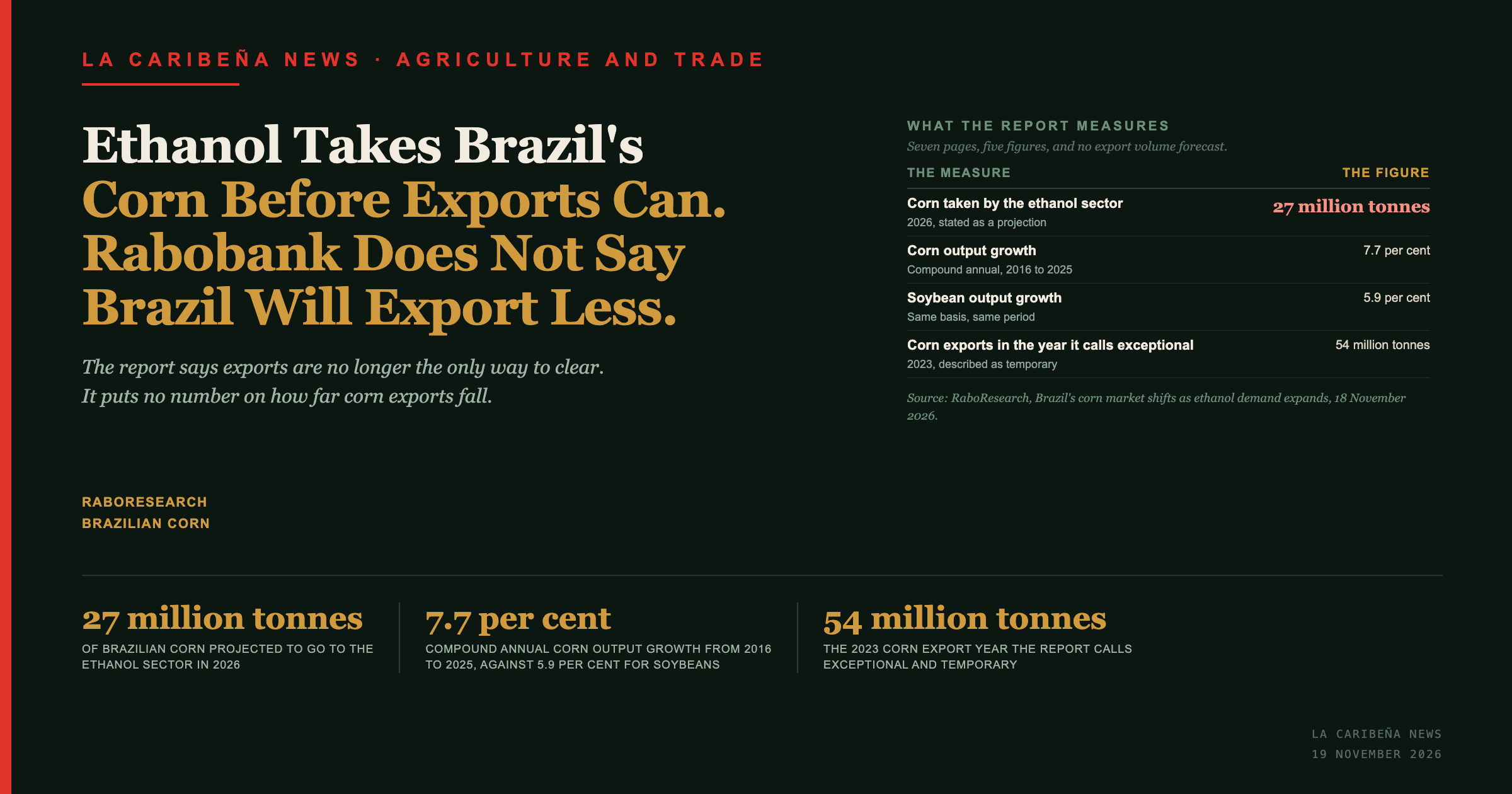
About 27 million tonnes in 2026, which the report gives as a projection rather than an outturn. It carries no share of Brazilian ethanol made from corn, no litre volume, no sized fall in export dependence and no numeric price effect, and no direct quotation from its author.
| What Rabobank measures | The figure | The period |
|---|---|---|
| Corn taken by the ethanol sector | about 27 million tonnes | 2026, projected |
| Corn output growth, compound annual rate | 7.7 per cent | 2016 to 2025 |
| Soybean output growth, same basis | 5.9 per cent | 2016 to 2025 |
| Corn exports in the year the report calls exceptional | 54 million tonnes | 2023 |
Corn has grown faster than soybeans over the decade, and the report says output has effectively doubled. It describes the 54 million tonnes of 2023 as "exceptional" and "temporary", which matters because that year is the one many buyers still price against.
Why does Mato Grosso carry the story?
Because one state now does the work of a country. Mato Grosso grows about 50 per cent of Brazil's second-crop corn. The report places it behind only the United States and China if it were counted on its own.
The state is also where the local price gap has closed. At Sorriso the basis stood at a discount of about US$3.3 a bushel in 2013. It stayed negative right through 2011 to 2015. The report says it has since "narrowed considerably". It gives no figure for where it stands now.
What does this mean for a buyer outside Brazil?
That the residual is smaller and less reliable. When exports were the only outlet, surplus corn had to leave, and the price reflected that pressure. An ethanol plant bidding for the same grain removes it before it reaches a port. Caribbean importers met the same mechanism this month, when a sixth cut to Peru's blueberry export forecast was the shortfall that reached the region.
Conab forecasts a record 366.1 million tonnes of grain, with wheat down a third and corn exports for the season just ending cut, on the state crop agency's own numbers. The Rabobank report gives the demand-side reason the two can move apart, and offers no price forecast anywhere.
Figures circulating with it are not in it. A column published on 17 November, a day before the report, cites "a Rabobank study shared with the columnist" and carries forecasts of 32 million tonnes for 2027 and 35 million for 2028, growth of about 30 per cent over two years, and two direct quotations. None of that appears in the 18 November report. Brazilian farm credit fell a fifth, and the private instrument inside it now funds almost half, which is the financing side of the same acreage.
<!-- archive: us-beef-quota-300000-tonnes-brazil-caribbean-2026 | read 19 Nov 2026 and not linked: it is a United States beef trimmings quota. Shared terms are Brazil and tonnes, a different commodity and a quota rather than a demand shift -->
The entities
- RaboResearch: the research arm of Rabobank, which published the report on 18 November 2026. - Marcela Marini: the analyst who wrote it. - Conab: Brazil's national supply company, one of the data sources named in the report and the source of the record harvest figure. - Unica: the Brazilian sugarcane and bioenergy industry association, a data source in the report's figures. - Mato Grosso: the state growing about half of Brazil's second-crop corn. - Sorriso: the Mato Grosso town whose local price basis the report tracks from 2011. - Cepea: the Brazilian agricultural economics centre, another of the report's data sources.
Frequently asked questions
Does Rabobank say Brazil will export less corn?
No. It says corn ethanol reduces the market's dependence on exports as the only way of balancing supply and demand, and that this is "not an end to Brazil's exportable surplus, but a reduction in the volume that must be cleared through exports". It gives no export volume forecast.
How much corn goes to ethanol?
About 27 million tonnes in 2026, which the report states as a projection.
How fast has Brazilian corn grown?
At a compound annual rate of 7.7 per cent between 2016 and 2025, against 5.9 per cent for soybeans. The report says output has effectively doubled over that period.
Why does the report single out Mato Grosso?
The state grows about half of Brazil's second-crop corn. The report says that on its own it would rank behind only the United States and China.
What happened to the local price gap at Sorriso?
It stood at a discount of about US$3.3 a bushel in 2013 and was negative throughout 2011 to 2015. The report says it has since narrowed considerably and gives no current figure.
Are the 32 and 35 million tonne forecasts in this report?
No. Those appear in a column published on 17 November, a day before the report, citing a Rabobank study shared with its writer. The 18 November report does not carry them, and it carries no direct quotation from its author.
Whose data is the report built on?
Conab, Unica, IBGE, SECEX, IMEA, Cepea and Bloomberg. Rabobank's disclaimer describes its forecasts as the bank's judgement as at the document's date.