By LCN Wire
What did Petrobras record and how large is it?
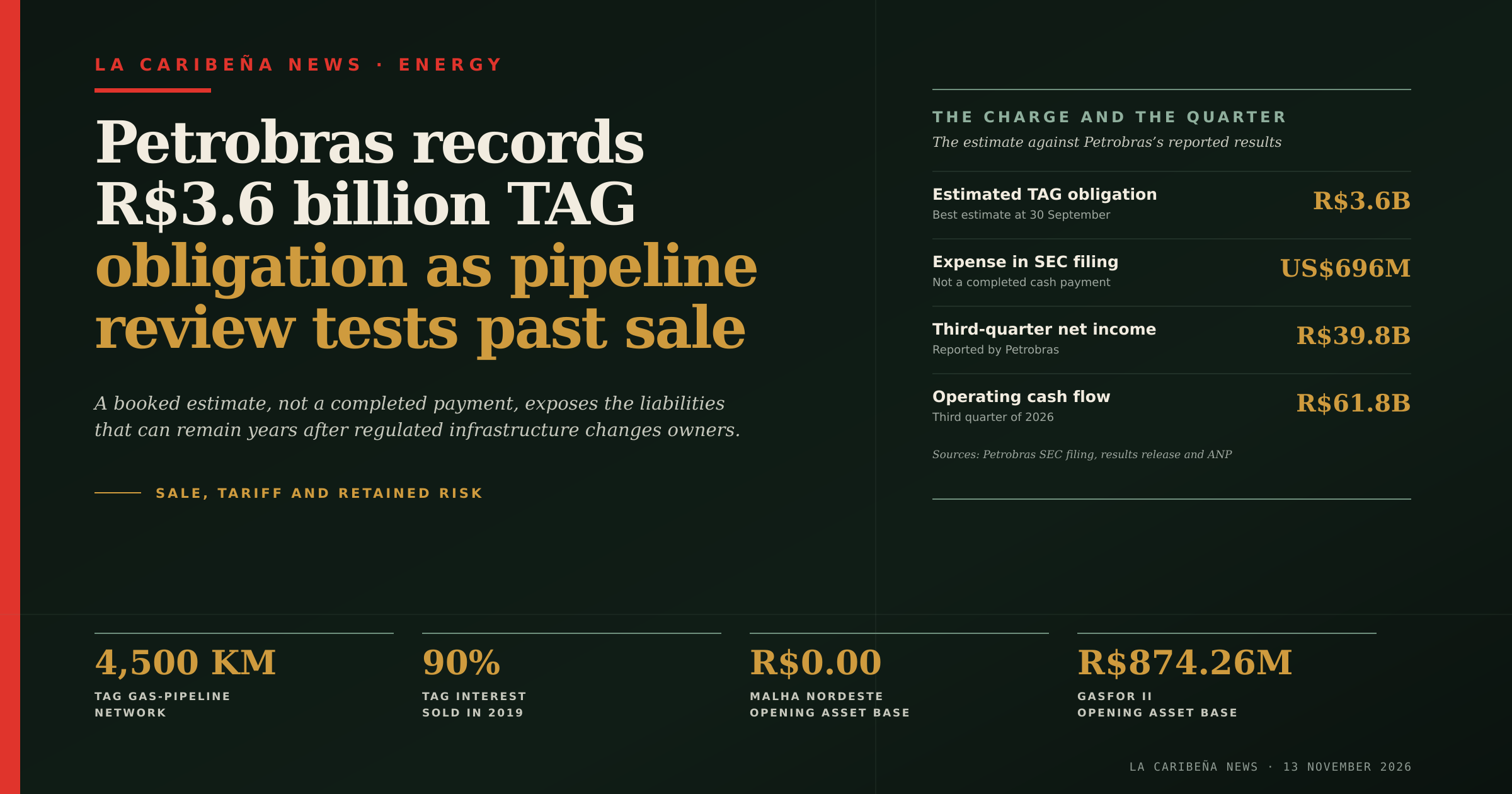
Petrobras booked a US$696 million charge from its 2019 sale of Transportadora Associada de Gás S.A., known as TAG.
The company's third-quarter financial statements filed with the United States Securities and Exchange Commission call the amount Petrobras's best estimate at 30 September. Brazilian reports put the matching obligation at R$3.6 billion.
The filing records a charge, not a payment made. It gives no settlement date and does not say the cash has left Petrobras. The figure is still uncertain, because appeals have gone to Brazil's Agência Nacional do Petróleo, Gás Natural e Biocombustíveis, or ANP, over the assumptions behind it.
Petrobras reported third-quarter net income of R$39.8 billion, or US$7.7 billion. Stripping out one-off items, it was R$47.9 billion.
The company also reported R$61.8 billion of cash from operations. On LCN's sums the TAG figure is about 5.8 per cent of that, and about 9 per cent of the quarter's reported profit.
Petrobras took the charge in a quarter of strong output and sales. In the same period crude exports reached a record 14.49 million tonnes in October. The export record does not change what Petrobras owes on TAG. It does help keep a contract charge apart from how the oil business itself is doing.
Why did a 2019 pipeline sale create an obligation in 2026?
The sale contract tied later payments to decisions the regulator would make once an existing transport deal ran out.
TAG owns about 4,500 kilometres of pipelines. An Engie-led consortium acquired 90 per cent of the company in 2019. Engie described the network as 47 per cent of Brazil's gas transmission network.
The consortium included Engie S.A., Engie Brasil Energia and Canadian pension investor La Caisse de dépôt et placement du Québec. Engie's winning bid valued that 90 per cent at US$8.6 billion.
TAG earned its money from long-term transport deals with Petrobras. Engie's transaction presentation said every bit of the network was booked under ship-or-pay terms.
So Petrobras paid for booked space whether it used it or not. Engie sold that as cover against swings in volume and price while the deals ran.
The cover did not last for ever. Once the contracts ran out, TAG's income would rest on tariffs the ANP approved. The regulator would look at the asset base, at efficient running costs, at the return it allows and at expected demand before setting them.
So the 2019 sale handed over the pipelines without settling everything they would cost. One payment under the contract still hung on a decision nobody had taken yet.
What does a zero regulatory asset base mean?
It means the ANP found nothing left for customers to repay through tariffs on TAG's Malha Nordeste network.
On 2 October, the ANP set the opening regulatory asset base for that network at R$0.00. It separately valued TAG's GASFOR II assets at R$874.26 million.
A zero value in the rules does not mean the pipes are worthless. It does not wipe out what they earn, who they serve or what they are worth to sell.
The finding is narrower. Under the ANP's method, the opening asset base counts only sound spending that past tariffs have not already repaid. The regulator decided customers had already paid for that network.
The point holds wherever a regulated asset changes hands. A buyer may pay billions for the cash it expects. The price paid does not prove customers still owe a return on what the thing cost to build.
The ANP has not set TAG's final tariff. Its review runs in three stages: the return it allows, the asset base, and the top revenue and tariff it permits.
The regulator set the real weighted average cost of capital at 7.63 per cent a year. That is a return allowed on infrastructure, not Brazil's policy rate. LCN reported separately that the Banco Central do Brasil held the Selic rate at 13.75 per cent. Treating the two as the same kind of risk gets both of them wrong.
What do ship-or-pay contracts teach Caribbean energy buyers?
They show how the risk of weak demand shifts from the owner of the pipe to a utility, a government or a big customer.
Under ship-or-pay the customer pays for booked space even when it ships less gas than planned. The owner gets steady income, which makes the project easier to fund.
The customer carries the other side of that bargain. If demand is slow, another fuel gets cheaper, or the project runs below plan, the bill can still fall due.
The same split shows up in Caribbean power and fuel contracts. A plant can bill once for being available and again for the fuel or power actually used. LCN's analysis of Guyana's rented power ships set the charge for the vessel apart from the bigger total once fuel is counted.
So a Caribbean buyer looking at a pipeline, a liquefied natural gas terminal, a power ship or a plant should ask five questions before signing:
1. What capacity must be paid for regardless of use?
2. Which party bears a fall in demand?
3. How are fuel, inflation and exchange-rate changes passed through?
4. What happens when a regulator changes the recoverable asset value?
5. Can the buyer reopen the contract if the market structure changes?
These are not reasons to reject long-term contracts. They are the terms that determine who absorbs a forecast that proves wrong.
What should Caribbean governments disclose when selling infrastructure?
They should disclose the liabilities that remain with the public seller, not only the purchase price received at closing.
A sale can retain adjustments tied to later tariff reviews, tax assessments, environmental claims, asset values or court decisions. The TAG obligation appeared in Petrobras's accounts seven years after the transaction.
For a port, pipeline, electricity network, airport or water concession, the public record should identify:
- contingent payments and refund clauses;
- guarantees and indemnities given to the buyer;
- the formula used for later price adjustments;
- the regulator's treatment of previously recovered capital;
- minimum revenue or capacity commitments;
- termination rights and compensation;
- foreign-exchange and inflation indexation;
- liabilities retained by the state or state enterprise.
The sale price also needs context. Petrobras received R$33.5 billion for the 90 per cent TAG interest, according to reporting cited in the transaction coverage. The R$3.6 billion estimate is about 10.7 per cent of that consideration.
A headline can therefore say that the state received R$33.5 billion in 2019 and still miss a material part of the bargain. The later adjustment changes the net economic result, even though it does not reverse the sale.
This is especially important where a public utility's customers financed the infrastructure through earlier tariffs. A government cannot judge the transaction only by what an investor will pay. It must also determine what customers have already paid and what they may be charged after the sale.
What happens next for Petrobras, TAG and gas users?
The ANP must complete the third stage of the tariff review and decide TAG's maximum permitted revenue and transportation tariffs.
On 12 November, the ANP said it would resume the process at an extraordinary meeting scheduled for 18 November. The review had been suspended temporarily while Petrobras and Nova Transportadora do Sudeste pursued a negotiated solution. Petrobras ended those discussions on 10 November.
Other claims and appeals remain under examination. Gas users therefore cannot treat a lower tariff as settled. TAG's owners cannot treat Petrobras's estimate as the final contractual adjustment.
Petrobras investors should watch for any revision to the US$696 million estimate, a settlement date and evidence of a cash payment. TAG customers need the final maximum revenue, operating-cost allowance and tariff.
Caribbean governments can act before facing a similar dispute. They can publish retained liabilities, distinguish asset value from unrecovered customer capital, and stress-test capacity contracts against lower demand.
The TAG pipelines changed owners in 2019. The contract's final economic allocation is still being decided in 2026.
Which entities shape the story?
- Petróleo Brasileiro S.A. (Petrobras): Brazil's state-controlled oil company and the former controlling owner of TAG.
- Transportadora Associada de Gás S.A. (TAG): the operator of about 4,500 kilometres of Brazilian gas pipelines.
- Agência Nacional do Petróleo, Gás Natural e Biocombustíveis (ANP): Brazil's regulator for petroleum, natural gas and biofuels.
- Engie S.A.: a member of the consortium that acquired the controlling TAG interest.
- Engie Brasil Energia: a member of the same consortium.
- La Caisse de dépôt et placement du Québec: the Canadian institutional investor that participated in the acquisition.
- Malha Nordeste: the TAG network for which the ANP set an opening regulatory asset base of zero.
- GASFOR II: the TAG assets given an opening regulatory value of R$874.26 million.
What will the title card show?
- Estimated TAG obligation: R$3.6 billion. Source: Petrobras third-quarter financial statements.
- Expense reported in US dollars: US$696 million. Source: Petrobras SEC filing.
- TAG network: about 4,500 kilometres. Source: Engie's acquisition announcement.
- TAG interest sold: 90 per cent. Source: Engie's acquisition announcement.
- Malha Nordeste opening asset base: R$0.00. Source: ANP decision of 2 October 2026.
- GASFOR II opening asset base: R$874.26 million. Source: ANP decision of 2 October 2026.
- Petrobras third-quarter profit: R$39.8 billion. Source: Petrobras results release.
- Petrobras operating cash flow: R$61.8 billion. Source: Petrobras results release.
Frequently Asked Questions
What did Petrobras record?
Petrobras recorded an estimated R$3.6 billion obligation linked to its 2019 sale of TAG. Its SEC filing reports the expense as US$696 million.
Has Petrobras paid the R$3.6 billion?
The cited financial statements do not record a completed payment or provide a settlement date. Petrobras describes the amount as its best estimate at 30 September 2026.
Does a zero regulatory asset base mean TAG is worthless?
No. It means the ANP found no prudent capital remaining to be recovered through future tariffs for the Malha Nordeste network. The pipelines can still produce operating revenue and hold commercial value.
Have TAG's transportation tariffs been reduced?
The asset-base decision did not establish TAG's final tariffs. The ANP must still determine maximum permitted revenue, efficient operating costs and the transportation charges.
What is ship-or-pay?
Ship-or-pay requires a customer to pay for reserved pipeline capacity even when it transports less than the contracted volume. The arrangement shifts part of the demand risk from the pipeline owner to the capacity buyer.
Why does the case matter to the Caribbean?
It shows that an infrastructure sale can leave the public seller with liabilities activated years later. It also shows why regulators must distinguish an asset's sale price from the capital customers have not yet repaid through tariffs.