By LCN Business Desk
All figures below are Guyana dollars.
The contract runs to $1,029,898,477 across four lots, News Room Guyana reported. Some 323 vendors trade in and around the market today, the same report said. The town holds 14,762 residents, the Bureau of Statistics recorded at the 2022 census. Georgetown food prices fell 0.5 per cent in August, reported in Venezuela's Food Basket Rose 12.5 Per Cent in August.
How long had anyone been asking for this?
The earliest dated written appeal found in the Guyanese press archive is 14 November 2008. Mayor Claude Henry wrote to Local Government Minister Kellawan Lall that the 75-foot tower attached to the Town Hall was "in a very deplorable condition", and that the council could not meet a repair the letter put at approximately $10 million, Kaieteur News reported in February 2010 when it published the letter. A contractor had put the job at $5.6 million in 2007. A second opinion later raised it to $15 million.
That appeal concerns the Town Hall tower, not the market floor. The market occupies the ground floor of the same 1868 building, and Town Clerk Angellina Collins named market vendors among the people obliged to pass beneath the structure every day. It is not a call to rebuild the market.
In February 2010 falling wood and broken glass caused minor injuries to a passer-by and a member of council staff. The council had raised about $1 million towards the work, from fundraising and donations. A Ministry engineer assessed the structure in April 2010 and the mayor said the findings had not been shared with the council, Kaieteur News reported; the municipality was told to remove loose material, which it did. By February 2011 the repair had passed to a private fundraising committee chaired by a bank manager, whose plan was concerts, a regatta and a food festival, Kaieteur News reported. In June 2012 a crane lifted the tower off, Kaieteur News reported. The National Trust of Guyana records the 22.86 metre structure as demolished that year owing to its dilapidated state.
Structural failure in the building that houses the market was settled by demolition, four years after the mayor wrote asking for repairs.
What did vendors themselves complain about?
Almost never the building.
Across eighteen years of archive the recorded vendor complaints are about fees, cleaning, security and competition from sellers on the road outside. In a June 2014 Stabroek News vox pop, ten vendors spoke: slow cleaning, livestock wandering in, a stall broken into with no compensation, and roadside competition drawing custom away. Two of the ten said the market was fine. In November 2017 Demerara Waves reported the Town Clerk moving to clear roadside sellers, because vendors paying for space inside kept complaining about those trading free outside.
In September 2024 dozens of vendors protested a doubling of stall fees from $500 to $1,000 a week, and washroom charges from $40 to $100, News Room Guyana reported. Farida Mohan, thirty-seven years in the market, told Stabroek News that "this market was very nice but since new one take over, the market going worse and worse". Claire Sattaur, who runs four stalls at $4,000 a week, said she sweeps around them and carries her own garbage because the council is short of staff. The council's position, on the record, was that the market operates at a loss. By October 2024 Bishwanauth Alvin, over forty years and six stalls, described stalls being abandoned, and Stabroek News ran the vendors' own phrase as its headline: the market was heading backwards. Mayor Wainwright McIntosh did not respond to that paper's request for comment.
In May 2013 Guyana Tourism Authority director Indranauth Haralsingh publicly called the New Amsterdam market the cleanest in Guyana, crediting daily cleaning and weekly pressure washing, Guyana Times reported at the time, while conceding the facility had previously been poorly maintained.
Was the market's condition ever independently surveyed?
Not in anything published.
When the Ministry of Local Government and Regional Development took the works to tender, Kaieteur News noted in June 2026 that the tender carried no engineer's estimate. No engineering assessment or condition report on the market itself appears in the published record.
The nearest thing to a survey is a party document. On 24 October 2025 Village Voice News reported an inspection by the We Invest in Nationhood party which listed washrooms described as deplorable and unsanitary, drainage overwhelmed in rain and flooding vendor stalls, sporadic pest control in the fisheries section, the rear of the compound accumulating as a dumpsite, unstable electrical systems, and structural deterioration of the council building. That list is attributable to Azruddin Mohamed and councillor Eon Lewis, not to an engineer, no other outlet carried it, and none of it has been independently verified. Parts of it match what vendors had told Stabroek News a year earlier.
Flooding is corroborated elsewhere. In July 2012 a spring tide and as much as ten inches of rain put sections of New Amsterdam under several feet of water, and Deputy Mayor Harold Dabydeen told Stabroek News that the council received no warning of unusual high tides, "so we can make preparations for the New Amsterdam market people and residents".
The New Amsterdam Market has not burned. The only fire on the Guyanese press record was a businessman burning rubbish on the vacant lot next door in September 2012, which caught the municipality's fences, Kaieteur News reported. Guyana's market-fire story is a Georgetown story, not a Berbice one.
What does the project cost, and why do the published figures differ?
The contract total is $1,029,898,477, and it is not a rounded one.
The primary record is National Procurement and Tender Administration Board contract 102/2026/13, Ministry of Local Government and Regional Development, national competitive bidding, 42 tenders received, awarded 4 August 2026. Singh & Son Construction took $334,419,383, Emerald's General Contracting & Distributors $258,387,052, A.A Construction $278,079,076 and Engineered Construction Company $159,012,966. Those four sum to $1,029,898,477 exactly.
| Lot | Contractor | Contract value |
|---|---|---|
| One | Singh & Son Construction | $334,419,383 |
| Two | Emerald's General Contracting & Distributors | $258,387,052 |
| Three | A.A Construction | $278,079,076 |
| Four | Engineered Construction Company | $159,012,966 |
| Total | $1,029,898,477 |
The four awards are on the tender board's own record. Which contractor holds which lot is the outlets' attribution, not the board's: its award entries read "Lots 1-4" without assigning them.
News Room Guyana gives that total, INews Guyana gives it, and so does the body of Kaieteur News. Origin Investments Inc. is the project consultant; its fee is not published, and no consultancy award against this contract appears in the tender board's own award record.
Kaieteur News's headline says $1.3 billion. Kaieteur News's first sentence says $1.03 billion. The four contracts fall $270,101,523 short of $1.3 billion, and nothing in the procurement record, in the ministry's statements or in any outlet's copy accounts for a sum of that size.
INews Guyana's headline calls the works a rehabilitation. Its first sentence calls them a reconstruction. The tender board describes the contract as construction of the New Amsterdam Municipal Market, and an engineer attached to the project told INews that a building at the rear of the compound will be demolished in the first phase. The 1868 fabric is not being retained, and the Department of Public Information said in August 2026 that the ageing market would be replaced by a modern, zoned facility. Minister of Local Government and Regional Development Priya Manickchand said the design tried not to deviate too far from the old market's architecture, which is homage in a new building rather than repair of an old one.
A third figure is in circulation and is not a cost. When bids opened, Kaieteur News reported that the works were expected to cost approximately $792 million. That was the lowest of the 42 combined bids, not a government estimate: the same report said no engineer's estimate was listed and that combined bids ranged from $792 million to $1.4 billion. The awards landed inside that range.
Kaieteur's June bid table put Singh & Son's lot one bid at $157,457,570, against the $334,419,383 the September reporting assigns to that lot, so either the bid table mislabelled its columns or the lot attribution is wrong.
What is being built, and can vendors really keep earning?
Three market buildings, an open vending area, parking, improved drainage and external works, phased over about twenty months, with individual buildings at thirteen to fifteen months.
The design carries more than 190 permanent stalls and a 6,230 square foot open vending area, with 33 meat stalls separated by type, another building holding 106 vegetable stalls and six dry-goods stalls, a food court, washrooms, administrative space, accessibility provisions and a service and goods lift so vendors stop hauling stock between floors. Kaieteur News prints the open area as 230 square feet, which is smaller than a single stall and is evidently a dropped digit. The outlets also differ on its capacity, Kaieteur putting it at about 320 vendors and News Room Guyana at about 515.
Manickchand called keeping the market trading a non-negotiable condition of the project. "We wanted to make sure that while we were building, we don't shut anybody down," she said. Regional Chairman Junior Bassant confirmed the old market will operate alongside the works.
Earlier works at this market went unfinished or unused. A renovation of the "back market", intended to bring roadside sellers indoors, began in 2010 and was still unfinished in mid-2011, Stabroek News reported. An abattoir the Local Government Ministry had built a few years earlier was too small to use and was later stripped of its roof and fittings by vandals. In July 2014 Local Government Minister Norman Whittaker said New Amsterdam "needs assistance", and in the same briefing named Corriverton, Rose Hall, Rosignol and Diamond as the markets receiving a $35 million improvement programme, Stabroek News reported. No national budget line for the New Amsterdam market appears in the press archives for any year between 2015 and 2025. That is an absence in the press record, not a proven absence of funding.
The complaint vendors brought to the sod-turning is the one they brought in 2014, in 2017 and in 2024. INews Guyana reported that vendors used the ceremony to raise roadside competition and the bylaws governing trade near the market. Manickchand's answer was that the new facility will hold everyone currently inside and outside it, and that "once the market is built, people have to come into the market". The September 2024 fee dispute is not addressed in any of the sod-turning coverage. The minister handed the municipality its $50 million annual central government subvention on the day.
Why does this matter to a reader in Georgetown?
Because market money has been going to the towns and past the capital for more than a decade, and this is the largest instance of it yet.
New Amsterdam is smaller than its reputation suggests. The Bureau of Statistics puts the town at 14,762 residents at the 2022 census, on preliminary results, against Corriverton's 11,488 and Rose Hall's 4,532, making it the largest of Region 6's three townships and, on the same table, Guyana's third-largest town after Georgetown and Linden. Region 6 as a whole holds 114,574 people. No official source describes the town as the region's commercial centre.
Manickchand said the New Amsterdam ceremony was the fifth sod-turning since she took the ministry, with five markets being rebuilt nationally. The last comparable programme, in 2014, spent $35 million on four markets and Stabroek News noted at the time that Georgetown's were missing from the list. That is the second programme in twelve years to reach everywhere but the capital.
Guyana increasingly lets its public works in lots to several contractors at once, which is how the Craig to Land of Canaan highway's eight contracts were structured, and the tender board that awarded this market is the same one that ran the MV Barima salvage tender. Manickchand warned the four contractors publicly that the project will finish on time and at cost "or you are going to face consequences", which is the kind of undertaking Guyana's procurement regime has historically struggled to enforce.
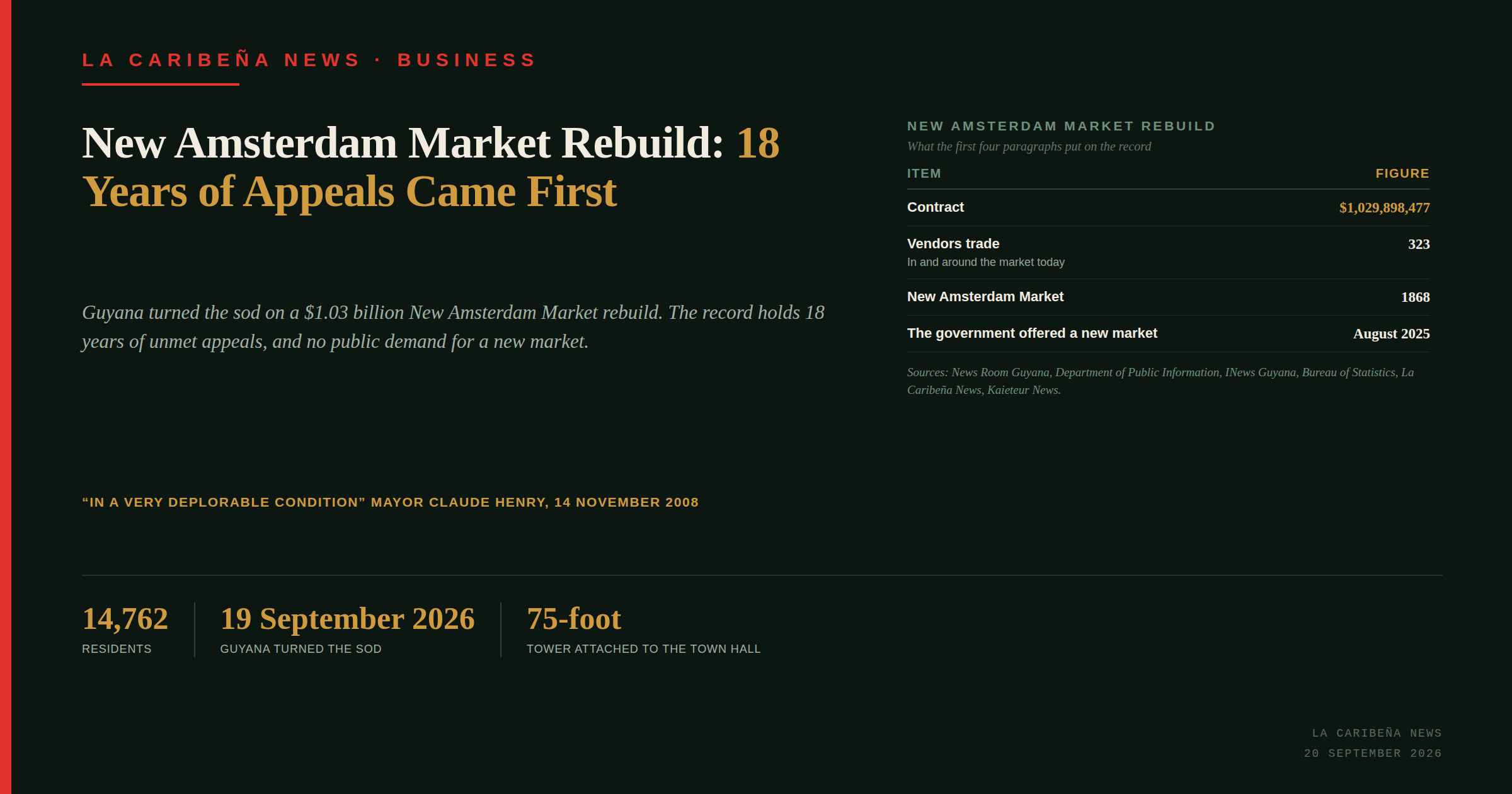
What the title card shows
- Quotation: "in a very deplorable condition", Mayor Claude Henry, 14 November 2008. Source: Kaieteur News.
- $1,029,898,477: contract. Source: News Room Guyana.
- 323: vendors trade, in and around the market today. Source: News Room Guyana.
- 1868: New Amsterdam Market. Source: Department of Public Information.
- August 2025: The government offered a new market. Source: INews Guyana.
- 14,762: residents. Source: Bureau of Statistics.
- 19 September 2026: Guyana turned the sod. Source: La Caribeña News.
- 75-foot: tower attached to the Town Hall. Source: Kaieteur News.
Frequently Asked Questions
How much does the New Amsterdam Market reconstruction cost? $1,029,898,477, across four contracts awarded under tender board contract 102/2026/13 on 4 August 2026. The four award values sum to that figure exactly. Kaieteur News's headline figure of $1.3 billion is not supported by its own body text, by the other outlets or by the procurement record, and is $270,101,523 above the contracted total.
How long have people been calling for the market to be repaired or replaced? The earliest dated written appeal found is 14 November 2008, when Mayor Claude Henry asked the Local Government Ministry to fund repairs to the tower on the 1868 building that houses the market. That is eighteen years before the sod was turned. No published demand for a new market was found anywhere in the archive before President Irfaan Ali promised one in August 2025, INews Guyana reported.
Will vendors have to stop trading during construction? Not according to the government. The work is phased, the first building to come down is at the rear of the compound, and affected vendors are to be relocated within the site. Minister Priya Manickchand called keeping the market open a non-negotiable condition, and Regional Chairman Junior Bassant confirmed the existing market will run alongside the works.
How many vendors use the market? About 323 trade in and around it at present. The new facility is designed for more than 190 permanent stalls plus an open vending area, which Kaieteur News reports as accommodating about 320 vendors and News Room Guyana as accommodating about 515.
Is the 1868 building being preserved? No. The tender board describes the contract as construction, an engineer attached to the project said demolition begins at the rear of the compound, and the minister described the design as staying close to the old market's architecture rather than keeping the structure. The tower that stood on the same building was dismantled in 2012.