By LCN Business Desk
Guyana has spent this month adding to its aviation position on paper. On Thursday it added something an aircraft can burn.
Sol Guyana Inc opened Jet A1 operations at Timehri on 26 November. The investment is more than US$10 million. Its parent company is Sunoco.
What does a second supplier change?
A price to compare against. Prime Minister Brigadier (Retired) Mark Phillips, performing the functions of President, put it in those terms at the launch, in a government press release that Guyanese outlets have carried close to word for word.
"Sol's entry into Guyana's aviation fuel market gives airlines an additional supplier at Cheddi Jagan International Airport, introducing competition that gives airlines a basis for comparing prices and service and encouraging suppliers to improve performance," he said. "The additional capacity also strengthens Guyana's case when we engage carriers considering a new route or more frequent flights."
An additional supplier implies a first. The release does not name the incumbent, and gives no market share for aviation fuel at the airport.
What else has Guyana added this month?
Agreements, a commission seat and a dated terminal. Between 16 and 19 November, Guyana signed air services agreements in Montreal with five countries. They are Canada, Curacao, Seychelles, Switzerland and Liberia. On 19 November it joined the Latin American Civil Aviation Commission, as its 23rd member.
Only Curacao among the five is visa-free for Guyanese. It is one of four whose releases state that no direct flights exist.
The Commission's open-skies treaty has granted fifth and sixth freedom traffic rights since 2010. Nine of its members have signed that treaty. Three have ratified it. A hub runs on exactly those fifth and sixth freedom rights.
Phillips dated the new arrival terminal to 2028. Infrastructure has to come with services a carrier can rely on between landing and departure, he said.
"As Government works to attract more visitors and expand Guyana's air links, we need to ensure airlines can count on the services available here at Timehri, including a reliable and competitive fuel supply," he said.
The hub question behind it is open. Guyana said on 29 September it was ready to finalise terms for a major airline to use Terminal 2 as a global hub, naming no carrier and no timeline.
Fuel is the one item on that list a carrier uses on the day it lands.
What is Guyana asking for in return?
Routes, training and notice to local firms. Phillips said Guyana added five new air routes in 2025 and is chasing more. One is a proposed direct service to Cayenne, under a renewed agreement with France.
The traffic those routes would carry is behind target. The Tourism Authority recorded 47,726 arrivals in October, a record for the month, while reaching 500,000 for the year asks November and December to grow at 11.7 per cent against ten months at 9.9.
Sol runs fuel operations at airports across the Caribbean. Phillips asked it to draw on that to train Guyanese staff, and to set out the qualifications a young Guyanese needs to enter the field.
He said he wanted people who start at the facility to reach supervisory positions. He also asked Sol to give local firms advance notice of the contracts it will put out, and of the standards they must meet, so they can decide where to invest. No contract list and no headcount were given.
The same remarks reached inland. Phillips said the Ministry of Public Utilities and Aviation reported earlier in November that bids for about 34 airstrip projects were under evaluation. The ministry's own notice of 11 November puts the figure at about 34 airstrips countrywide.
On safety he said staff must have the authority to raise concerns, and the support to see them addressed, even when a flight is behind schedule.
What should a Caribbean reader take from this?
That the constraint on a Georgetown route is moving from paper to plant.
An airline weighing a new service now has two fuel suppliers to quote against each other. It also has a terminal dated 2028, five air services agreements signed this month, and a hub negotiation with no carrier named.
A freight forwarder or ground handler has been told to expect contracts. It has not been told what they are.
The fuel is at Timehri. The routes are not yet.
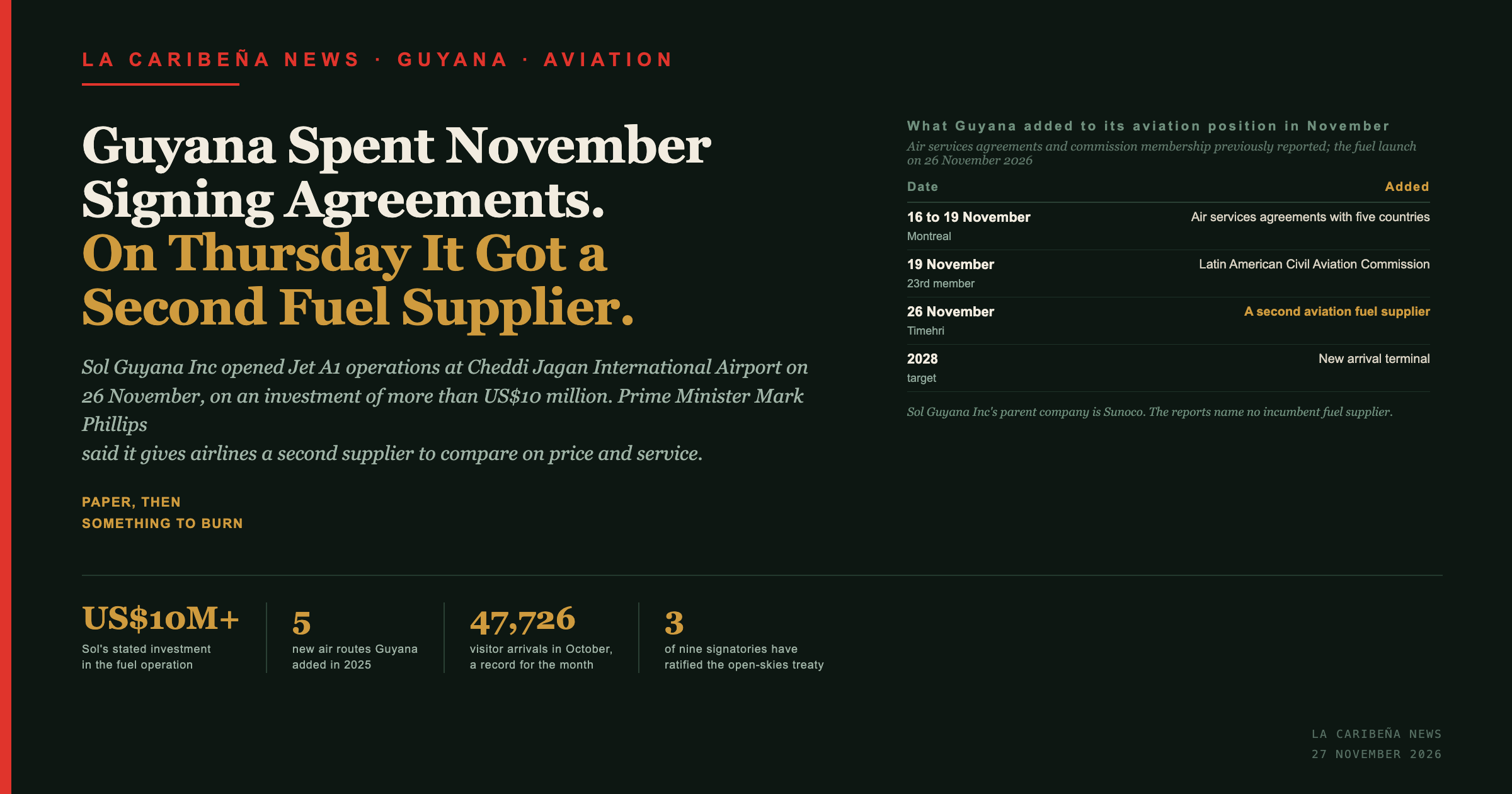
Title card, text equivalent
All figures on the title card, with their sources.
The panel sets out what Guyana added to its aviation offer in November: air services agreements with five countries signed between 16 and 19 November, membership of the Latin American Civil Aviation Commission on 19 November as its 23rd member, and a second aviation fuel supplier at Cheddi Jagan International Airport on 26 November. Sources: La Caribeña News for the first two, and the launch of 26 November 2026 for the third.
The four figures in the bottom strip:
- US$10 million: the stated investment behind Sol Guyana Inc's aviation fuel operations, described as more than that figure. Source: Prime Minister Mark Phillips at the launch, 26 November 2026.
- 2028: the target year for the new arrival terminal at the airport. Source: the same.
- 5: new air routes Guyana added in 2025. Source: the same.
- 47,726: visitor arrivals in October 2026, a record for the month. Source: La Caribeña News on the Guyana Tourism Authority's figures.
Entities named in this report
- Sol Guyana Inc opened the Jet A1 aviation fuel operation at Timehri. Its parent company is Sunoco.
- Cheddi Jagan International Airport (CJIA) at Timehri is where it sits, and where Terminal 2 is planned.
- Brigadier (Retired) Mark Phillips is Prime Minister of Guyana and was performing the functions of President at the launch.
- Jet A1 is the kerosene-grade fuel used by commercial jets.
- The Latin American Civil Aviation Commission admitted Guyana as its 23rd member on 19 November 2026.
- The Guyana Tourism Authority reports the monthly arrivals figures.
- The Ministry of Public Utilities and Aviation is evaluating bids on about 34 airstrip projects.
Frequently asked questions
What did Sol Guyana open at the airport?
Jet A1 aviation fuel operations at Cheddi Jagan International Airport, Timehri. It launched on 26 November 2026. The Prime Minister put the investment at more than US$10 million. Sol Guyana Inc's parent company is Sunoco.
Why does a second fuel supplier matter to an airline?
It gives a carrier a second quote. Prime Minister Mark Phillips said the entry lets airlines compare prices and service. He said it also strengthens Guyana's case when it approaches carriers about new or more frequent flights.
Who supplied aviation fuel at the airport before?
The reports of the launch describe Sol as an additional supplier and do not name the incumbent. No market-share figure was given.
What else did Guyana add to its aviation position this month?
Air services agreements with Canada, Curacao, Seychelles, Switzerland and Liberia, signed in Montreal between 16 and 19 November. It also joined the Latin American Civil Aviation Commission on 19 November, as its 23rd member.
When is the new terminal due?
The new arrival terminal is targeted for completion in 2028. A separate negotiation for a major airline to use Terminal 2 as a global hub has no carrier and no timeline on the record.