By LCN Business Desk
Guyana's largest industry is secured by a promise from a company that its petroleum agreement does not name. The promise is attached to a position rather than to a corporation: whoever stands above ExxonMobil Guyana Limited. On 1 July a different corporation took that position, in a different American state, while the oil-spill case sat between the Court of Appeal and the Caribbean Court of Justice. Nothing in that agreement obliged anyone to mention it.
What is Guyana arguing about?
Whether the regulator can be made to demand an unlimited guarantee from the parent of the company that holds the Stabroek permit.
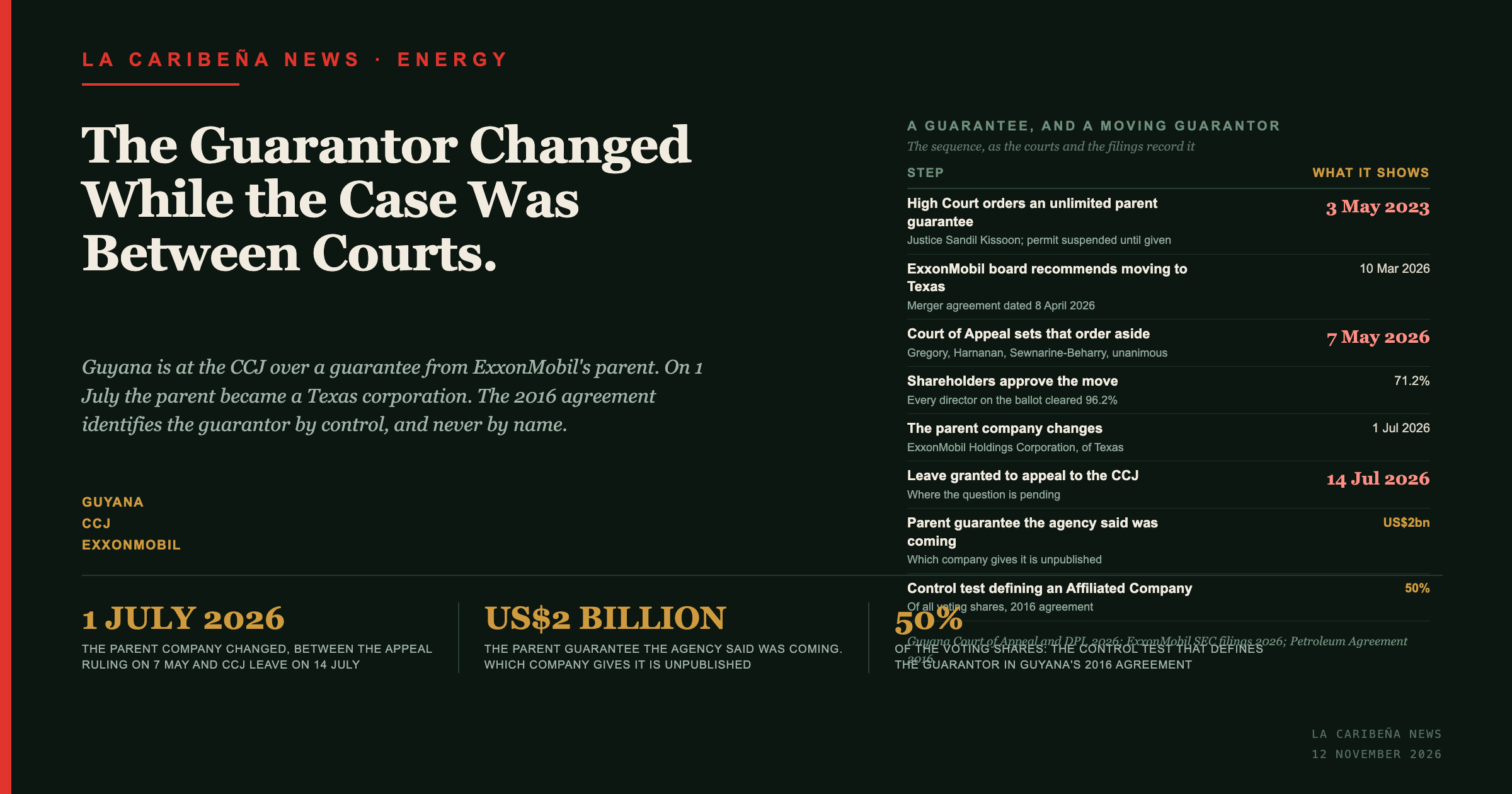
Frederick Collins and Godfrey Whyte brought proceedings against the Environmental Protection Agency over the Liza Phase One permit held by ExxonMobil Guyana Limited. On 3 May 2023 Justice Sandil Kissoon found the agency in breach, ordered that liability insurance and an unlimited parent company guarantee be provided, and ordered the permit suspended until they were. Kaieteur News reported the agency as saying Guyana was poised to receive a US$2 billion parent guarantee, and the judge as holding that the permit holder would still be in breach with it.
On Thursday 7 May 2026 the Court of Appeal, sitting as Justices Dawn Gregory, Nareshwar Harnanan and Priya Sewnarine-Beharry, unanimously set that aside, on the ground that neither the permit nor the Environmental Protection Act provides for an unlimited guarantee. Attorney General Anil Nandlall, added as a party at that stage, said afterwards that quantum and adequacy are "matters exclusively for the Government, EPA, and the Permit Holder". Leave to take the question to the Caribbean Court of Justice was granted on 14 July, and it is pending there. Both rulings are given here as reported, not as quoted from the judgments.
Who is ExxonMobil's parent company now?
ExxonMobil Holdings Corporation, of Texas, which took the position on 1 July.
Exxon Mobil Corporation, a New Jersey corporation, completed what its filings call the Redomiciliation Merger on 1 July 2026, under an Agreement and Plan of Merger between itself, ExxonMobil Holdings Corporation and Ensign LLC, both of Texas. Each share was exchanged for one share in the Texas company, which became the successor registrant under Rule 12g-3(a) of the Securities Exchange Act and now carries the XOM ticker. Shareholders approved it on 27 May by 71.2 per cent, against 96.2 per cent or better for every director on the same ballot.
The New Jersey company did not disappear. It sits one rung down, remains the primary obligor on its own debt, and on 25 September issued US$185,883,000 of notes due 2076 in its own name, guaranteed by the Texas company above it. Guyana's licence holder sits further down again: ExxonMobil Guyana Limited, registered in the Bahamas, appears in the group's most recent list of significant subsidiaries as 100 per cent owned directly or indirectly. It operates the Stabroek block on 45 per cent, with Chevron on 30 per cent and CNOOC on 25 per cent.
So the phrase "ExxonMobil's parent company" picked out one corporation in New Jersey when the case was argued in 2023, and picks out another in Texas now. Both still exist. One is above the other.
Was the move a response to the Guyanese ruling?
The dates rule it out.
ExxonMobil's board recommended the redomiciliation on 10 March 2026 and the merger agreement is dated 8 April 2026, both before the Court of Appeal ruled on 7 May. The company said at the time that the move "will not affect business operations, management, strategy, assets, or employee locations", and chairman Darren W. Woods put the case as "aligning our legal home with our operating home, in a state that understands our business". Nothing connects it to Guyana. The parent moved for reasons of American corporate law, on an American timetable, and the Guyanese proceedings ran on either side of it.
Does Guyana's petroleum agreement name the guarantor?
It does not. It defines the class of company that may give the guarantee, and leaves the choice inside that class.
The 2016 Petroleum Agreement requires each contractor party to provide "an Affiliated Company guarantee or other form of guarantee acceptable to the Minister", in proportion to its interest and for a combined ten per cent of the budget for each work commitment period. It then defines the class:
"Affiliated Company" in relation to the Contractor means, a company or corporation; (i) which is, directly or indirectly controlled by the Contractor; or (ii) which directly or indirectly, controls the Contractor; or (iii) which is, directly or indirectly, controlled by a company or corporation that also, directly or indirectly, controls the Contractor. For the purpose of this definition "control" means the right to exercise a vote of fifty percent (50%) or more of all the voting shares.
A test written on control rather than identity survives a change of identity. Limb (ii) reaches whoever controls the licence holder, however many companies up the chain and whatever that company is called. The Texas corporation entered the class on 1 July without the New Jersey one leaving it.
Article 25.1 requires the Minister's written consent before the Contractor assigns or transfers its rights. The three companies that merged were the two American corporations and Ensign LLC; ExxonMobil Guyana Limited was not among them and parted with nothing. The agreement obliges the Contractor to notify the Minister of development plans, of assets acquired and of emergencies. Across its 58 articles it nowhere obliges anyone to tell Guyana that the ownership above the Contractor has changed.
The agreement's particular articles do not always match what is said about it in general. The government has said it makes no provision for ring-fencing, and Article 11.5 of it lets the contractor allocate cost recovery to production from any field.
What does this mean for others contracting with a multinational's local subsidiary?
That the protection attaches to a position rather than to a balance sheet, and positions move.
Guyana's arrangement is the ordinary one across the region. A government or a company contracts with the local subsidiary of a large foreign group. The subsidiary is thinly capitalised by design, so the comfort comes from above it, as a parent or affiliate guarantee. That comfort is written as a relationship, because at signing nobody knows what the group will look like in a decade, and naming a single company is the brittle-looking choice.
The redomiciliation is what the flexible choice costs. The occupant of the position changed lawfully, for reasons unconnected to Guyana, during litigation about that position, and no Guyanese instrument obliged anyone to say so. The change is legible only in United States securities filings.
A control-based definition secures the position and not a particular set of accounts. The company occupying it on the day a claim is made may be an operating parent, or a holding company whose own assets are shares in its subsidiaries, and those are different things to be owed money by. Where such a claim would end up is settled elsewhere in the same agreement: Article 26.5 puts the seat of arbitration in Washington DC, under UNCITRAL rules administered by the American Arbitration Association, and an award is enforced where the guarantor and its assets are.
Which company gives the US$2 billion the agency described, and whether the instrument naming it was signed before or after 1 July, is not answered on the public record this newspaper can reach.
The entities
- ExxonMobil Guyana Limited, formerly Esso Exploration and Production Guyana Limited, holds the Stabroek interest and the Liza Phase One permit, and is registered in the Bahamas.
- ExxonMobil Holdings Corporation is the Texas corporation that became the group's publicly traded parent on 1 July 2026.
- Exxon Mobil Corporation is the New Jersey corporation it replaced, which survives one rung below it.
- Frederick Collins and Godfrey Whyte are the litigants who brought the proceedings against the Environmental Protection Agency.
- Justice Sandil Kissoon gave the 2023 High Court ruling. Justices Dawn Gregory, Nareshwar Harnanan and Priya Sewnarine-Beharry sat on the Court of Appeal.
- Anil Nandlall is Guyana's Attorney General, added as a party at the appeal.
- Stabroek block is operated by ExxonMobil on 45 per cent, with Chevron on 30 per cent and CNOOC on 25 per cent.
Figures
- 3 May 2023: the High Court ruling. 7 May 2026: the Court of Appeal reversal. 14 July 2026: leave granted to appeal to the CCJ. - 1 July 2026: the date the parent company changed, falling between the second and third of those. - 10 March 2026 and 8 April 2026: the board recommendation and the merger agreement, both before the Court of Appeal ruled. - US$2 billion: the parent guarantee the Environmental Protection Agency said Guyana was poised to receive. - 71.2 per cent: the shareholder vote for the move, against 96.2 per cent or better for every director on the same ballot. - Ten per cent: the share of each work commitment period's budget that must be covered by affiliate guarantee under the 2016 agreement. - Fifty per cent or more of the voting shares: the control threshold that defines an Affiliated Company. - US$185,883,000: notes due 2076 issued by the New Jersey company on 25 September 2026, guaranteed by the Texas parent.
Frequently Asked Questions
Who is ExxonMobil's parent company? ExxonMobil Holdings Corporation, a Texas corporation, since 1 July 2026. It replaced Exxon Mobil Corporation of New Jersey, which still exists one rung below it.
Does that change Guyana's petroleum agreement? The agreement was made with ExxonMobil Guyana Limited, which was not a party to the merger and transferred nothing. It defines the company that may guarantee the licence by control of fifty per cent or more of the voting shares rather than by name, so the new parent falls inside the same definition as the old one.
What is the CCJ case about? Whether the Environmental Protection Agency can be required to demand an unlimited parent company guarantee for oil-spill liability under the Liza Phase One permit. The High Court said yes in 2023, the Court of Appeal said no on 7 May 2026, and leave to appeal was granted on 14 July 2026.
Was ExxonMobil's move to Texas connected to the case? The board recommended it on 10 March 2026 and the merger agreement is dated 8 April 2026, both before the Court of Appeal ruled on 7 May.
Is Guyana entitled to notice when the parent changes? The 2016 agreement requires the Contractor to notify the Minister of development plans, assets acquired and emergencies. It contains no requirement to notify a change in the ownership above the Contractor.