By LCN Business Desk
What does the FAA now say caused it?
Faulty equipment, says the FAA, with its root cause analysis not finished.
Administrator Bryan Bedford named it at a press conference on 14 November. He ruled out two things that had been said all night.
We see zero evidence of anything nefarious, and zero evidence of anything AI-related. So we want to be clear that we have a equipment issue, and we're working through what this defective piece of equipment was.
He said the findings would be shared once they are ready.
Transportation Secretary Sean Duffy put the failure in a place and a task:
In at least one of our remote FAA locations, a contractor was doing routine maintenance to switch telecommunication lines from old copper wire, and they were bringing it over to fiber.
He said the move from copper to fibre has run across American institutions for decades, and in Guyana One Communications has taken down 35 tonnes of copper.
Duffy has separately described switches and routers overloaded with data. He said there was no total loss of radar or communications.
Update, 16 November 2026. When this article was published LCN declined to name the contractor, because a single uncorroborated account attributed possible errors to a named firm and no party to the inquiry had named one. The agency has since named its own network service provider. In published questions and answers dated 15 November the FAA says L3Harris “had been doing work at the El Dorado site, including deployment of a new router”, and that when the data inconsistencies occurred “L3 Harris blocked those two locations and the network stabilized”. It puts the flood at 1,000 connection attempts every four to five seconds, says 17 of its 22 air route traffic control centres became unstable, and says the broadcasting function was then disabled on about 60 similar routers as a precaution. It repeats that there is no indication of a cyberattack.
Fault has not been assigned, and the FAA's document does not attempt to. Speaking at a briefing the day before it was published, Transportation Secretary Sean Duffy said a newly installed router “started flooding other routers in our air traffic control system”, and that the agency was still working out whether the cause was “incompetence” by the contractor or “a faulty router”, The Guardian reported. Naming the provider is not the same as establishing who or what was at fault, and the root cause investigation continues.
That document also moves two numbers this article reported. It puts Friday's cancellations at approximately 12,462, including 9,082 by major airlines, against the more than 4,700 counted by FlightRadar24 above, and it adds that not all of them were directly caused by the ground stop. It also times the stop at approximately 3.30pm Eastern, where this article has 3.54pm and Secretary Duffy said 3.36pm. Three times for one event remain unreconciled.
Why did a US equipment fault reach flights that never land in the United States?
Because the test was the airspace crossed, not the airport served.
Air Canada cancelled every flight to and from the United States for the rest of the evening. It then named a second group, in its own post at 5:44pm on 13 November: "Flights to and from the Caribbean and South America may also be impacted." A later post put the condition more precisely, saying flights between Canada, the Caribbean and South America that transit US airspace might go.
The Greater Toronto Airports Authority stated the same rule from the other side. International and domestic flights "that do not require transit through the U.S. airspace will continue to operate", it said.
Together they draw a line that has nothing to do with where a passenger is going. A flight from Toronto to a Caribbean island lands nowhere in the United States. It sells no US seat and pays no US airport. It crosses US airspace, so it was in scope.
Aircraft already flying were treated differently. Air Canada said any flight already airborne had been told it could continue.
Were Caribbean flights actually cut?
One is confirmed by name. The rest is undisclosed.
A Toronto-area couple had their Air Canada flight home from Sint Maarten cancelled on the Friday. It came after boarding and more than an hour on the tarmac. They were put off the aircraft and found a hotel.
No other Caribbean departure has been confirmed cancelled. No airline and no airport has published a route-level list.
Princess Juliana International Airport in Sint Maarten, where that flight was due to leave, has published nothing about the event. Its newsroom on 14 November carried a Wingo marketing campaign and a charity walk. By its own account the airport carries more than 1.8 million passengers a year, on 30 airlines serving 34 destinations.
Searches of regional outlets by name return no coverage. A figure of thirteen affected Caribbean airports is circulating on a travel aggregator, and no carrier, airport or regulator has stated it.
So a Caribbean business cannot yet establish what the day cost its own air links. A foreign carrier issued the warning. The data sits with foreign carriers and a foreign regulator.
How large was the disruption?
More than 4,700 flights cancelled on the Friday, and three different totals for the Saturday.
FlightRadar24 put Friday at more than 4,700 cancellations and 10,000 delays. The analytics firm Cirium counted 827 diversions by 7:05pm Eastern. Of those, 670 aircraft returned to the airport they had left and 157 went somewhere else. Cirium also recorded about 11,000 flights carrying more than 1.5 million passengers still scheduled to depart US airports after 4pm.
Saturday is less settled. CTV News reported more than 2,000 US cancellations. A count attributed to FlightAware put it at 3,465 within, into or out of the United States, with 1,255 more delayed. A third figure of 3,692 is also in circulation. None of the three has been reconciled against the others.
The stop was issued at 3:54pm Eastern and the airspace reopened at 8:15pm. It was the longest in 25 years, and the second nationwide stop of all departures since the attacks of 11 September 2001.
Was this foreseen?
In writing, in September, by the United States government's own auditor.
A Government Accountability Office report of September 2026 warned about the air traffic infrastructure. The account of it comes from Tony Stanton, a former senior executive at Australia's Civil Aviation Safety Authority, speaking to Al Jazeera. It flagged ageing copper cables dating to the 1960s. It warned that delay in modernising could bring further disruption.
The report also found that officials were prioritising speed over scheduling. Changes were often made at the same time, and overwhelmed the system. On the Friday officials accepted that new technology added to the network had overloaded older parts of it. That produced intermittent gaps in communications and radar.
Duffy has called for US$50bn in upgrades.
Which Caribbean routes sit in the exposed class?
The Canadian ones, and the region is adding them this winter.
LCN reported that Puerto Plata gains three new international routes this winter. Canada's Flair starts Montreal on 18 December and Toronto on 19 December. Colombia's Wingo began a Bogota route on 6 October, adding about 8,900 seats across the season on two flights a week.
Two of those three are Canadian, and Canada to Caribbean services are the category Air Canada named.
Route concentration decides what a cancellation costs. LCN reported that United is the only carrier flying between Georgetown and Houston, a route it has run since April 2024. On 25 August the airline named ten new cities in its largest international expansion ever, and none is in the Americas. A passenger on a route served by three carriers loses a flight. A passenger on a route served by one loses the route.
When does it end?
The FAA expects full schedules by Sunday, and is measuring itself against Thanksgiving.
Bedford said he expects airlines back to full schedules by the end of Sunday 15 November. Duffy said it would take time to get back to capacity. He expected operations to be running normally into the Thanksgiving travel period. That begins in under two weeks, and is the busiest stretch of the American flying year.
Air Canada said on Saturday morning that it had cancelled about 250 flights on the Friday, affecting about 27,000 passengers, and that more had followed.
To help alleviate the situation, we have added extra flights where possible to increase capacity and accommodate affected passengers.
The entities
- Federal Aviation Administration (FAA): the United States civil aviation regulator, which ordered the ground stop and has not finished its root cause analysis. - Bryan Bedford: Administrator of the FAA, who attributed the stop to faulty equipment on 14 November 2026. - Sean Duffy: United States Secretary of Transportation, who said a contractor was switching a remote FAA site from copper wire to fibre. - Air Canada: the Canadian carrier that cancelled about 250 flights on 13 November and named Canada to Caribbean services as also exposed. - Greater Toronto Airports Authority: the operator of Toronto Pearson International Airport, which said flights not crossing US airspace would keep operating. - Princess Juliana International Airport: the Sint Maarten airport from which the one confirmed Caribbean cancellation was due to depart, and which has published nothing about the event. - Government Accountability Office (GAO): the United States congressional auditor, whose September report warned about ageing copper cabling in the air traffic network. - Cirium: the aviation analytics firm that counted the diversions.
What the title card says
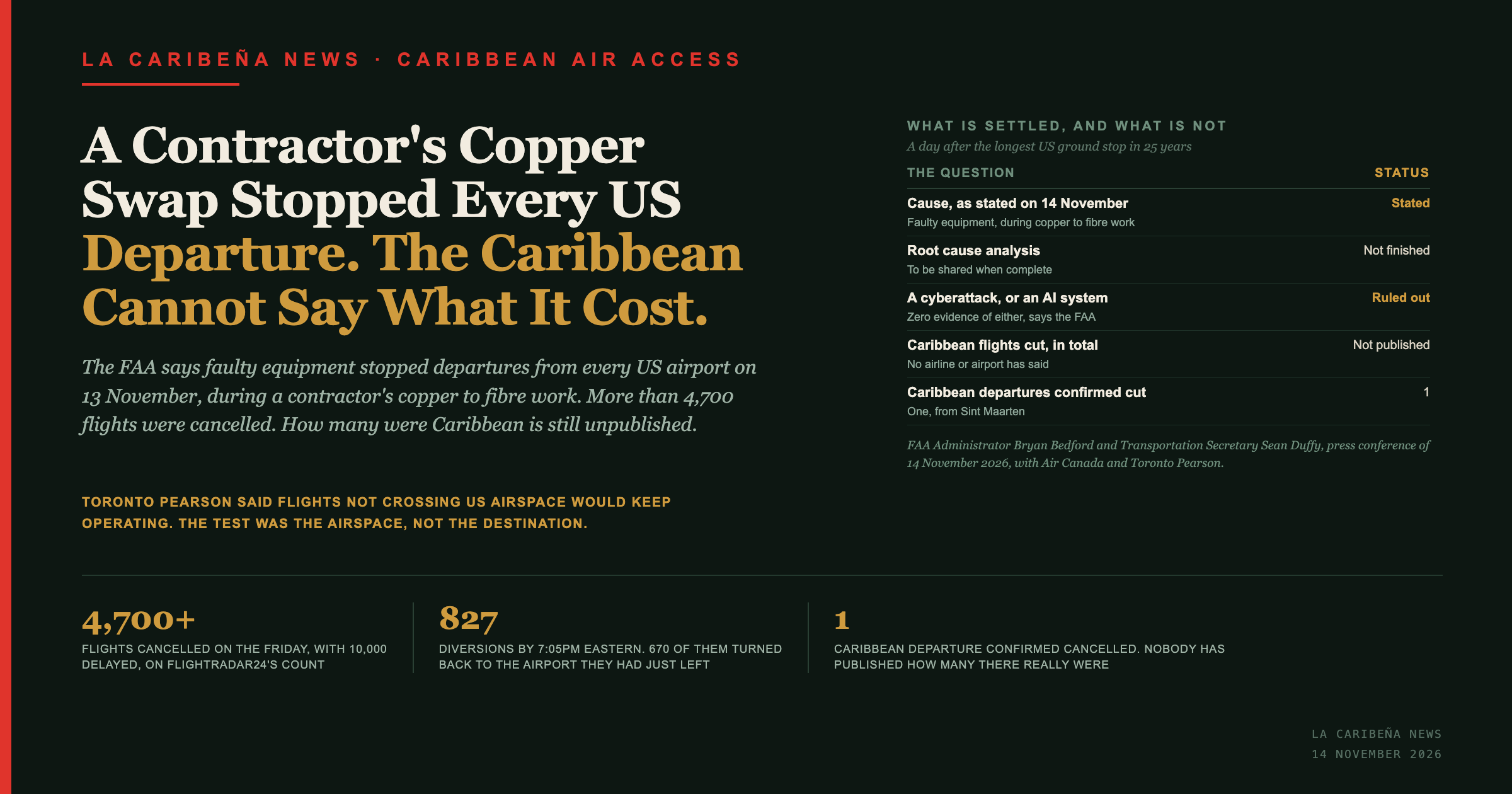
- Departures stopped: every airport in the United States, 13 November 2026. - Window: 3:54pm Eastern to 8:15pm Eastern. - Cancellations on the Friday: more than 4,700, with 10,000 delays. - Diversions by 7:05pm Eastern: 827, of which 670 returned to the airport they left. - Cause as stated on 14 November: faulty equipment, during a contractor's copper to fibre work. - Confirmed Caribbean departures cancelled: one, from Sint Maarten. - Sources: FAA statements of 13 and 14 November 2026, Air Canada, the Greater Toronto Airports Authority, FlightRadar24 and Cirium.
Frequently asked questions
What caused the ground stop?
The FAA says faulty equipment. Its administrator said on 14 November that the root cause analysis was not finished. He said it would be shared when it is.
Was it a cyberattack or an AI system?
Neither. The FAA administrator said there was zero evidence of anything nefarious, and zero evidence of anything AI-related.
Were Caribbean flights cancelled?
One Air Canada departure from Sint Maarten is confirmed cancelled. No airline, airport or regulator has said how many Caribbean flights went in total.
Why would a flight that never lands in the United States be cancelled?
Because it crosses US airspace. Toronto Pearson said flights that do not cross US airspace would keep operating. Air Canada named Canada to Caribbean services that do cross it.
How many flights were cancelled altogether?
More than 4,700 on the Friday, with 10,000 delayed, on FlightRadar24's count. Saturday totals differ by source, from more than 2,000 to 3,692.
When will schedules return to normal?
The FAA administrator said he expects full schedules by the end of Sunday 15 November.