By LCN Business Desk
A tariff is the part of market access that gets negotiated in public and reported when it ends. It is not the part that decides who ships.
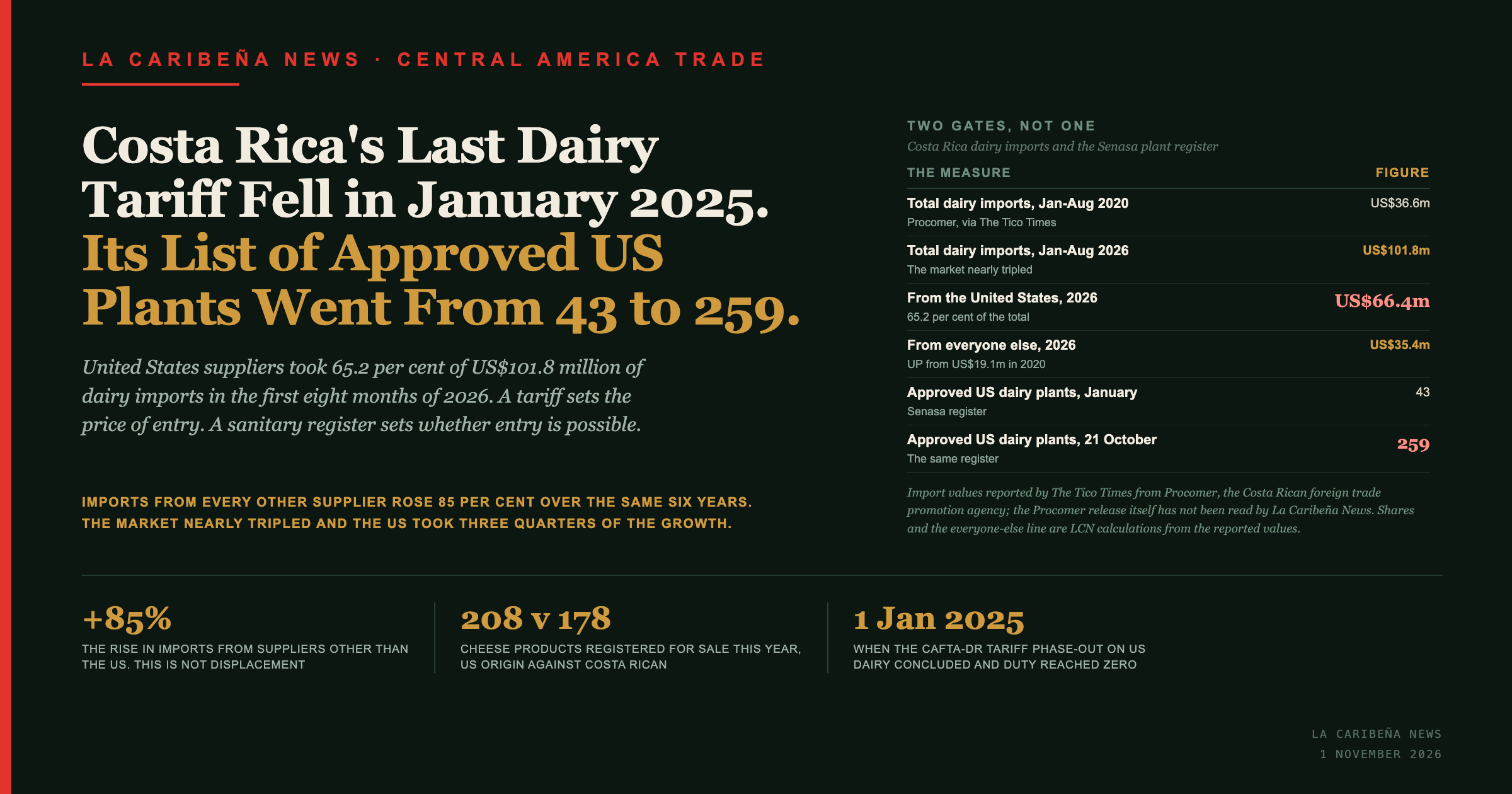
Before a single container of cheese leaves the United States for Costa Rica, the plant that made it has to appear on a list held by a Costa Rican agency. In January that list carried 43 United States dairy establishments. By 21 October it carried 259.
What has happened to the trade?
The market has nearly tripled in six years, and the United States has taken three-quarters of the growth.
| Costa Rica dairy imports, January to August | 2020 | 2026 |
|---|---|---|
| Total | US$36.6m | US$101.8m |
| From the United States | US$17.5m | US$66.4m |
| United States share | 47.8% | 65.2% |
| From everyone else | US$19.1m | US$35.4m |
*Values as reported by The Tico Times from Procomer, the Costa Rican foreign trade promotion agency. Shares and the everyone-else line are LCN calculations from those values. Imports arrived from 37 countries in 2026.*
The word that does not apply here is displacement. Every other supplier sold more dairy into Costa Rica in 2026 than in 2020, by 85 per cent in aggregate, and the European Union alone reached US$14.9 million, up 15.4 per cent on 2025. What changed is the division of a much larger market. Of the US$65.2 million by which annual imports grew over those six years, US$48.9 million came from the United States.
Anyone reaching for a story about a small producer being shut out will have to account for the fact that the small producers' own sales rose.
Why does a plant register matter more than a tariff?
Because a tariff sets the price of entry and a sanitary register sets whether entry is possible at all.
Costa Rica's Servicio Nacional de Salud Animal, Senasa, must approve each foreign establishment before its animal products may be sold in the country. Byron Gurdian, who heads epidemiological surveillance and animal health at the agency, put the principle plainly: "every foreign establishment that exports animal products to Costa Rica must be controlled by the agency."
That register went from 43 approved United States dairy plants in January to 259 in October, a sixfold rise inside ten months. A duty-free tariff line is worth nothing to a producer whose plant is not on it.
The effect shows up downstream, in the Ministry of Health's Regístrelo platform, where products are registered for sale. Between 1 January and 30 October it listed 208 cheese products of United States origin. It listed 178 from Costa Rica.
Do Costa Ricans agree on what caused it?
No, and the disagreement is on the record.
Ivannia Quesada, president of the National Chamber of Milk Producers, said the rise in plant authorisations "coincided with the rise in imports". Erick Ulate, executive director of the Free Consumers Association, said the approvals "are routine work by Senasa and its foreign counterparts". Marina Rodríguez, corporate director of sustainability and corporate relations at the dairy cooperative Dos Pinos, described the increased competition as "a challenge".
Coincidence is what Quesada claims and it is as far as the published record reaches. Nothing in it establishes that the approvals caused the imports, or that the sequence ran the other way, with approvals processed because exporters applied once the tariff reached zero.
What does this mean for a Caribbean importer?
That the date a tariff reaches zero is the date to start watching the registry, not the date the story ends.
Caribbean states import most of what they eat, and several hold trade arrangements with the United States or are negotiating terms with partners whose products face sanitary approval on arrival. The Costa Rican sequence is the useful one to hold: the tariff schedule completed, the approvals multiplied, and the import share moved. Each step is published, each is dated, and only the first of the three is usually treated as news.
LCN has reported the same market from the other direction, where New Zealand sells milk into Guyana and buys timber, and separately what happened when Washington opened 300,000 tonnes of beef to the hemisphere and only Brazil could fill it. The pattern across all three is that access on paper and access in practice are different measurements, and the second one is held by an agency rather than written into an agreement.
A firm supplying a product that needs an establishment approval in its destination market should not treat the tariff change announced in the trade press as the competitive event. The event is the month a competitor's plant appears on the list, and that list is a public document, published by the importing country, and almost never reported.
The entities
- Procomer is Costa Rica's foreign trade promotion agency, the source of the import figures.
- CAFTA-DR is the Dominican Republic-Central America-United States Free Trade Agreement, under which the tariff phase-out on United States dairy concluded on 1 January 2025.
- Senasa, the Servicio Nacional de Salud Animal, is the Costa Rican animal health service that approves foreign establishments exporting animal products.
- Regístrelo is the Costa Rican Ministry of Health platform on which products are registered for sale.
- Dos Pinos is the Costa Rican dairy cooperative.
- National Chamber of Milk Producers is the Costa Rican dairy producers' body, whose president is Ivannia Quesada.
- Free Consumers Association is the Costa Rican consumer body, whose executive director is Erick Ulate.
What the title card says
- Headline: Costa Rica's last dairy tariff fell in January 2025, and its list of approved United States plants has gone from 43 to 259.
- United States share of Costa Rica's dairy imports, January to August 2026: 65.2 per cent of US$101.8 million. Source: Procomer, as reported by The Tico Times.
- The same share in January to August 2020: 47.8 per cent of US$36.6 million. LCN calculation from the reported values.
- Senasa register of approved United States dairy plants: 43 in January 2026, 259 at 21 October 2026.
- Cheese products registered on Regístrelo, 1 January to 30 October: 208 of United States origin, 178 of Costa Rican origin.
- Imports from suppliers other than the United States rose 85 per cent over the same six years. LCN calculation.
- European Union dairy exports to Costa Rica, January to August 2026: US$14.9 million, up 15.4 per cent on 2025.
Frequently Asked Questions
What share of Costa Rica's dairy imports comes from the United States?
United States suppliers accounted for 65.2 per cent of US$101.8 million of dairy imports in the first eight months of 2026, according to figures from Procomer reported by The Tico Times. In the same period of 2020 the share was 47.8 per cent of a US$36.6 million total.
Has the United States pushed other dairy suppliers out of Costa Rica?
No. Imports from suppliers other than the United States rose from US$19.1 million to US$35.4 million over the same six years, an increase of 85 per cent by LCN's calculation. The total market nearly tripled, and the United States supplied about three-quarters of the growth rather than taking volume from others.
What changed in the tariff?
The tariff phase-out on United States dairy under CAFTA-DR concluded, and United States dairy has entered Costa Rica duty-free since 1 January 2025. One dairy-industry outlet places full liberalisation a year earlier, and the 2025 date is the better supported of the two.
What is Senasa's plant register and why does it matter?
Senasa, the Costa Rican animal health service, must approve each foreign establishment before its animal products can be sold in the country. Its register of approved United States dairy plants rose from 43 in January 2026 to 259 by 21 October. A duty-free tariff line is of no use to a producer whose plant is not approved.