By LCN Business Desk
The European Union's Entry/Exit System has been taking biometrics at every external border since 10 April 2026. Who gives fingerprints to it, and where, depends on a list written in 2018.
A Trinidadian flying to Amsterdam gives fingerprints on arrival. It takes a few minutes at the border, it costs nothing, and the journey was going to happen anyway.
A Guyanese flying to Amsterdam gives the same fingerprints months earlier, at a counter in Paramaribo or Port of Spain, having bought a flight to get there.
The biometric is identical. The difference is which annex of a European regulation the passport sits in.
The entities
- Entry/Exit System is the EU border database, the EES, created by Regulation (EU) 2017/2226. - Regulation (EU) 2018/1806 is the statute listing which nationalities need a Schengen visa, in Annex I, and which do not, in Annex II. - Visa Information System is the VIS, the EU database holding visa applicants' fingerprints. - European Travel Information and Authorisation System is ETIAS, the pre-travel authorisation for visa-exempt nationals. - Caribbean Community is CARICOM, whose member states fall on both sides of the visa list. - Schengen area is the 29 European countries operating the common border.
What does the Entry/Exit System actually take?
A face from everyone, and fingerprints only from travellers who do not hold a visa.
The system has been fully operational since 10 April 2026 at every external crossing point. It replaces the passport stamp with a digital record of entries, exits and refusals. A progressive rollout started on 12 October 2025, and the Commission reported more than 45 million crossings registered since.
The split sits in two articles of the Regulation, and it runs the opposite way to what most travellers assume.
| Traveller | What the border records | Regulation |
|---|---|---|
| Subject to a visa requirement | facial image | Article 16(1) |
| Exempt from the visa requirement | facial image and fingerprints | Article 17(1) |
| Children under 12 | no fingerprints | Article 17(3) |
| Holders of long-stay visas | outside the system | Article 2(3)(e) |
Regulation (EU) 2017/2226. Article 17(1)(c) specifies fingerprint data "from the right hand, where present, and otherwise the corresponding fingerprint data from the left hand".
A visa holder is not fingerprinted at the border because the prints are already held. They were given to a consulate when the visa was applied for, and they sit in the Visa Information System. The border reads a face and matches it to a file that exists.
So the visa-exempt traveller is the one who gives prints at the frontier. The visa-required traveller gave them earlier, somewhere else.
Which Caribbean states are on which list?
Nine members of the Caribbean Community, CARICOM, are visa-exempt. Five are not.
| Visa-exempt, Annex II | Agreement in force |
|---|---|
| Barbados | 1 March 2010 |
| Bahamas | 1 April 2010 |
| Saint Kitts and Nevis | 1 August 2015 |
| Dominica | 28 May 2015, provisional application |
| Trinidad and Tobago | 1 May 2016 |
| Grenada | 1 February 2019 |
| Antigua and Barbuda | 1 November 2021 |
| Saint Vincent and the Grenadines | 1 May 2023 |
| Saint Lucia | 1 November 2023 |
Dates from the European Union's own summary table of visa waiver agreements. Annex II also lists the British Overseas Territories of Anguilla, Bermuda, the British Virgin Islands, the Cayman Islands, Montserrat and the Turks and Caicos Islands.
Annex I, which requires a visa, carries five CARICOM members: Guyana, Jamaica, Haiti, Suriname and Belize.
That is not a ranking of anything. It is a list, and it has moved over time in one direction. Four of the nine joined in the last decade and two of those in 2023.
Is Dominica's exemption settled?
On the Union's own table it is still provisional, eleven years after it began.
Four of the Annex II entries carry a footnote. Dominica, Grenada and Saint Lucia carry footnote 4. Saint Vincent and the Grenadines carries footnote 8. The two are worded identically. The exemption "shall apply from the date of entry into force of an agreement" on visa exemption concluded with the European Union.
All four agreements were signed on 28 May 2015 and applied provisionally from that day. Three have since recorded a date of entry into force. Grenada's is 1 February 2019, Saint Vincent's 1 May 2023, Saint Lucia's 1 November 2023.
Dominica's entry still reads "28 May 2015 (provisional application)". It is the only Caribbean line on the table marked that way.
This newspaper has not read the agreement text or the Council decisions behind it, and the Union's summary page does not say what provisional application means for a traveller at a border. What can be said is narrow and checkable: the footnote ties the exemption to entry into force, and the table does not record one.
What does this cost a Guyanese traveller?
A flight, before the flight.
The French embassy in Georgetown takes fingerprints, and takes them only for people travelling to France. A Guyanese going anywhere else in the Schengen area applies in person at the Netherlands embassy in Paramaribo or the German embassy in Port of Spain. This newspaper reported in October that Guyanese fly to Suriname or Trinidad to give a fingerprint, and that the EU's own Visa Code already allows one member state to enrol biometrics for others.
President Irfaan Ali put the cost in days at a tourism conference in Georgetown on 7 October 2026. Four days, he said, before a visa to attend a conference he had been invited to.
Set that against the Trinidadian at Schiphol. Both travellers end up in the same database. One was enrolled in the course of a journey they were making anyway. The other bought a separate international flight to be enrolled in advance.
Does ETIAS change the picture?
It adds a step for the nine, and nothing for the five.
The European Travel Information and Authorisation System, ETIAS, is a pre-travel authorisation and it applies to visa-exempt nationals. It does not touch a traveller who already needs a visa, because the visa is the authorisation. It was due in the last quarter of 2026 and, on the public record this newspaper can find, no start date had been announced as at October 2026. When it does start it will reach every Annex II nationality, which in this region means the nine CARICOM members listed above and the six Caribbean British Overseas Territories beside them.
So the next change narrows the gap from the other end. The nine will acquire a form to fill and a fee to pay before travelling. The five already have an appointment to keep in another country.
What should a Caribbean business traveller do about it?
Check which list the passport is on, and plan the biometric step, not the flight.
| If your passport is | The biometric happens | Plan for |
|---|---|---|
| Annex II, visa-exempt | at the EU border, on arrival | a few extra minutes at the frontier, and ETIAS when it starts |
| Annex I, visa-required | at a consulate, before departure | the consulate's location, which may be in another country |
For a Guyanese, Jamaican, Haitian, Surinamese or Belizean company sending staff to Europe, the planning question is not the air fare. It is where the nearest consulate for the destination state is, and how far ahead it is taking appointments. The Entry/Exit System does not change that, and it does not add a second fingerprinting to it.
What it does change is the record. Entries and exits are now logged digitally against that biometric file, and the 90 days in any 180 are counted by a machine rather than read off a stamp.
What the title card says
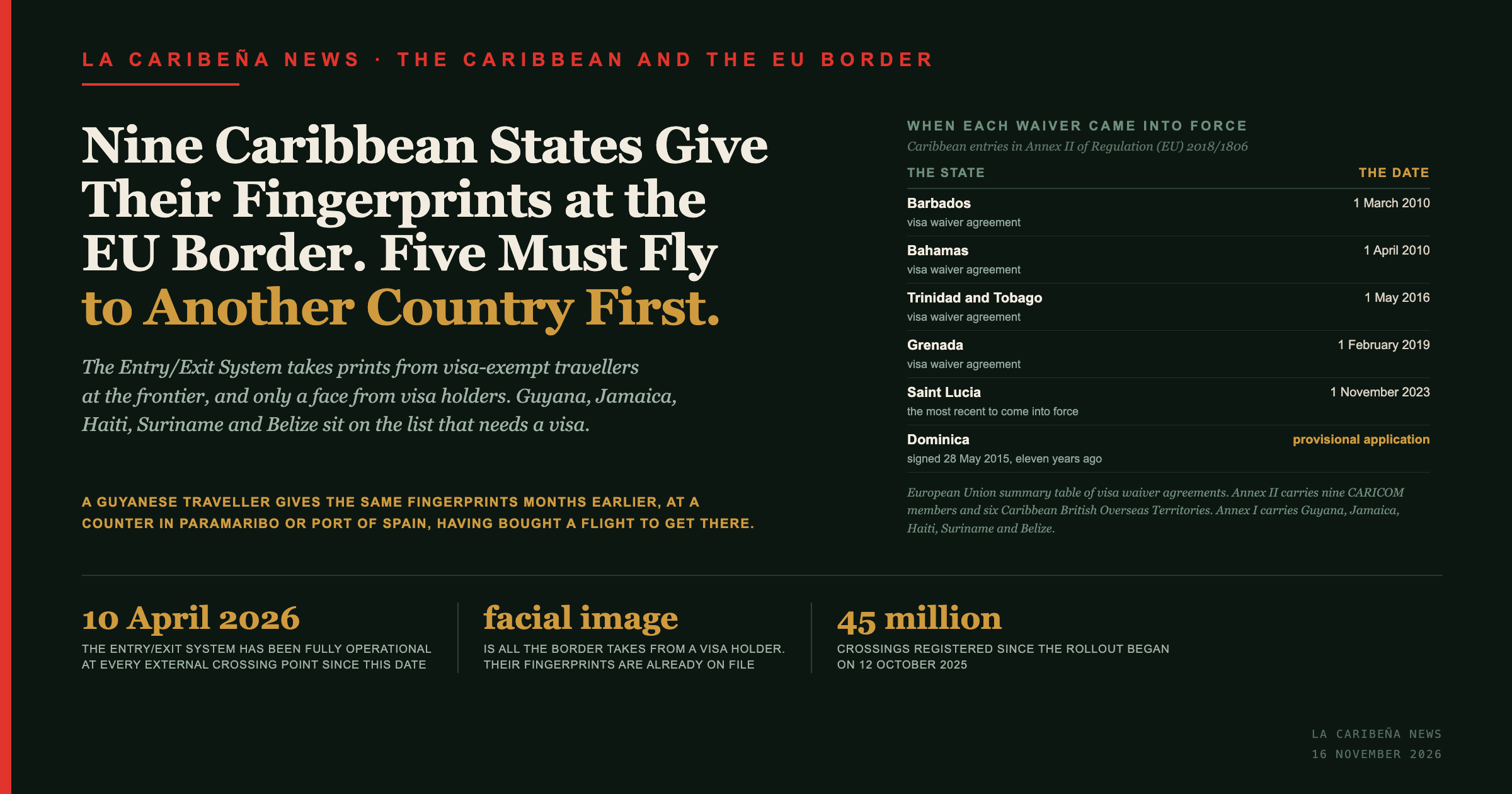
- Headline: nine Caribbean states give their fingerprints at the EU border, and five must fly to another country first. - EES fully operational: 10 April 2026, at every external crossing point. - Progressive rollout began 12 October 2025, with more than 45 million crossings registered since. - Article 16(1), visa holders: facial image recorded at the border. - Article 17(1), visa-exempt travellers: facial image and fingerprints recorded at the border. - Article 17(3): children under 12 exempt from fingerprints. - CARICOM members in Annex II, visa-exempt: 9. - CARICOM members in Annex I, visa-required: 5, being Guyana, Jamaica, Haiti, Suriname and Belize. - Dominica's visa waiver agreement: 28 May 2015, still recorded as provisional application. - Most recent Caribbean agreements to enter into force: Saint Vincent and the Grenadines, 1 May 2023, and Saint Lucia, 1 November 2023.
Frequently Asked Questions
Does the Entry/Exit System fingerprint everyone?
No. Article 17(1) of Regulation (EU) 2017/2226 records a facial image and fingerprints for travellers exempt from the visa requirement. Article 16(1) records a facial image for travellers who hold a visa, because their fingerprints are already in the Visa Information System from the visa application.
Which CARICOM states need a Schengen visa?
Five appear in Annex I of Regulation (EU) 2018/1806: Guyana, Jamaica, Haiti, Suriname and Belize. Nine appear in Annex II and are exempt, along with six British Overseas Territories in the Caribbean.
Why is Dominica's entry marked provisional?
Its visa waiver agreement was signed on 28 May 2015 and applied provisionally from that date. The European Union's summary table still records that status, where Grenada, Saint Vincent and the Grenadines and Saint Lucia now carry entry-into-force dates. The agreement text itself has not been read by this newspaper.
Does ETIAS apply to Guyanese travellers?
No. ETIAS is for visa-exempt nationals. A traveller who already requires a Schengen visa is outside it. It was due in the last quarter of 2026 and no start date had been announced as at late October.
When did the Entry/Exit System become fully operational?
10 April 2026, at all external border crossing points. A progressive rollout had begun on 12 October 2025.