By LCN Business Desk
The rocket lifted off at 8.14 in the morning from Kourou, which is about 500 miles from Georgetown and closer to Port of Spain than Miami is.
What it carried was 36 satellites for the network Amazon hopes will compete with Starlink. On the markets Amazon has named so far, none of them will sell it to anyone in the Caribbean.
What went up from Kourou on Tuesday?
Thirty-six Amazon Leo satellites, on an Ariane 64, into an orbit about 460 kilometres up.
Arianespace put the mission at 2 hours and 4 minutes from lift-off to the last satellite separating. It calls the flight VA271. Amazon calls it Leo Europe 4. It was the tenth flight of Ariane 6 and the tenth to work, and the fourth this year carrying Amazon's satellites.
The launcher flew with four of the new P160C boosters for the second time. Each holds 156 tonnes of solid propellant and lifts what Ariane 64 can carry to low orbit by a tenth, to about 22 tonnes.
Amazon has bought a lot more of these. In September it ordered six further Ariane 64 launches, which takes its order to 24.
Where can a customer actually buy Amazon Leo?
In five countries, with seven more coming through a television company.
Amazon has named the United States, the United Kingdom, France, Germany and Canada as its first markets. In South America it sells through DIRECTV Latin America and Sky Brasil. That covers seven countries: Argentina, Brazil, Chile, Colombia, Ecuador, Peru and Uruguay. In Australia it has a deal with the national broadband company, for more than 300,000 rural customers.
On the public record this newspaper can find, Amazon has named no Caribbean market. No Caribbean regulator has published a decision on an Amazon Leo application either.
Amazon's own language is careful. Steve Metayer, who runs production for Amazon Leo, said the launch was a strong result "as we prepare to roll out Amazon Leo to customers". The network is still getting ready to sell.
One thing could change that quickly. In April Amazon agreed to buy Globalstar, which brings licensed spectrum and approvals in more than 100 countries. A company that owns approvals need not apply for them.
What is already licensed in the region?
Starlink, almost everywhere, and by a different instrument each time.
Jamaica's Office of Utilities Regulation granted it service provider and carrier licences in 2022, and the hardware is there in quantity: after Hurricane Melissa, the police kept no record of receiving 696 Starlink terminals, Jamaica's Auditor General found. The Telecommunications Authority of Trinidad and Tobago, or TATT, gave it a Type 2 Concession. That runs ten years and covers a public domestic fixed network by satellite. Turks and Caicos signed a 15-year licence on 27 August 2026. The Cayman Islands issued its first satellite licence on 23 December, under a framework it wrote for the purpose. It had banned the sale of terminals there in 2024, because no licence existed to sell them under. Bonaire, Sint Eustatius and Saba hold a 15-year licence. Cuba holds no licence and the service is not sold there.
Guyana is the one that is not clear. Reports in the country say the service is running, while a telecoms market review published in May 2026 says the government is still assessing the application. Those cannot both describe the same day, and no licence register settles it.
What does a satellite licence cost in the Caribbean?
Between about 1 per cent of revenue and 7 per cent, with some territories charging a flat sum instead.
| Territory | What the operator pays |
|---|---|
| Turks and Caicos | 7 per cent of gross annual revenue, plus 1.8 per cent of gross as a regulatory fee, plus US$23,600 a year for spectrum |
| Barbados | BBD 20,000, about US$10,000, or 1 per cent of gross revenue, whichever is greater |
| Trinidad and Tobago | a flat frequency fee of about US$57,000 |
| St Vincent and the Grenadines | EC$5,000 to start, about US$1,850, then EC$12,000 a year for spectrum and 3 per cent of revenue |
| St Lucia, Grenada, Dominica, St Kitts and Nevis | EC$20,000 to start, about US$7,400, then 3 per cent of gross, plus 0.5 per cent and EC$1,500 a band for frequency |
| El Salvador | nothing for the spectrum, by decree |
Every figure above except the Turks and Caicos one comes from Starlink's own filing, dated 15 April 2025. It was arguing at the time that it was being overcharged. These are its account of what it pays elsewhere, not figures published by those regulators.
Size does not explain the spread. Trinidad and Tobago has 1.6 million people and charges a flat fee. Turks and Caicos has fewer than fifty thousand and takes a share of revenue, which rises with every customer signed. The two approaches move apart as a market grows.
What happened when the operator pushed back on the price?
The regulator kept its price. The operator signed anyway.
The Turks and Caicos Islands Telecommunications Commission ran a public consultation in 2025 on how to licence satellite internet. It set out two options, and one of them was to create a new category while keeping the 7 per cent and 1.8 per cent rates already in its fee regulations.
Starlink filed against that. Its submission says the existing rates "have historically posed an insurmountable trade barrier to Starlink's ability to serve users in Turks and Caicos". It asked for the licence fee to come down from 7 per cent of gross revenue to no more than 2 per cent of net revenue, and the regulatory fee from 1.8 per cent of gross to no more than 1 per cent of net. It argued that rates above those levels "do not accord with global best practice" and "deter market entry".
To make the case it named neighbours: El Salvador, which exempted satellite operators from spectrum charges by decree, and St Vincent and the Grenadines, "a country with a population of around 103.000 people", where it pays 3 per cent.
The Commission kept 7 per cent. Starlink signed in August 2026 for fifteen years.
That sequence is worth any Caribbean government's attention before its own talks. The largest satellite internet operator in the world put it in writing that the rate was a barrier to entry. A regulator in a country of fifty thousand people declined to move. The company took the licence on those terms.
Which territories have not settled this yet?
Trinidad and Tobago, Curaçao and Guyana, in different ways.
Trinidad licensed Starlink first and is writing the general rules afterwards. TATT put out a consultation paper on 7 September 2026, on a framework for authorising satellite services. The concession had been granted years before. Curaçao's regulator was expected to answer Starlink's application in June 2026 and no decision has been published since. Guyana's position is the contested one described above.
Regulators here have been busy this year with who may sit inside a network. INDOTEL published Resolution 100-2026 on 13 November, freezing new high-risk vendor equipment in the core of Dominican networks. A satellite licence asks that question about the sky.
What should a Caribbean business take from this?
Three things, and the first one is a date that has not been set.
A second supplier changes the price of business connectivity, and the second supplier has not applied here. A firm that budgets for competition in 2027 is budgeting for something nobody has announced.
The gate is the licence and not the satellite. The hardware passes overhead whatever a ministry decides. What settles whether a firm in Mahdia or South Caicos may lawfully buy a terminal is a piece of paper in a regulator's office.
And the price of that paper is now public. A government weighing a satellite licence can read what four of its neighbours charge, in the operator's own words, and what the operator said about the highest of those rates. These decisions run on published timetables and anyone may answer them. The Bahamian regulator has one open in another industry now, where submissions close at 5 p.m. on Friday 4 December 2026.
The entities
- Amazon Leo: Amazon's low Earth orbit satellite broadband network, renamed from Project Kuiper in November 2025. - Arianespace: the launch operator, a subsidiary of ArianeGroup, which flew the mission from French Guiana. - Turks and Caicos Islands Telecommunications Commission: the regulator that consulted on and then set the territory's satellite licensing terms. - Starlink: the SpaceX satellite internet service, licensed across most of the region. - Globalstar: the satellite operator Amazon agreed to buy in April 2026, which holds regulatory approvals in more than 100 countries. - Office of Utilities Regulation: Jamaica's regulator, which licensed Starlink in 2022. - Telecommunications Authority of Trinidad and Tobago: the regulator that granted a ten-year concession and is now consulting on a satellite framework. - INDOTEL: the Dominican Republic's telecoms regulator. - Eastern Caribbean Telecommunications Authority (ECTEL): the regional regulator covering St Lucia, Grenada, Dominica, St Kitts and Nevis and St Vincent and the Grenadines.
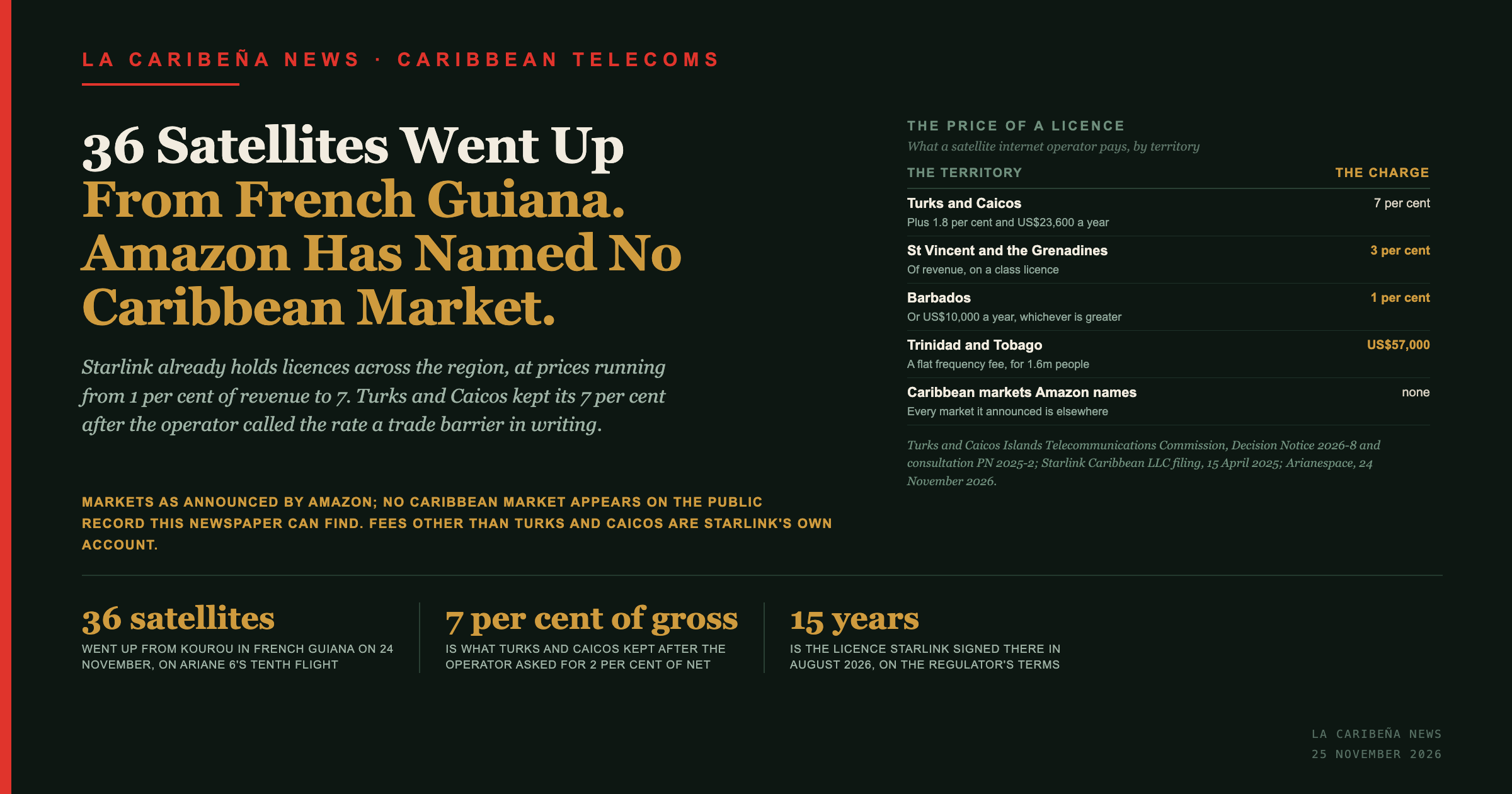
What the title card shows
36: Amazon Leo satellites launched from Kourou, French Guiana, on 24 November 2026. 460: kilometres, the orbit they were delivered into. 10: the flight number for Ariane 6, and the number of its flights that have worked. 136: Amazon Leo satellites Arianespace has placed in orbit in under ten months. 24: Ariane 64 launches Amazon has now under contract, after ordering six more in September 2026. 0: Caribbean markets Amazon has announced for the network, on the public record this newspaper can find. 7 per cent: the share of gross annual revenue Turks and Caicos charges for a satellite licence, which the operator asked to have cut to 2 per cent of net revenue and did not. 15: the length in years of the licence Starlink signed there in August 2026. Fee figures for Barbados, Trinidad and Tobago, St Vincent and the Grenadines, the four ECTEL states and El Salvador are Starlink's own account in its filing of 15 April 2025, not figures published by those regulators.
Frequently asked questions
Can a business in the Caribbean buy Amazon Leo today?
Not on anything Amazon has announced. Its named markets are the United States, the United Kingdom, France, Germany, Canada, Australia and seven South American countries reached through DIRECTV Latin America and Sky Brasil. No Caribbean regulator has published a decision on an Amazon Leo licence application on the public record this newspaper can find.
Why does a launch from French Guiana matter to the rest of the region?
Because the satellites are the supply side of a service the region buys. Kourou is inside the Caribbean's own neighbourhood, and the constellation going up from it is the one best placed to compete with the only satellite broadband service most territories have licensed.
What does Starlink pay for a Caribbean licence?
It depends entirely on the territory. Turks and Caicos charges 7 per cent of gross annual revenue plus a 1.8 per cent regulatory fee and US$23,600 a year for spectrum. Barbados charges about US$10,000 a year or 1 per cent of gross revenue, whichever is greater. St Vincent and the Grenadines charges 3 per cent. Trinidad and Tobago charges a flat frequency fee of about US$57,000.
Did Starlink object to the Turks and Caicos fee?
Yes, in writing. Its April 2025 submission to the Commission called the existing rates an insurmountable trade barrier and asked for the licence fee to fall from 7 per cent of gross revenue to no more than 2 per cent of net revenue. The Commission kept 7 per cent, and Starlink signed a 15-year licence in August 2026.
Is Starlink licensed in Guyana?
The record disagrees with itself. Reports in Guyana describe the service as operating, while a telecoms market review published in May 2026 says the government is still assessing the licence application. No published licence register settles which is current.