By LCN Business Desk
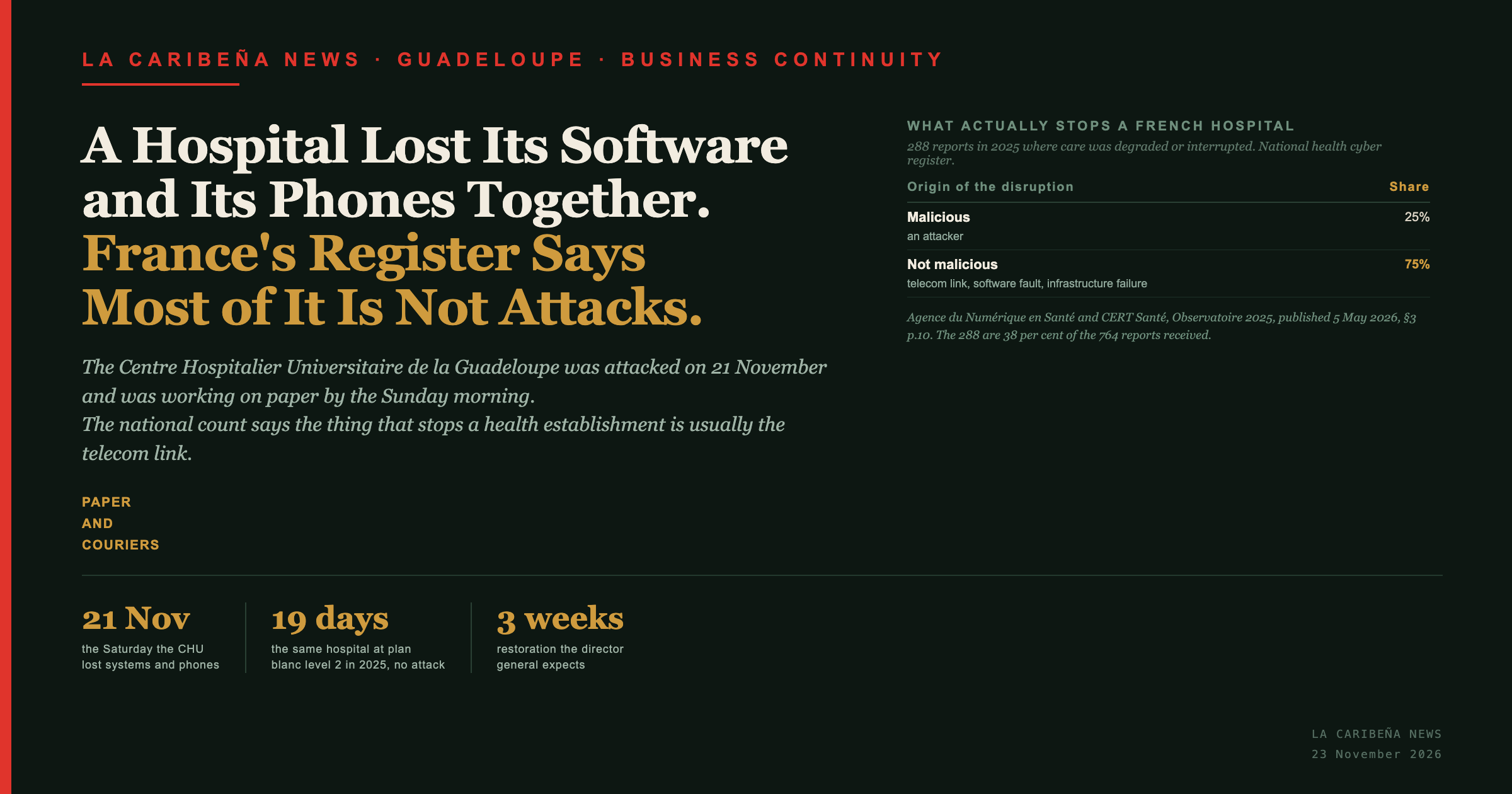
The Centre Hospitalier Universitaire de la Guadeloupe (CHU) was attacked on Saturday 21 November 2026, and by Sunday morning it was working on paper. Its computer systems and its telephone lines went together.
For a business reading this from Georgetown or Bridgetown, the attacker is the least transferable part of the story. The dependency is the transferable part.
What does the hospital say happened?
Its director general says an outside attack came in through a supplier, and he says that is not yet confirmed.
The attack landed in the middle of a physical move the hospital had been planning for years. The CHU runs three sites: Chauvel at Pointe-à-Pitre, Palais Royal, where the mother-and-child unit has been housed since a fire in 2017, and the new hospital at Belle-Plaine in Les Abymes. Belle-Plaine is the destination for the other two. The Guadeloupe business magazine Ewag, the only named publication carrying a figure for the new site, puts it at 558 beds built with 716 million euros of State money. It took its first patients on 13 April 2026.
So the week of the attack was already a week of moving wards. Chauvel was hit hardest, and the transfers were kept running through it. Paediatric emergencies crossed to Belle-Plaine overnight on 23 November as planned.
Éric Guyader runs the CHU. He told Guadeloupe La 1ère and Agence France-Presse that the hospital is the victim of an attack from outside, and that it blocked both the computer system and the phone system.
His teams did not know at first. They took it for an ordinary computer failure on the Saturday evening. Then they saw what he describes.
des bases de données cryptées inaccessibles, prouvant une attaque volontaire de notre système d'information
Encrypted databases, locked against the hospital itself.
On the route in, Guyader says the access came from an earlier hack of one of the hospital's own technology suppliers. The attackers then used that supplier's addresses. That account is the victim's own and no second party has endorsed it. Le Quotidien du Médecin calls it unconfirmed information. The health technology title DSIH says it remains to be confirmed. The supplier is not named. A supplier route is common, and it can surface long after the event. Aeroméxico told the Mexican public its customer data was taken through an outside provider, and had not reported it to the SEC. That was eleven months after the access.
The hospital's own communiqué, which has been published only as quoted by DSIH and Le Quotidien du Médecin, makes no mention of any leak of personal or medical data. That is silence rather than a denial, and Le Quotidien du Médecin records the question as neither confirmed nor denied. Neither the hospital's communiqué nor the French reporting of it uses the word ransomware. On the public record this newspaper can find, no group has claimed the attack and no ransom has been demanded.
Guyader expects full restoration to take several weeks. What was put off covers surgery and medicine alike. Operations, consultations and scans are called off in part to 27 November, the hospital cannot be reached by phone, and the emergency number 15 still works. Professor Patrick Portecop, who heads the Samu, advised nobody to present without calling the 15 first.
Why was "we will use the telephone" not available?
Because the telephone system is software on the same network as everything else.
Not long ago a hospital's phone system was its own machine. A box in a cupboard, with copper wires running out of it to every handset in the building. It broke in its own way and on its own schedule. When the computers went down the phones kept working, because the two had almost nothing to do with each other.
Then voice over internet protocol moved the phones onto the computer network. Handsets, switchboard and patient record now run over the same wires, and often behind the same logins. What reaches one of them reaches all three.
What the CHU fell back on, Guyader said, was this:
On revient au papier et au crayon, en faisant appel à des coursiers qui se déplacent d'un service à l'autre.
Paper, pencil and runners between departments.
That was the fallback inside the building. Outside it, the CHU asked other hospitals on the island to take some of its patients. Its emergency departments stayed open.
A continuity plan that falls back from computers to telephones has one path, not two, wherever both ride the same network. Twice in five days this month, the thing that spread a failure was the backup.
What does France's own register say about this kind of disruption?
That attacks are a minority of it, and the leading cause is losing the telecom link.
The Agence du Numérique en Santé and CERT Santé publish a yearly count of security incidents in the health sector. Its 2025 report, out on 5 May 2026, records 764 reports from 606 bodies. Of those, 400, or 52.4 per cent, were malicious.
In the report's own words:
288 signalements reçus en 2025 indiquent que les établissements ont été contraints de passer en mode dégradé ou d'interrompre la prise en charge des patients soit 38% des signalements reçus. Seuls 25% de ces incidents ont une origine malveillante, les 3 causes principales étant la perte de lien télécom, un bug applicatif généralement sur le DPI ou un dysfonctionnement de l'infrastructure.
Only a quarter of the incidents that stopped or degraded care were malicious. The three leading causes are loss of the telecom link, a software fault in the patient record, and a failure of the kit it all runs on.
Two bounds on that. France has one official register of this kind, so every French press figure descends from it and ours is single-sourced to it. And hospitals fell from 77 to 61 per cent of filings for a dull reason. Care homes and labs joined the register, which moved the base rather than the risk.
Has this hospital been stopped before?
Three times on the public record, and not one of them was an attack.
The CHU lost telephony including access to the emergency number 15 in October 2024. It was hit again in December 2025, across labs, radiology and the emergency unit. The dates of those two are reported inconsistently across outlets.
The third is documented precisely. On Monday 24 March 2025 the hospital triggered level 2 of the plan blanc after the failure of a storage array holding its applications and data. Its own communiqué at the time called the incident "d'origine technique et aucunement lié à une cyberattaque". It was lifted on Friday 11 April 2025, 19 days later.
The hospital is now telling patients that work is put off into the following week. Its own last such event, caused by hardware and not an attacker, ran nineteen days.
What must a French hospital report, and to whom?
Without delay, to a single portal, and the clock everyone quotes does not apply here.
The plan blanc is no longer the statute's name for the plan. Article 68 of loi n° 2019-774 of 24 July 2019 struck it from article L.3131-7 of the code de la santé publique. That article now asks only for a plan setting out what to do when an event disturbs care. It survives as level 2 of the response scale in article R.3131-10. The establishment's own director declares it under R.3131-11, telling the regional health agency without delay. The préfet cannot trigger it, and the director has no power of requisition. That belongs to the préfet under L.3131-8.
The health-sector cyber reporting duty carries no numeric deadline. Article L.1111-8-2 of the same code says establishments "signalent sans délai", without delay, and the implementing articles are D.1111-16-2 to D.1111-16-4, from décret n° 2022-715 of 27 April 2022. A hospital files once, to a single portal. From there the national agency sends it on. It reaches the health ministry, the regional agency and the Agence nationale de la sécurité des systèmes d'information (ANSSI). The hospital does not notify each of them itself.
France has not transposed the European Union's NIS2 directive. The bill passed the Senate in first reading on 12 March 2025 and the National Assembly on 17 November 2026. There is no final adoption and no promulgated law. ANSSI's own live pages still describe "sa transposition", "les futures entités essentielles" and the "projet de loi". So the directive's 24-hour and 72-hour reporting cascade does not yet bind a French hospital, whatever commercial compliance guidance asserts.
Data protection is engaged whether or not anything was taken. Under article 4(12) of the General Data Protection Regulation, a breach includes destruction, loss and alteration. Nothing has to be stolen. The European Data Protection Board's guidelines 9/2022 deal with encryption by an attacker directly. Article 33 sets the 72-hour notice to the regulator. Article 34, which governs telling the individuals, carries no 72-hour figure at all.
What should a Caribbean business take from it?
That the duty to tell anyone is the part that changes most across the region, and the dependency is the part that does not.
Whether a firm hit this way must tell its customers depends on where it sits. The same breach and the same passengers, and whether Caribbean Airlines must tell them depends on which country they booked from. The regional registers are often empty: one vendor's script reached 178 large organisations and five Caribbean cyber registers carried nothing. CARICOM has a cyber plan and critical infrastructure is still the gap, and a teaching hospital is critical infrastructure on any definition.
Where warnings come, they come from national teams. The Bahamas warned its own businesses about a ransomware group absent from the FBI advisory. And the aftermath stays unresolved for a long time: a power cut at Brazil's largest port found a virus already inside, and the port still cannot say what it reached.
A quarter of the incidents that stop a health establishment are malicious. The rest are the telecom link, the application and the infrastructure. A firm that hardens only against attackers has prepared for the smaller share of its own downtime.
The entities
- Centre Hospitalier Universitaire de la Guadeloupe (CHU): the teaching hospital attacked on 21 November 2026, running three sites mid-transfer, with the main affected site at Chauvel in Pointe-à-Pitre. - Éric Guyader: the CHU's director general, the named source for the attack account. - Chauvel: the CHU site at Pointe-à-Pitre, hit hardest by the attack. - Palais Royal: the site housing the mother-and-child unit since a fire in 2017, moving to Belle-Plaine. - Belle-Plaine: the new hospital site at Les Abymes, carrying 558 beds, State-financed at 716 million euros, which took its first patients on 13 April 2026. - Plan blanc: level 2 of the French hospital response scale under article R.3131-10 of the code de la santé publique, declared by the establishment's director. - Agence du Numérique en Santé and CERT Santé: the bodies publishing the annual Observatoire of health-sector security incident reports. - Agence nationale de la sécurité des systèmes d'information (ANSSI): the French cyber agency, which the director general says identified the likely route in. - NIS2 directive: the European Union network and information security directive that France has not yet transposed. - General Data Protection Regulation: the regulation whose article 4(12) treats loss of availability as a breach.
What the title card shows
21 November 2026: the Saturday on which the cyberattack struck the Centre Hospitalier Universitaire de la Guadeloupe, blocking its information systems and its telephony. 288: the reports in 2025 in which French health establishments were forced into degraded mode or interrupted patient care, being 38 per cent of all reports to the national register. 25 per cent: the share of those 288 with a malicious origin, the leading causes otherwise being loss of the telecom link, an application bug and an infrastructure failure. 75 per cent: the balance of those 288, whose origin was not malicious. 764: the total security incident reports the Agence du Numérique en Santé recorded for 2025, of which 400 were malicious. Three weeks: the restoration the hospital's director general expects. 19: the days the same hospital spent at level 2 of the plan blanc in 2025 after a storage array failed, an incident it said was technical and in no way linked to a cyberattack.
Frequently asked questions
What happened at the CHU de la Guadeloupe?
A cyberattack on Saturday 21 November 2026 blocked the hospital's information systems and its telephony. Its director general Éric Guyader said teams first took it for an ordinary computer failure before finding encrypted and inaccessible databases.
How did the attackers get in?
Guyader says the access came from the earlier hacking of one of the hospital's information technology suppliers, whose addresses were then used. DSIH and Le Quotidien du Médecin both record that account as unconfirmed, and the supplier has not been named.
Was patient data stolen?
The hospital has not said. Its communiqué makes no mention of a leak, which is silence rather than a denial, and Le Quotidien du Médecin records the question as neither confirmed nor denied.
How long will it take?
The director general expects full restoration to take several weeks. When the same hospital triggered level 2 of the plan blanc in March 2025 after a storage array failure, it ran nineteen days.
Are most hospital IT disruptions caused by attacks?
No. The French national register recorded 288 reports in 2025 where establishments entered degraded mode or interrupted patient care, and only 25 per cent of those had a malicious origin. The leading causes were loss of the telecom link, an application bug and an infrastructure failure.
<!-- archive: ai-pacing-plan-caribbean-china-guyana-2026 | term collision only. That piece is about AI governance policy and names no incident, no health body and no breach duty. Nothing in it bears on a hospital outage or on French reporting law. --> <!-- archive: st-kitts-cannabis-banking-access-regulation-55-real-time-transaction-record-2026 | term collision only on regulation, data and access. That piece is about who may inspect a cannabis transaction database in St Kitts. It shares no subject, jurisdiction or duty with this one. -->