By LCN Business Desk
The cartel formed in 2007, the year Brazil was chosen to host the World Cup. It ran until the middle of 2011, by which time the stadium tenders had been decided.
The ruling came on 18 November 2026, nineteen years after the first meeting. Parts of the case never reached a verdict at all, because the time to punish them had run out.
What did Brazil's competition authority decide?
It fined two companies and three people, and recorded that three other firms and eleven individuals had already settled.
The authority is the Conselho Administrativo de Defesa Econômica, known as CADE. Its tribunal ruled unanimously that Construtora OAS S.A., Delta Construções S.A. and three individuals formed a cartel. The tenders were for building and renovating the stadiums in the host cities. The fines come to about R$135 million, roughly US$25 million at late-November rates.
The file is Processo Administrativo nº 08700.006630/2016-88.
Five stadiums were in the case. Mané Garrincha in Brasília, Arena Amazônia in Manaus, Arena Pernambuco in Recife, the Maracanã in Rio de Janeiro, and Arena Castelão in Fortaleza.
| Party | Outcome |
|---|---|
| Construtora OAS S.A. | fined |
| Delta Construções S.A. | fined |
| Three individuals | fined |
| Grupo Odebrecht | settled |
| Carioca Christiani Nielsen Engenharia S.A. | settled |
| Construtora Queiroz Galvão, now Álya Construtora S.A. | settled |
| Eleven individuals | settled |
| Andrade Gutierrez Engenharia S.A. | leniency, 2016 |
| Others not named in the ruling | closed for want of evidence, or out of time |
One scheme produced four different outcomes, and only the first group pays a fine.
How did the cartel work?
The firms met and decided in advance who would win which stadium.
CADE's finding is specific about the method. The companies' representatives met, in the authority's words, "para dividir, entre as participantes do cartel, qual empresa sairia vencedora nas licitações relacionadas a cada estádio", which is to say to decide between themselves who would win each stadium. Having agreed that, the group submitted cover proposals and formed consortia to deliver the result.
A cover proposal is a bid meant to lose. It exists so that the tender looks contested on the day it is opened, and so the file shows a field rather than one name. The buyer sees several prices and believes it chose among them.
The scheme did not look like a scheme. It looked like a competitive tender with a clear winner.
Is a cessation agreement the same as being found guilty?
No. The instrument exists precisely to end a case without one.
Odebrecht, Carioca Christiani Nielsen and Construtora Queiroz Galvão, now Álya Construtora, signed what Brazilian law calls a Termo de Compromisso de Cessação. Eleven individuals signed too. In doing so they acknowledged the practice under investigation. Together they committed to pay about R$120 million, roughly US$22 million, to Brazil's Fund for the Defence of Diffuse Rights.
For those parties the proceedings are now suspended, and they stay suspended until CADE verifies that the obligations have been met. There is no finding of guilt against them in this ruling and no fine on them in it.
The case began with a different instrument again. Andrade Gutierrez Engenharia signed a leniency agreement with the authority in 2016. That is what opened the investigation.
So three things that look alike on a page are not alike at all. A leniency agreement is given to the firm that comes forward first. A cessation agreement is an admission and a payment that stops a case. A fine is what is left for those who do neither.
Why did it take nineteen years?
Because the conduct ran to 2011, the leniency agreement came in 2016, the formal investigation opened in July 2019, and the ruling came in November 2026.
The delay has a cost and the ruling records it. Alongside the fines and the settlements, the tribunal closed the case against some respondents. For some the evidence was insufficient. For others the right to punish had lapsed under Brazil's limitation rules.
A cartel that ran for four years took fifteen more to reach a decision, and the clock beat part of it.
Which of these firms have built in this region?
Most of them have, and one is on a Guyanese road now.
Álya Construtora, under its former name, holds the contract for the 121-kilometre Linden to Mabura Hill road, the first phase of Guyana's link to Lethem. The Caribbean Development Bank called it the largest project it had ever funded. Guyana's Minister of Public Works told the National Assembly on 23 November that the road is 89 per cent complete and due on 8 December, with liquidated damages if it slips.
The others are not strangers here either. In Venezuela, Odebrecht won 32 projects worth some US$40 billion after 2003, on official numbers, while Queiroz Galvão, Camargo Corrêa and Andrade Gutierrez took eight between them. At least 23 Odebrecht projects there were left unfinished or stalled. Honduras is the sharper case, because two parties to the Brazilian cartel appear on the same contract. The government signed with OAS and Queiroz Galvão in 2012 on a road worth US$220 million. In May 2015, OAS ceded all its rights and obligations to Queiroz Galvão on the Goascorán logistics corridor section it had been building.
When a Caribbean or Latin American government advertises a highway, these are among the firms that answer.
What should a Caribbean government take from this?
That the useful question about a bidder is not whether it has been convicted of anything.
A procurement officer running a prequalification list will rarely find a conviction. What turns up instead are instruments like these: a leniency agreement, a settlement, a case closed on time limits. Each means something different, and only one of them is a finding of guilt.
A competitive-looking field proves nothing on its own. The stadium tenders had several bidders and recorded prices, and that was the design.
The region already measures the opposite problem. In the Virgin Islands, six of eleven Cabinet-approved contracts in the first half of 2026 went to a single supplier with no public tender, which the Governor published as a change from every earlier period he had measured. A sole-source award at least declares what it is. A rigged tender does not.
Guyana's own published record is not strong on this point. This newspaper reported that the eight contracts for the Craig to Land of Canaan highway do not appear on the national register of awarded tenders at all. The same register carries 2,153 rows with no currency and 1,456 with no date of award. A register that does not record what was awarded cannot show a pattern in who keeps winning.
The entities
- Conselho Administrativo de Defesa Econômica (CADE): Brazil's competition authority, which ruled on 18 November 2026. - Termo de Compromisso de Cessação: the Brazilian settlement instrument under which a party acknowledges the conduct under investigation, pays, and has its case suspended. - Construtora OAS S.A.: one of the two firms fined. - Delta Construções S.A.: the other firm fined. - Andrade Gutierrez Engenharia S.A.: the firm whose 2016 leniency agreement opened the investigation. - Álya Construtora S.A.: formerly Construtora Queiroz Galvão, a settling party, and the contractor on Guyana's Linden to Mabura Hill road. - Carioca Christiani Nielsen Engenharia S.A.: a settling party. - Grupo Odebrecht: a settling party. - Fund for the Defence of Diffuse Rights: the Brazilian public fund that receives the settlement money.
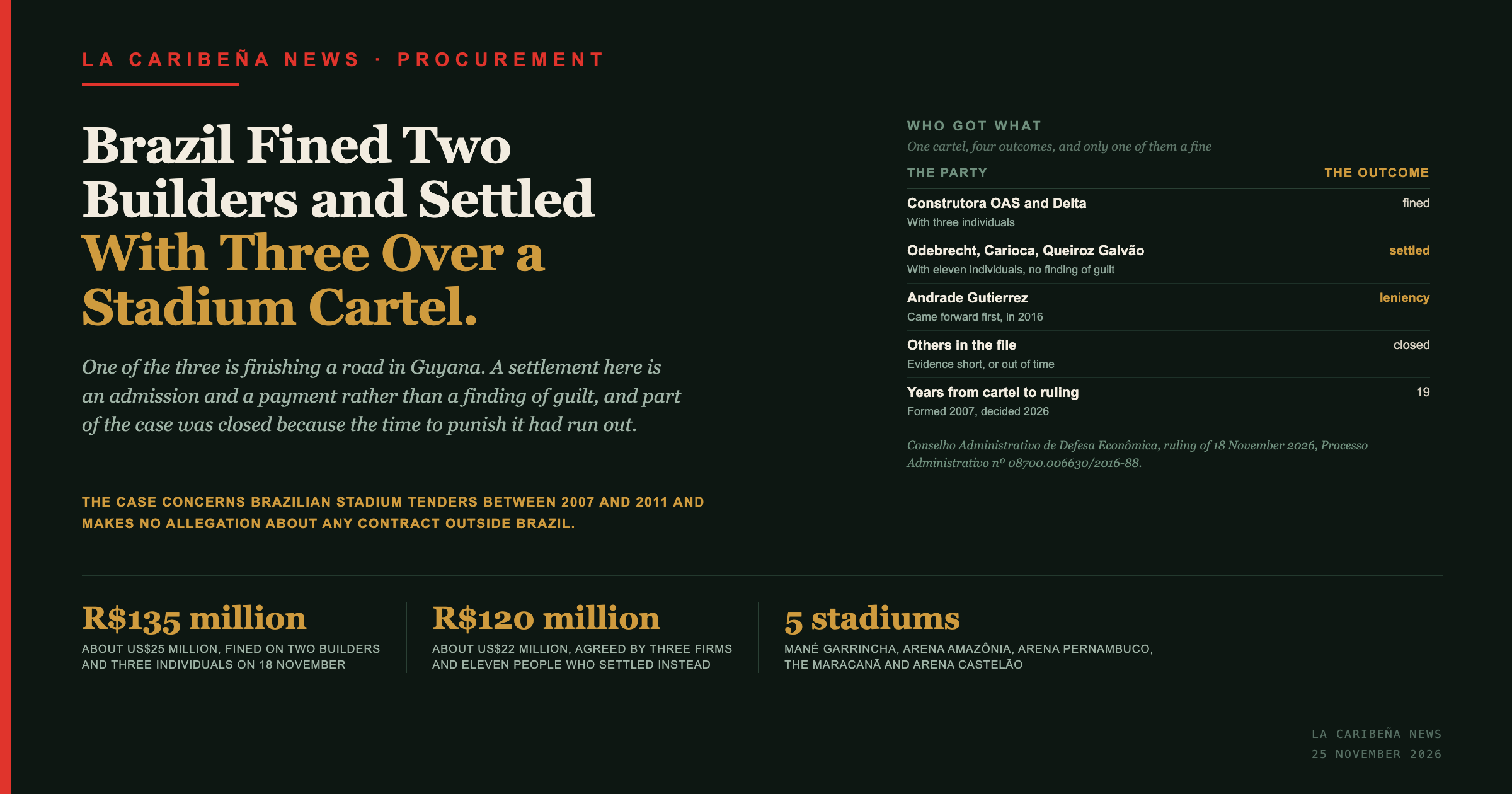
What the title card shows
18 November 2026: the date of the ruling. 2007 to mid-2011: when the cartel operated, beginning the year Brazil was chosen as host. 5: stadiums in the case, being Mané Garrincha, Arena Amazônia, Arena Pernambuco, the Maracanã and Arena Castelão. R$135 million, about US$25 million: the fines on Construtora OAS, Delta Construções and three individuals. R$120 million, about US$22 million: what Grupo Odebrecht, Carioca Christiani Nielsen and Construtora Queiroz Galvão, now Álya Construtora, agreed to pay with eleven individuals under cessation agreements. 2016: the year Andrade Gutierrez Engenharia signed the leniency agreement that opened the case. 19: years from the cartel forming to the ruling. Some respondents had their cases closed for insufficient evidence or because the limitation period had expired. Currency conversions are at late-November rates.
Frequently asked questions
What did CADE actually rule on 18 November 2026?
It fined Construtora OAS S.A., Delta Construções S.A. and three individuals about R$135 million for forming a cartel in the tenders for five 2014 World Cup stadiums. The decision was unanimous. It also recorded that other parties had settled earlier, and closed the case against some respondents for lack of evidence or because the limitation period had run.
Does a cessation agreement mean a company was found guilty?
No. Under a Termo de Compromisso de Cessação the party acknowledges the practice under investigation and agrees to pay, and the proceedings against it are suspended until the authority verifies compliance. It is a settlement that ends the matter without a finding of guilt.
Which firms settled rather than being fined?
Grupo Odebrecht, Carioca Christiani Nielsen Engenharia S.A. and Construtora Queiroz Galvão, now Álya Construtora S.A., together with eleven individuals. They committed to pay about R$120 million to Brazil's Fund for the Defence of Diffuse Rights.
What is a cover proposal?
A bid submitted in order to lose. Its purpose is to make a tender look contested, so that the agreed winner's price appears to have been tested against rivals. CADE found the firms used cover proposals and consortia to secure the outcome they had agreed in advance.
Does this case concern any Caribbean contract?
No. It concerns tenders for stadiums in Brazil between 2007 and 2011 and makes no allegation about any contract outside that. Several of the firms in it have worked across the Caribbean and Latin America, and one holds the contract for Guyana's Linden to Mabura Hill road.