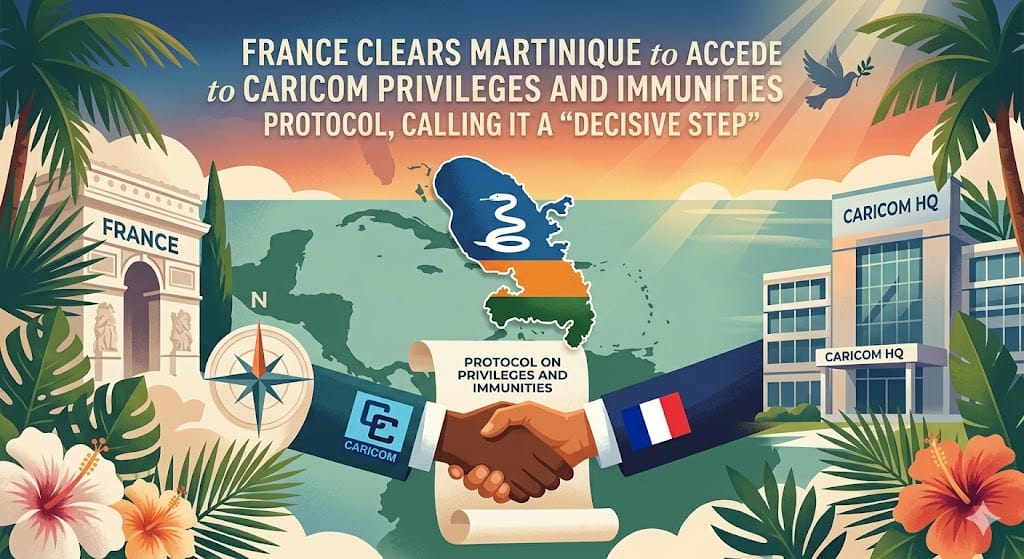
GEORGETOWN, Guyana — France said on Friday it has approved Martinique’s accession to the Caribbean Community’s (CARICOM) Protocol on the Privileges and Immunities, calling the move a “decisive step towards the regional integration of overseas territories.”
The French Embassy in Guyana issued the statement after Paris gave the green light for Martinique to join the CARICOM agreement that defines legal immunities and privileges for the regional bloc’s institutions and officials. The embassy said France will continue to work with its overseas communities to support their regional integration.
CARICOM’s Protocol on the Privileges and Immunities sets legal protections for delegates, staff and missions, and is a prerequisite for fuller participation in many regional bodies. The accession does not automatically grant nationals of Martinique—an overseas department of France—the right to free movement or citizenship-based benefits within CARICOM. Public reaction on social media reflected that distinction, with commenters asking whether Jamaican citizens would gain visa-free access to Martinique and calling for free movement of nationals as a condition of deeper integration.
The development is largely symbolic for integration, but it carries practical governance and compliance implications. Legal experts say accession facilitates CARICOM’s operations in member territories and clarifies immunities for CARICOM personnel operating there. It could also require adjustments to administrative procedures in areas such as diplomatic licensing, tax exemptions and legal jurisdiction.
France’s involvement in CARICOM affairs has long been sensitive. Several French overseas territories in the Eastern Caribbean, including Martinique and Guadeloupe, participate in regional forums, but remain constitutionally part of France. Paris has framed the approval as support for overseas territories’ regional ties while maintaining national sovereignty.
Caribbean governments and private-sector actors are likely to scrutinize concrete effects on trade, travel and regulation. CARICOM has pursued deeper economic integration for decades, including protocols on movement of skilled nationals and trade facilitation. Any expansion of privileges for CARICOM institutions in French territories could ease administrative friction for regional meetings and joint projects.
Compliance and governance advisers say the next steps will require legal harmonization. “Accession to the privileges and immunities protocol clarifies the legal status of CARICOM agents but also imposes compliance tasks for host administrations,” said a governance specialist familiar with regional accords. Firms advising clients on cross-border activity in the Caribbean, including those focused on regulatory compliance, will monitor implementation closely.
The announcement attracted modest public attention on social media. The original post sharing the embassy statement recorded engagement from regional audiences who raised questions about movement and sovereignty—issues that could shape future political debate.
For CARICOM and France, the approval marks a formal step toward closer institutional ties between the regional bloc and an EU member state’s overseas departments. The practical impact will depend on subsequent administrative actions and political negotiations over mobility, jurisdiction and the scope of privileges extended to CARICOM officials on French territory.